My Friend’s Fiance is Cheating and I’m Not Going to Hold My Peace

3 Mar
Before we even get started, the title is a metaphor. I have no friends, to my knowledge, whose almost-spouses are cheating on them at present.
I have been there before, though—caught in the quandary of whether or not to tell my friend what I’ve observed. One cannot often predict whether it will be me or the fiance whose statements are given more credence, but generally speaking, in that scenario, when I’ve dared to suggest such a thing, it was my friendship that ended. Given that, more often than not, I have since opted not to point out what I know as long as there’s been no evidence of physical or emotional abuse, because in the end, I will not be the one who suffers, and staying out of the fray, I will be available if the whole thing explodes to offer support to my friend.
But this time it’s different–if THIS marriage is consummated, my behind and those I dearly love–even those family members who are utterly and inexplicably charmed–are on the line too. The explosion will be devastating not only to those friends who have fallen in love with a master manipulator whose regard for others is nonexistent, but to literally thousands, if not millions, of people. This “reality” show will be far more realistic than you imagine.
I’m talking, of course, about Donald Trump.
It’s not like the signs haven’t been there. I’ve got photographs, audio, video, of the subterfuge, going back years and years. There are many other witnesses to the behavior that screams that you’re marrying an adulterer. Now even some of your family members are noticing. But, as I’ve said before, let us dare to lay those pictures out in front of you, and you’ll dismiss them, accusing me of overreacting or making me out to be the devil instead. He’s got you and there’s nothing I can do for you, it seems. Now, suddenly, family members who thought him innocuous, have started to feel the slime and make some noise. Others are deciding to bend in submission to the inevitability. The date’s been set, the ring’s on the finger, and for some, there will be no turning back.
Except for that part of the marriage ceremony where the question is asked if “anyone here present know[s] of any reason that this couple should not be joined in holy matrimony, speak now or forever hold your peace,” only the engagement party itself stands between us. I hope between then and now, you consider another suitor who isn’t as much of a domestic abuser.
But if you don’t, fair warning. From now until the wedding day, there will be no holding of my peace. Even if he waterboards me.


Are you waiting for the same thing as I am?

18 Dec
It was 1969 and at the end of a mixed bag of a decade. As an adolescent in the midst of her 13th year, I was acutely aware of what was going on around me—the Vietnam War was still in process, two Kennedy brothers, Martin Luther King, Jr., and a number of others involved in the civil rights movement in one form or another had been killed. Still in the midst of the “Cold War,” we were less than a decade past a time when school kids wore dogtags and regularly went through drills where they crouched under desks or with their heads between their knees. Age 30 was a line of demarcation. If over 30, many people thought those under were irresponsible, lascivious, out of control. If under 30, many thought those over were rigid, oppressive, too in control. Yet, in the midst of it all, we’d actually sent some guys off into space and landed them on the moon! Very involved in the organized church in my small town of Cordele, Georgia, I became aware of another battle raging, one which emanated from the venerated Emory University, not two hours driving away from my home. A professor had said God was dead and the literal minded (I said literal, not liberal, mind you), similarly to today, had a metaphorical heart attack.
I was already questioning spiritual things by that point—the fact that inside church we were singing, “Jesus loves the little children of the world,” and outside church the same people were clearly saying, “But we don’t.” And then I’d read for myself that Jesus talked about loving our neighbors and turning the other cheek, and had even repaired the ear of a soldier cut off by Peter, who’d grabbed a sword from somewhere and lopped it off. Yet at the same time, it was somehow God’s will that we send young men just a few years older than I was halfway around the world to kill the Communists?
For Christmas that year, my sister gave me a little book of poetry and prose she’d bought for me at her college bookstore. It was a small book in size, but there was nothing small about the messages inside. In fact, this little book provided for me the feeling I wasn’t alone in considering the possibility that none of us knows or can know the “whole truth,” and that skepticism and curiosity about contradictions only strengthens, matures, refines one’s faith. To this day, I keep the book close by. It isn’t as difficult as it used to be, because almost 40 years later, I was given the pleasure of republishing the little book by Dr. Lois Cheney, the woman who’d written the gems inside. One of my early favorites is now a favorite again.
How does God’s truth prevail?
A large chunk of truth was placed right in the midst of men by the Almighty God. And people saw it and were awed by it, and were humbled by it. They walked around and around it, looking at it, gazing at it, and loving it. Then they got organized.
First, they posted a guard over it, while others built a fortress for it. That was o.k. for a while. Then they decided to do more with it. So they sent in five wise, devout men to study it. They stayed in there a long, long time. Then strange and quarrelsome noises began to come from within the fortress, and out stalked the five men, red-faced and very angry, each with a large packet of papers under his arm. They walked off in five different directions reading loudly from their papers, which said what the chunk of truth really meant. People scurried around, first listening to one and then another, and finally they grabbed up all their belongings and followed after the one they liked the best. And they built little camps about a mile away and studied the pages of their chosen leader, which told them what the truth really meant.
Things would be calm for a while, then from first one camp and then another, would come sounds of angry voices and scuffling. And you’d see several people jump up and walk off in different directions with fresh packets of paper under their arms, that explained what the truth really meant. Again, little clusters of people would follow, and they’d establish fresh camps about a mile further off. This went on and on.
Soon there were many, many camps for miles and miles in all directions, each with its packet of papers, explaining how the truth really was. Sometimes they would argue and debate which of them was closer to the ancient fortress. Sometimes there’d be awful fights between camps, and the camp that won would proudly enlarge its scope of what truth really meant, and pride themselves on expanding and perpetuating the real truth. Sometimes camps would combine their packets of paper. Sometimes some people would get weary with the whole thing, and go off without any papers at all. They’d establish camps where the land was good or the water was plentiful or some other reason than setting up a camp around some silly papers.
Every once in a while would come a wanderer, usually all alone. The wanderer would roam through the camps or skirt them, and would wind up coming right up to the neglected and overgrown fortress, and walk right in and stare at the real chunk of truth. The wanderer would gaze and gaze at it, and pick it up and handle it, and stroke it, and start strutting all over the place, glowing and carrying on, and generally throwing camps into confusion. The wanderer would do all sorts of old-fashioned things in old-fashioned ways, grinning and humming all the while.
And that’s how God’s truth prevails.
Which one of these people are you? Are you waiting for the same thing I am?

Vally

P.S. You can buy a copy of God is No Fool for yourself right here. And believe me, if you’re like me, if you’re alive then, it will still be on your bedside table 30 years from now.

Breathe

9 Dec

It was March 2002, six months after 9/11, and I was in Dublin, Ireland. My body clock had not yet reset itself, so I was still awake at 2:00 in the morning. Trying not to disturb my fellow travelers, I grabbed a notebook and headed downstairs to the all-night coffee shop in the lobby of our hotel.

In this particular hotel, the night desk clerk doubled as the coffee shop waiter, and while I sat in a booth with my pen and paper, he proceeded to sweep the floor. It was just him and me, so I decided to strike up a conversation.

The toll of a 90% drop in tourism in Ireland that year was obvious. We were oddities, Americans who had ignored the tendency to hunker down, to not fly–especially internationally–and those in the Irish service community noticed it. There were several times when people spontaneously approached us and thanked us for being there. This young night clerk/coffee shop waiter was among them.

“May I ask you a question?” I asked him.

“Of course, you can,” he said, stopping and leaning on his broom.

“What did you think when you heard about planes flying into the World Trade Center?”

He paused for a second. “Do you really want to know?”

When I nodded, he said, “Well, my first response, of course, was to feel sad. You know, there were quite a few Irish people who were in the buildings too. But the second…well, honestly…was…, ‘Now they know.'”

Through the years since, few things have hit me between the eyes quite like this three-word phrase. He was, of course, talking about the fact that before 9/11, most of the world outside of America was well-acquainted with the always-there spectre of life changing in a “New York minute,” as the Don Henley song proclaims.

“In a New York minute
Everything can change
In a New York minute
Things can get little strange…”

This young man, barely 30, if that, had grown up in Belfast before the 1994 ceasefire between the IRA and British forces in Northern Ireland. He’d had an everyday admonition from his parents, probably from the day he was born, to be careful, to watch closely when he walked down the streets near his home. At any moment, a perfectly average car could explode with no warning, devastating anyone who was near. Events like the Oklahoma City bombing or the future Boston Marathon tragedy were “old hat” to this young man.

Our bodies, wondrously, are built with an emergency system. We are each capable of a surge of adrenalin that renders us able to run faster or fight harder than under “normal” circumstances. If angry or frightened (which are pretty much the same feeling except for the projection of responsibility), we are temporarily supplied with the physical power to do things we couldn’t even approach doing when not angry or afraid.

That emergency system works very well in the face of literal physical emergencies. It came in handy thousands of years ago when the type of emergency confronted was a bear or tiger. It came in handy to Queen Elizabeth II when Windsor Castle caught on fire. It was told that she’d single-handedly grabbed a precious rolled-up tapestry and run out with it. I’ve heard of prople lifting the rear of a multi-ton car to free someone they love trapped beneath only to find themselves unable to budge it an hour later. And as drivers, we’ve all managed at one time or another to avoid collisions in remarkable ways. That weak-kneed feeling that comes after we’ve just avoided being creamed is the system returning to “normal.”

There’s an Achilles heel of that emergency system, though. It can’t determine what is a “real” emergency and what is a “perceived” emergency. And it’s a looping thing. If we’re aroused, if the adrenalin is in our systems, making our hearts beat faster, our palms sweaty, our muscles stronger, we are more likely to perceive there’s an emergency when there isn’t. Connections develop between things we know are not threatening when the fight-or-flight response is not in mid-stream and that same-old usually adaptive response. That’s part of the mechanism of phobias. Somehow, the fight-or-flight response has been invoked and connected to something that isn’t an emergency at all. It’s classical conditioning — instead of saliva and the ringing of a bell, it’s whatever we’ve decided is threatening and the elicitation of the emergency system.

And sometimes, when things happen that all the running and fighting in the world won’t fix, we’re left with a new state of “normal.” What was once just a call-on-it-when-it’s-needed function is in force all the time. We forget what it felt like not to be afraid. We forget what it felt like not to be angry. As I used to tell my clients, “We’re all dressed up with no place to go.”

It’s bad enough when the fight-or-flight response gets out of kilter for one, but it’s devastating when it spreads. And it’s highly contagious. A lot of things happen that no one person in a group is intending. Think of the number of people who are hurt everytime there’s a stampede at a sporting event. If you’re Christian and know the story of Barabbas, what do you think really happened there? Without the contagion of those around them, do you really think that any one of those people would have chosen Barabbas instead of Jesus to free?

It takes self-control, the ability to invoke our thinking brains despite all the signals coming from our bodies that we are threatened, and assess the reality of the danger for ourselves as best we can, to prevent the sad results that always occur when the mob mentality takes over. Unless we stop ourselves and use the cognitive parts of our brains, our reason, to determine if we are facing real emergencies or if our bodies are sending us misguided signals, the probability that we will overreact is high. If you’re a parent, how many times have you perhaps spanked your child in a fit of anger or fear, only to wonder if the pop was harder than it should have been?

The irony of the situation is that there is one thing we can do to start the return of our bodies to the lowest stage of alert. We can stop and breathe. One slower, deeper, calm breath sends the message to our fight-or-flight system that it may be a false alarm, giving us time to consider what we are contemplating. It takes one breath to allow us to take back control, to quiet the frightened child inside who’s not thinking at all.

Sometimes, yes, the decision we make is that we are, indeed, in danger. That there is something we can do to protect ourselves, something we must do to reduce the probability of facing a future catastrophe. But the key is to make a decision not driven by the fight-or-flight system, to distinguish between real emergencies and the stories we have concocted in our minds out of nothing but fear.

When FDR said to the people of the United States that there was nothing to fear except fear itself, this is what he was talking about. It’s what we should be talking about now. It’s what we MUST talk about now.

In a New York minute, everything can change. The possibility is always there. But the probabilities wax and wane. Changes, born of misguided actions stimulated by our no-thought-fight-or-flight systems, are not inevitable, but some of them are irreparable. We must choose our responses with wisdom and courage, or we will become the victims of our own hallucinations.

Yes, now we know. But before we act, we must breathe.


A Weekend to Remember

5 Oct

I went into the weekend slammed with work I had been unable to complete because of previous commitments. In my case, it’s usually feast or famine, so when feast times come, it’s usually best to dive in headfirst and remain there until most of the tasks are completed or at least whittled down.

But God had a different idea. A lot happened, but most of it spurring a contemplative mood that I haven’t been able to shake. Which is part of the reason I’m writing this. I can’t get back to work without saying something.

In the first place, one of those earlier commitments had been to spend two days with an author client, now friend, going over her manuscript, which is about a woman from the Greatest Generation, a woman who, as an aside, was the first civilian woman ever to jump out of an airplane with a parachute. That incident had occurred when she and her husband were traveling from Teheran back to Cairo where he was stationed just after WWII. They’d landed in the desert at night, and managed to find their way to each other despite it. (Almost comically, she’d jumped wearing a dress suit and high heels, and managed to do so without even getting a run in her nylons, which were still quite scarce.) A group of Bedouians had ultimately come along and led them in the right direction, or they might not have made it.

Then I’d gone to my first Leadership Asheville class, the topic of which was History and Diversity, and learned about the unanticipated negative impact of urban renewal back in the 60’s and 70’s on the African-American community.

Those two things alone were enough to get me started, but the ride had only just begun. Thursday and Friday had involved a children’s picture book about a stork and a pelican who were best friends, written by an author who happens to be Jewish. We’d ventured into a discussion of our feelings and ideas about the current deal with Iran.

By “accident,” I found out that a childhood friend, Gwyn Hyman Rubio, who I had only seen once in 40 years was signing her most recent book at a bookstore in Waynesville on Saturday afternoon. Waynesville is about 30 miles west of Asheville, and despite the rainy forecast, I decided I had to take my chances and go. I’d already heard from several friends in different parts of South Carolina that flooding had begun and the rain was still falling, but I thought, “What the heck! I don’t know when I’ll get another chance to see her.”

I figured too that it would boost my spirits. I was already feeling a little down with respect to our mutual hometown in South Georgia because one of the casualties of all my work had been the decision that I couldn’t make my 40th high school reunion, which was already in process.

By accident of schedule, my best friend Jan who’d driven over with me, and I were able to have a couple of drinks with Gwyn and her husband Angel. We talked about the book industry and its ongoing changes. We joked about the fact that though Angel is Cuban by ancestry, he isn’t related to the current presidential candidate whose last name he shares. We talked about the fact that I was missing the reunion, and commented on the continued need for racial dialogue and reconciliation across our beloved South.

Jan and I were hoping to meet her brother and sister-in-law for dinner, but missed it because of a wreck on I-40 on the way back–due, of course to hydroplaning–but were able to reschedule for Sunday evening. It was the first time we’d had a chance to see them after the tragic and inexplicable death of one of Sam’s closest friends on a motorcycle road trip they’d taken the weekend before. A large tree had broken off and fallen, landing squarely on his friend, killing him instantly. The chances were something like 1 in 20 million.

During the week, it had fallen to my friend Bek to provide support for the wife of the man who had died, and she described, in the midst of the shock and horror of the trauma, a most beautiful and holy ritual. Though both Christian and Buddhist in belief, the man’s wife had chosen the Buddhist tradition of mourning–his body remained at home, where it was carefully and lovingly washed and placed in a shroud. I couldn’t help but feel the holiness, the reverence of the experience, so foreign to most of us in the West.

Meanwhile, on Saturday night in New York, the son of two dear Jewish friends had proposed to his girlfriend. He’d drilled a hole in a book about his great-grandmother, an immigrant from Lithuania who came to New York to escape the Russian pogroms in 1906, and in the slot, he had placed his soon-to-be fiancee’s great-grandmother’s ring. It was October 3, coincidentally Brian’s great-grandmother’s birthday. Twenty-four family members had gathered together to surprise her in a restaurant around the block from their apartment in Manhattan and the celebration was on.

After hearing about it from my friends, I popped onto Facebook and saw posts from friends in South Carolina, seeing photographs from Columbia and Charleston and the flooding, of people helping others. I saw my sister’s post about her wedding day, October 4, 1996. Already planning to marry the next year, they’d abandoned those plans and married the day after he learned he had lung cancer. He would survive seven months.

I glanced at posts about the Oregon college shooting and the one just a week before in Mississippi, where a long time friend is also a professor, and the flack about the Pope expressly meeting both a gay former student and accidentally meeting the clerk in Kentucky who refused to issue marriage licenses to same-sex couples. I saw photographs of what was a joyful service at my old Episcopal Church, replete with all manner of animals brought for a blessing, including a few canines who reportedly howled in harmony with what I know was the beautiful soprano voice of my friend Jenn.

And, then, this morning, I saw a post from one of my classmate’s spouses, talking about the seeds of healing she had seen at the reunion, of racial reconciliation that had tenderly shown its face. And I had to stop and write, despite all the work still waiting for me.

At the very same moments in time this weekend, people were quietly renewing acquaintances and actively helping people they didn’t even know escape from houses submerged under water. They were mourning the very raw recent deaths of their beloveds and remembering those who have long since gone on. Even cross-species blessings were underway, odd timing given that Gwyn’s novel is about the intricacies of love for a human through the eyes of a parrot.

Black, white, Christian, Muslim, Hindu, Buddhist, Jewish, male, female, older and younger, animals and humans, dancing and singing, howling and mourning, loudly and quietly in contemplation and action. And God was in the midst of them all.

There are no lines of demarcation when it comes to Love. They are only illusions.

The Death of the Political Middle

2 Oct

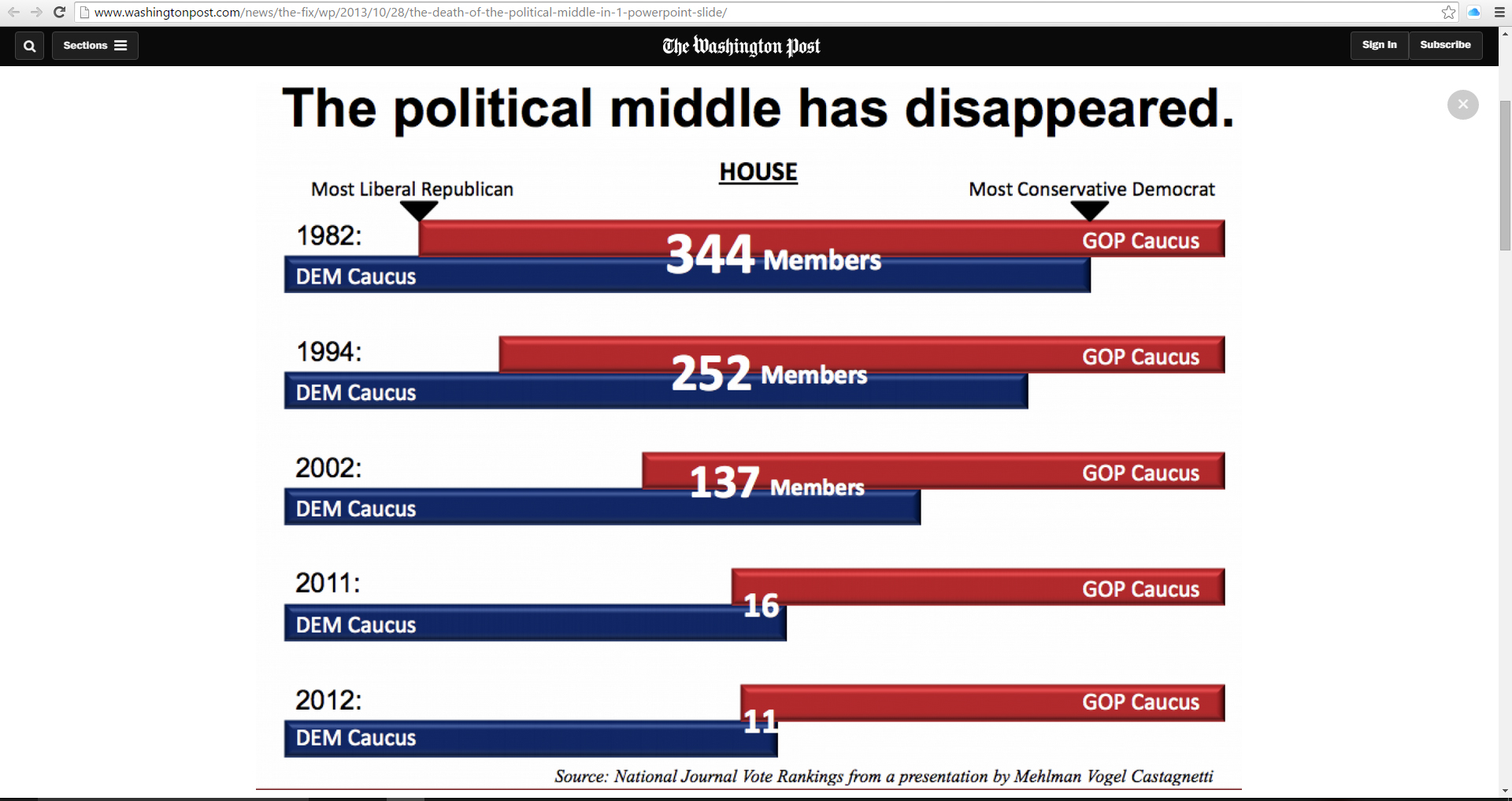
Death of the Political MiddleA friend shared this graphic about the U.S. House of Representatives and I have to say that although I was not surprised, I was disheartened. This was simply the confirmation of what I had intuited had happened in our federal government. I can guess what the same analysis would look like on a statehouse-by-statehouse level as well, given the nature of the bills introduced (and perhaps more importantly not introduced), and it isn’t pretty either.

A social scientist by training, however, I would show the same “picture” in a different way, however—as a shift from what approximated the “normal” curve to its inverse, which looks more like a “U.” And I would have reversed the picture horizontally, to reflect what we think of as “right” and “left” in political terms. Here is a pictorial representation of the normal bell curve.

normal curve with standard deviationsIn 1994, for instance, the composition of the U.S. House of Representatives looked more like this, with the most liberal Republican out near the +1 point (to the right) and the most conservative Democrat out near the -1 point (to the left). In the vernacular of the standard deviations of the normal curve, this means that the views of the representatives, irrespective of political party affiliation, fell in between. In another way of putting it, 68.2% of the representatives fell into what might be described as the “political middle.”

The rest of the crowd–namely the far-left Democrats and the hard right-wing Republicans made up the remaining 32.8%–16.4% toward the left fringe, 16.4% toward the right fringe. With influence from both fringes, the middle 68.2% found plenty of ground on which to agree, and we could depend on reason to intervene and do the hard work of ensuring that the general point of agreements, the bills introduced, included caveats that did not heavily favor one side over the other. To find a consensus and move forward, the job was relatively easy–each bill had to include as much protection for the realistic concerns of those who disagreed, whose positions fell on either side of the midpoint. There was, for the most part, respect, a fair hearing of the other perspective and dialogue and negotiation so that the result was as much of a win as possible for both sides. Those toward the middle kept the extremists on either side under control. The challenge then was the working out the details of how to handle those extraneous points of disagreement. What followed was the need to watch after implementation to make sure that the predicted positive impact expected was what was happening and to correct unintended negative consequences. Governing is project proposal and project management, theoretically approved or disapproved by the nation’s shareholders–the people.

inverted normal curve with standard deviations

Now, the U.S. House looks like this. The challenge now to productivity is that the central question being asked by both sides isn’t even the same. The abortion issue is a case in point. The question for wise people to work to answer as best they can is, “How can we honor life to the utmost as early as possible while preserving the personal liberty and opportunity guaranteed by our 1st Amendment to adult citizens?”

But no. Instead, there is the attempt to paint those who are pro-choice as anti-life as if those positions were the same, with no regard at all for the question of personal freedom and choice that is front and center when it comes to guns. And the reverse is true as well. I’m still waiting for those on the side of choice to stand up and acknowledge the evil perpetrated in the Pennsylvania abortion clinic once run by the infamous Kermit Gosnell. (If you don’t know what I’m talking about, my point is made. Google it. But be prepared. It is NOT pretty.)

You can’t work out extraneous points of disagreement when there is no basic agreement in the first place to anchor the conversation around. There must be middle ground, hem and haw, ying and yang, forward progress together in a beneficial way for all of us. The focus must be one of “both, and” and not “either, or” because if there’s one thing we know for sure, the product of the dialogue of the diverse, especially of diverse opinions on issues that affect all of us directly or indirectly, is far better than that of one side or the other alone. In plain English, two heads are better than one–especially when the heads have different perspectives and ideas to contribute that the other side wouldn’t have been able to see in a million years.

Abraham Lincoln said, “A house divided against itself cannot stand,” and we did our damndest to prove him right 150 years ago. We’re still struggling with that same ill-advised perspective, the one in which no agreement was come to about the equal value of human life irrespective of color or any other personal characteristic. We’ve given voice to those on the fringe who believe that the solution to division is easy—that all you have to do is just destroy those who disagree with you—wipe them or their influence out, either through slander, libel, humiliation, or prison—if not literal murder. Thou shalt not bear false witness, says one of the Ten Commandments (or categories, as they Jews who started this actually think of them).

Inconveniently for those false-prophet-following Christians who’ve never bothered to actually read the Bible for themselves, Jesus himself was the person from whom President Lincoln borrowed the phrase. Matthew 12:25, for your reference: “And knowing their thoughts He said to them, “Any kingdom divided against itself is laid waste; and any city or house divided against itself shall not stand.” The “them” he referred to were the Pharisees who suggested that it was through Satan’s power that Jesus had healed a man. (Sounds a lot like some quick to invoke Hitler in reference to the President if you ask me.)

I would point out, too, that some 40 years after Jesus was crucified, his words came to fruition. One faction of Jews maintained that force was the way to overturn the Roman rule, while another—notably the followers of Jesus—understood that love and kindness was the only force that could not be overcome. The clash of these two divisions, ruled by those who favored force, ended in the destruction of the temple in Jerusalem, and a diaspora of Jews that would send the whole lot into the farthest corners of the earth until 1948. We should take note of that. The Hebrews had been around a much longer time than we Americans have, and it didn’t help them a bit.

We are in a dangerous place, indeed, except for the fact that for now, the people—us—have the ability to remove from office those snakes who are creating and sustaining the divide, all with the power of our votes. Despite what the media and the political operatives would have us think, I still believe that the majority of citizens of the U.S. still look like that normal curve when it comes to their willingness to find and live according to that middle ground. But we have to move and we have to move now.

So, I ask you to join me in the next year in doing a lot of listening and not so much talking. No matter which political party you lean toward from the center, listen to what the candidates say. Pay attention to the “true colors” that reveal themselves. Be prepared to vote them out of office, even if it means voting across the party lines. Whether they’re talking about the primaries or their opponents in the general election, when you hear them bash, not the ideas of the others about how to achieve what we need to, but the others themselves, mark them off your list, once and for all. Hold their feet to the fire, because if they’ll screw those they’re supposed to agree with, they’ll screw you too. All you have to do is accidentally end up with an opinion on the other end of an inverted normal curve.

A house divided against itself cannot stand. Mark my words. And then again, don’t mark my words. Mark Jesus’s words. And Lincoln’s. Because an American diaspora is not inconceivable. And for this once-proud-to-be-an-American, Ireland is suddenly looking better and better.

We can do this.

Miracles and Grace

10 Jul

I read an article this morning in The State, the newspaper in Columbia, S.C., describing the process of how the Confederate flag came finally to be removed from the Statehouse complex there in the South Carolina capital. Speaker of the S.C. House Jay Lucas, incidentally in the role because of the indictment and conviction of his predecessor for fraudulent use of campaign funds, was quoted as saying that passing the bill in only one day was “miraculous and a testimony to the House.”

The removal of the flag from the government complex is symbolic of a first step, but only a first step, in repairing—no, check that—a first step toward establishing for the first time in South Carolina’s history the long overdue respectful and mutually-beneficial public discourse that befits a state in a nation that claims to protect the liberties of all its citizens.

But Speaker Lucas is wrong. Saying that it was a “testimony to the House” is tantamount to patting someone on the back for actually doing the bare minimums of a job he contracted to do.

I was discouraged, also, by the audacity of some of the House members asking for “grace,” which translated to ensuring a place of honor for the flag itself. I was thankful, though, that, in the article, the writer had encased the word in quotes, as I do here.

Lucas was right in calling the feat “miraculous” and there is most definitely a place for the word “grace” in this conversation, but neither word applies to actions of the members of the South Carolina House or even the Senate. There should be no attempt for those who have finally done the thing they should have done myriad times before to claim accolades for themselves. It pollutes the very air around the event. No, it was the grace of the families of the Mother Emanuel 9, indeed, spawned by the grace of the nine murdered individuals themselves that brought this “miracle,” the unhardening of hearts, about.

From the day of the public expression of forgiveness of the cold-blooded murder of their loved ones, I have been thinking of St. Paul. I have always thought it a failure in the Christian churches in which I have worshiped not to spend more time in contemplation of his conversion. Here was a young man brought up in his “church,” a member not of the wealthy majority political party in the Sanhedrin, but their rivals, the upper middle class Pharisees. Young Saul, as he’d been known then, had assumed the mantle of vigilante, representing the Pharisees’ condemnation of those Jews who had proclaimed allegiance to the words of the Rabbi Jesus. He had stood by, holding the extra clothes of those compatriots who stoned a gentle man to death who reminded them—all the while he was dying—of the history of their faith, the giants of their heritage, and the goodness of the God they all supposedly worshiped.

I can guess that the hairline crack appeared in Saul’s reserve that day, that the pricking of his conscience—the rising up of the truth from behind practiced years of denial—began then, else we wouldn’t know that story in particular. In the Book of Acts, where the story is told, what follows as a bookend on the other side of a mention of St. Philip’s ministry, is the story of the Damascus Road, the beginning of epiphany for the man handpicked by God to deliver the message to the Gentiles, those ancestors from which the majority of us Americans are descended. Without him, we might never have known the story of Jesus at all.

But it doesn’t stop there, in my opinion. The coup de grace (notice the word) came later, when, blinded by the light he had seen, Saul was sitting, shaken, in Damascus, not sure at all of what had happened to him. It was when Ananias, who, knowing full well that Saul and his band had been terrorizing those like him and Stephen and the others the apostles had ordained, obeyed the instruction of the Holy Spirit and went to him. It was when, knowing that Saul’s betrayal of the very men he had faithfully represented had sealed his fate, the community of believers protected him, ensuring his safe passage from Damascus, that the rest of his denial fell away.

Now renamed, it was as if Paul had been reborn. And it had been at the hands of grace. Nothing more, nothing less. He knew he was guilty as an accessory to murder of innocent men. He knew that he deserved nothing less than death himself, according to the dictates of the Commandments he had grown up studying. He accepted the responsibility of that, would live the rest of his life knowing he was stained with the blood of men who had done nothing at all to him—especially the fellow who’d started it all by walking peacefully, unresistingly, forgivingly, to his death at the hands of the Sanhedrin.

It has been said that mercy is not getting what we deserve and grace is getting what we don’t deserve. I am inclined to agree. Those of us who both cracked the whips and those of us who stood by holding their clothes and said nothing deserve nothing. No credit for suddenly coming to our senses, having the scales fall from our eyes, and then doing the right thing. The flag should remain in prominence somewhere—if it is a reminder of heritage, it is a heritage that will never be unstained by the wickedness of man’s inhumanity to man. It will not stop it, but keeping it in front of our eyes will, perhaps, slow it down.

Throughout history, it has never been war, conquest, violence that has changed the world. It has always been grace. We saw its effect in Gov. Nikki Haley’s eyes on June 22 as she called for the flag to be removed. We heard it in Sen. Lindsey Graham’s explanation of the change in his position on the flying of the Confederate flag at the state’s capitol. We witnessed it in the emotional words of S.C. Rep. Jenny Horne, a descendant of Jefferson Davis, the president of the Confederacy himself, in the halls of the South Carolina House. Grace that began in the forgiveness of a misguided young man like Saul.

Amazing grace, how sweet the sound that saved a wretch like me.

One by One

28 Jun

I’ve chimed in here and there on Facebook during the past few days, sparring with others over the Confederate flag in general and in specifics in the state of South Carolina, but, introvert that I am, I had to wait before writing a blog to let the dust and noise settle so I could contemplate what I am truly feeling. The first item of business I had to consider is the enormity of the deaths of nine Christian disciples at the hands of a misguided, and perhaps demented young man, and the response of the people of South Carolina and across the South itself. And then there were not one, but two rulings from the U.S. Supreme Court, both of which honestly surprised me because of the cynicism I admit I’ve felt in recent years. And then today, I learned that the Episcopal Church, of which I am a member, elected a new presiding bishop who is African-American—from the Diocese of North Carolina, a one-time Confederate state and my newly adopted home. On the very first ballot, no less.

Years ago, when I was a psychotherapist, our “protocol” was to give a new client a battery of tests—a measure whether anxiety was a long-standing problem or just a function of a recent trauma, the MMPI, occasionally others based on what the client’s presenting complaint was. The results of those “inventories” provided a jumping off point for therapy, and it was easy to form an initial sense of the areas needing exploration. There was never a time when I wasn’t forced to completely reevaluate the ongoing treatment plan in my head on the basis of the disclosure of an experience by the client and his or her perception of the event I couldn’t have anticipated. I learned quickly that every person who walked through our doors was unique, that I could make no generalized statements about any of them on the basis of their employment or clothes or physical characteristics. Symptoms, yes, but not demographic data. For me to assist them in finding a path to healthier functioning in their own individual lives and relationships, in their own individual circumstances, with their own individual bodies and brains required that they trust me to hear their stories from their points of view without judgment. In a word, it required me to respect and honor the boundaries between us, the differences, while seeking the similarities that supercede them—our desires to love and achieve, be special and important to someone, to be loved and appreciated for who we are, irrespective of where we came from or the mistakes we have made.

As a child, what drew me to the stories about Jesus was the idea that God knew every hair on my head. Not the heads of all girls or the heads of straight-A students or the heads of all Americans or the heads of all Southerners or the heads of all Southern Baptists or the heads of children raised by single parents or the heads of financially-challenged families or whatever demographic group of which I was a part or was to become a part of in the future. God knew every hair on MY head. God knew every circumstance, every experience, every good behavior, every bad behavior, and wonder of all wonders, loved me in spite of them all. It didn’t matter what other members of the groups of which I was a part did or didn’t do, said or didn’t say, approved of or didn’t approve of. I was considered, comforted, confronted, blessed, all by my little, inconsequential self. What they did, what they thought…was irrelevant.

For me, the next logical step in that burgeoning awareness was knowing that if God knew every hair on my particular head, then he knew every hair on everybody’s else’s head, too, and that he loved them as fiercely and as unconditionally as me, no matter what I thought of them.

The only question, then, was what to do when the boundaries collided. And when that collision happened—and it is inevitable, a hundred times a day—how do we respond?

Jesus lived as the ultimate respecter of boundaries. It didn’t matter that Zaccheus was a tax collector, despite the fact that most of the people in the crowd probably wanted to strangle him and had already dismissed him as a traitor to his people. He called him down from the tree and sat down at his table with him. It didn’t matter that the woman at the well, or the woman caught in adultery, was someone that he, according to local or cultural laws, was prohibited from speaking to. He stood right there, in front of God and everybody, and told her—in the act of speaking to her—that she too could drink the living water straight from the well, without bowing to any man or religious law. He even looked at the thief hung beside him on a cross and said, in effect, “Hey, I don’t know what you did, but I know who you are, and you’re coming with me.”

In terms of the U.S. Constitution, the boundary questions are the same. If we are to be equally protected and equally privileged under the law, at what point is there a collision that renders us unequal? Who gets to say where the line is? And what do we do to try and ensure, however imperfectly, that no equal citizen is disenfranchised from the expression of that equality? That, and that alone, is the job of the U.S. Supreme Court, of nine equally-endowed and equally imperfect people.

In the end, whether we’re talking about Jesus or the U.S. Constitution, it all comes down to respecting each other’s boundaries. Doing the oh, so difficult work of examining our own motives and acting in a way that accepts the pragmatic reality that there are limits to the expression of our freedom and the limit is the boundary of the “other,” whether we’re talking about the neighbor we are to love as we love ourselves or the First Amendment and all the rest of the amendments, which only attempt to clarify and define where those boundaries are, protecting and preserving the rights of all Americans—irrespective of what one individual or one demographic group or one religious congregation has arrogantly deemed to be the authoritative end all of what God says. I can’t help but believe, if I look at the words and actions of Jesus as a whole, that what he meant by loving each other was based squarely on the concept of respect of each other’s boundaries. As both he and St. Paul would say later—if we love God and each other, the rest of those commandments, all dealing with boundary violations, will take care of themselves.

Because of that perspective, being a Christian and being an American—in the ideal—are not difficult for me to reconcile, to live in parallel, but thankfully, there is still a boundary between the two. We must make no choices, give no favors to one religious opinion over another. I am eternally thankful to have been born an American because of that. I can rest in the assurance that Sharia law or Mormon law or Roman Catholic law or even Episcopal law will not govern me as long as the separation of church and state remains intact. But having that assurance comes with responsibility and personal limits, too. Every Muslim, every Mormon, every Roman Catholic, every other religious adherent—is safe from whatever cockamamie religious law Franklin Graham or Pat Robertson proclaims or the ones I dream up in my head, too.

Even the Affordable Care Act, and its haters, is a battle of boundaries. How do we promote the well-being of those who can’t, for mostly reasons of poverty and depressed income, irrespective of our wretchedly arrogant opinions of their deservedness, pay the premiums of health insurance in 2015 without putting those who are barely making it, but making it, at risk? How do we not favor the members of one group over another, based on the circumstances and the timing of their lives in the midst of a recession from which we have not, despite all the political rhetoric, completely recovered? It ain’t easy, but the personal boundary assaults from both sides of the issues are ugly, and they have no place in our public discourse.

The other happenings of this week raised boundary issues, too—individual ones. There are nine dead individuals, dead because of one of those physical characteristics and not the desires of their hearts, their individual experiences, or their own individual respect for the boundaries of others. Dead because a young man violated their boundaries in a vicious way that cannot be mended, only forgiven and punished. Dead because a young man, right or wrong, perceived that his boundaries and those of his association were in danger of violation, that “their” country was being “taken over.”

There are people who, for whatever reasons that no one but God can discern or judge (though I personally doubt the latter is even an issue—see above), are attracted to people of their own gender, who now have the freedom in America to publicly and legally proclaim their love and commitment to each other, no matter what I or anyone else may find uncomfortable about it. The boundaries of respect, at least under the law of the land, are upheld. We can’t stop another equal citizen from expressing their love as a matter of public record just because we don’t think it’s biblical or natural or fill in the blanks with your own adjective.

There’s a boundary battle between those who maintain that a flag is simply their “heritage,” flown by soldiers defending a “right” that is no right under God or the Constitution by any measure—that of owning other humans and defining their value as less than whole—and those in the group devalued and diminished by the symbolism of the flag, who cannot view it without the visceral and archetypal memory of split families, of murder, of whips, of rape, or being stolen from their lands and chained and sold as recently as 150 years ago. Both crying for the very same thing—respect, the birthright of every child of God.

There have been boundary issues since Cain and Abel. There will be boundary issues long after we’re gone. Jesus said as much. “Our father,” he taught us to pray, “forgive us our trespasses (violations of other’s boundaries) as we forgive those who trespass against us (violate our boundaries).” We are only offended, ranting and raving about our “rights,” when we perceive that a boundary of ours has been violated. It is our duty as Americans, but more importantly as Christians, to commit to examining our own desires and behavior, seeking never to intentionally offend, to be clear on where the boundaries between us really are (translate where our rights end and those of others begin) and to forgive the real—and the ones we only imagine in our heads—offenses against us. It isn’t in any way easy—but it is possible. Jesus showed it over and over, and the families of the Mother Emanuel nine did it in living color.

To solve these boundary disputes requires that, just like Jesus did every time, we meet each other one by one, seeking the similarities between us and respecting the differences as what they can be—the icing on the cake of a rich, diverse, multi-colored life for us all. One gun owner at a time, one gun-control advocate at a time. One person of black, white, Asian ancestry at a time. One “liberal” at a time, one “conservative” at a time. One heterosexual, one LGBT at a time. One Southerner at a time, one non-Southerner at a time. One 1 percenter, one 99 percenter at a time. One welfare recipient, one corporate CEO at a time. One Republican at a time, one Democrat at a time, one Independent at a time, one candidate at a time, one every-hair-on-the-head-loved-by-God-just-like-me person at a time. We will, no doubt, find those we choose not to engage with because of their inability to show respect, but that decision can’t be generalized without squandering potential we cannot recover. Lord knows how much we lost long before the nine people at Mother Emanuel.

God bless the United States of America, our President and members of the Executive Branch, our Congressional representatives and senators, our state governors and representatives and senators, and one other nine of significance this week—the U.S. Supreme Court.

But most of all, God bless us every one, and help us to do the same. One by one.

“True” Christians

7 Apr

One of the stories wafting around the internet in the past week or so is the allegation that a Dublin, Georgia teacher told some member or members of her classroom that a “true” Christian wouldn’t vote for Obama since on her authority (or some website’s she defended when a parent-teacher conference was called) Obama isn’t a Christian (and by default, shouldn’t be the President of the United States despite the Establishment Clause she obviously didn’t understand when she took high school civics–assuming she passed).

It’s an allegation, yes, but I don’t have a problem believing it. I’ve been hearing such for over 50 years. My sister was told no “true” Christian would vote for Bill Clinton back in 1992, and before that being a “true” Christian was an excuse for not integrating schools. You know, it was God’s will to keep the races separate. No “true” Christian would go against a teaching as obvious as that, despite the fact that there’s nothing obvious about it at all.

“True” Christians, by my estimation, would be those who pay attention to what Christ said first, understanding even the Old Testament through the lens of a man who, if nothing else, stood on the premise that loving others–even if you’ve drunk the Koolaid that convinces you that you know the life history and circumstances of the woman in front of you in the grocery line paying with food stamps–is the only requirement for following him. Absent love, as St. Paul would later say, calling yourself a Christian and suggesting that you and you only are a “true” Christian on the basis of a voter choice is just a lot of loud noise. I think it more–namely, I think the lack of humility demonstrated by anyone who would presume they know what a “true” Christian is and are entitled to disseminate that information has taken the Lord’s name in vain. Which, in case you don’t know, is a much more serious offense.

Today a couple of days past Easter, I was thinking about the fact that the only time we know of that Jesus’s anger got the best of him was when he encountered the people in the outer courts of the temple in Jerusalem who were blocking access to the inner sanctum and profiting by it. You know, the moneychangers — the ones who were selling doves for those who couldn’t afford lambs that were to be sacrificed by some religious leader (and not themselves) and suggesting that the poor couldn’t possibly be “true” Jews because they hadn’t worked hard enough in their opinions, I guess, to merit an audience with God.

I thought about the fact that I’ve never had a problem with the concept of democracy and its parallel with Jesus’s message of the equality of people before God and the importance of people over made-up rules that protect no one except the rule-makers themselves, because they both honor the value of individual human beings irrespective of circumstance. And I thought about voting and healthcare and religious freedom and the gay-marriage controversy and “my right to an AK-47 trumps your child’s safety” and I decided that if Jesus were here and his kingdom were of this world instead of the spiritual one over which he claimed kingship, he’d be pretty pissed off about now.

But it wouldn’t be at the voters who may be denied access to vote–the inalienable right of a citizen in a democracy. Wouldn’t be at the people who couldn’t even afford a healthcare “dove” or the people who commit to each other to love and cherish each other above all others despite having the same private parts. And certainly, the guy who restored an ear Peter cut off just before running and hiding and denying he even knew Jesus wouldn’t look very kindly at someone who suggests his alleged right to own whatever weapon he wants supersedes respect for the logic and reason God gave us all. No, Jesus wouldn’t be mad at those people, and he would remind us that “true” love is demonstrated in laying down not only one’s life, but one’s demands and desires, if the inalienable rights of others are being shortchanged.

They asked Jesus how to tell the difference between false prophets and “true” ones, and his answer was clear. By the fruit of their labor. And if the fruit of the labor diminished and denied rather than encouraging, supporting and honoring the lives of all those around them, irrespective of their differing look or opinion, the Jesus I’ve read about over and over would more likely assign the phrase “false prophet.” That’s certainly who those religious leaders were whose tables got turned over. And they were the same ones who got so indignant, so angry about the possibility that if Jesus were really the king their power over the masses would be less strangling and their daily bread not so lavish, that they made up stories about him and convinced the Romans that he was a danger to them.

Down through the ages, “true” Christians most often ended up dead for the very same reasons Jesus did, and he predicted it. “True” Christians didn’t keep any of their income, such as it was. “True” Christians got eaten by lions, murdered by gladiators in front of adoring crowds. A good old middle-class wannabe Christian told Jesus he was ready to follow him and Jesus responded that he should look closely at him before he said it in earnest, reminding him that “the Son of Man had nowhere to lay his head.” I doubt who the guy voted for would’ve even entered the picture.

So, if you’re inclined to announce that anyone other than yourself isn’t a “true” Christian, if I were you, I would take pause, and remember that fruit of the labor thing. And I would contemplate just whose table Jesus would go for the next time.

Duke, Basketball, and Muslim Calls to Prayer

17 Jan

I grew up in the 60’s and 70’s in a small Southern town in southcentral Georgia where, as is true in many Southern towns, the Baptists and Methodists substantially outnumbered members of other Christian denominations, not to mention those of other faith traditions. Born into a Southern Baptist family myself, it would be a few years before I realized other traditions even existed, much less thought about what it might feel like to walk in the shoes of people whose spiritual journey was different, but as intrinsic to who they were as mine is to me.

But I would realize it and think about it, and the reason was basketball.

The catalyst for me was the delayed implementation of the Supreme Court decision in the Madalyn Murray O’Hair case ten years before, which prohibited official prayer and Bible-reading in public schools. Unlike some recent ones, that Supreme Court’s decision was one that, though I continued to be devoutly Christian, I agreed with and agree with still.

I liken my transformation to the reaction of Timothy Buskirk’s character in the movie Field of Dreams at the end of the movie when suddenly, after being completely unable to see the “baseball” men, and on the verge of buying the note on his sister and brother-in-law’s farm because he didn’t agree with the fact that they’d built a baseball field in the middle of their corn crop, the scales had fallen from his eyes.

Part of the change had to do with the fact that a couple of my friends and I had started a group at our high school that met every morning to pray before school, and no police or governmental official had said a thing about it. In fact, the principal had given us the library to meet in. We even had our picture in the yearbook, along with the other organizations. What happened is that the old “they’re trying to keep prayer out of schools” routine that’s still parroted today by many who didn’t give a tinker’s damn about prayer of any kind when they were in school…fell flat. If that was the intent of “they,” they sure came up short. Besides, Jesus said he would be there when two or three gathered in His name, not when their school made them sit through an invocation or in the moments before a football game.

The other reason was that some of my best friends from elementary school on turned out to be Jewish. Another couple of friends were Roman Catholic, which in a time not long after people had been concerned about the possibility that JFK would yield to the Pope instead of the Constitution, put them in a what must have been a quandary of sorts as well. Several of them were my cohorts on the girl’s basketball team.

I got to thinking during the “Christmas” holidays that year about what it had been like for those Jewish kids. I knew they probably hadn’t minded the time off from school, but I wondered how it had felt to them to be kids and not really understand why they didn’t get to leave milk and cookies for a jolly fat man in a red suit named after a saint (which we didn’t have in the Baptist church, but no matter) who supposedly delivered gifts to kids all over the world, but only Christian kids. (On another note, where the Catholics were concerned, I wondered about something called mass and something called Lent and having ashes put on your forehead and communion services where they actually served baked bread and wine in a cup and not saltines and grape juice in little tiny glasses.)

I came to the conclusion that the spiritual beliefs of every girl on our team, whatever they happened to be, were as meaningful to her as mine were to me, and that our abilities to play basketball together made the fact that we were Jewish and Catholic and Methodist and Baptist—and even Hindu or Muslim, if there were any I didn’t know about—a lot more interesting, and I was always curious. It bothered me, though I doubt I ever said anything about it then, that we NEVER played basketball on Sunday, because it was the Sabbath, but Friday and Saturday were okay, despite the fact that the Jewish Sabbath starts on Friday night. No matter what, however, come Monday we were back on the court together, jumping rope, running “suicide” drills, doing “ape drills,” shooting foul shots, running laps, all manner of things that made us so sore that students could easily tell who was on the basketball team the next day if they were paying attention.

It was those experiences—the wins, the losses, even the soreness we shared that mattered to us, not the things that were different about us. To do anything that in any way suggested that one of those things that made us different made one of us superior—especially our faith traditions or lack of them—wasn’t just dis-unifying. It was ill-advised. It was ignorant. It was wrong. It still is.

We were kids—American girls who just happened to also be Jewish and Catholic and Methodist and Baptist, and when we stood and put our hands over our hearts and said the Pledge of Allegiance, we weren’t pledging allegiance to the Christian United States of America or the Jewish or the Muslim. We were pledging allegiance to a country that’s by no means perfect, but holds, as one of its ideals, respect for every citizen—not the superiority of one over the other on any basis except behavior. That’s the whole point of the separation of church and state. It’s the reason we haven’t turned into Syria or Iraq…at least so far.

When I first heard of Duke University’s decision to do a public Muslim call to prayer, the powers that be had already reversed the decision. And I was frankly glad to hear it. I was equally glad to learn that a Muslim group had been meeting and praying in the basement of the chapel for some time and would continue to, just as our little group in high school did for a few more years even after I was gone. Despite the fact that the school had the good intention to attempt to “unify” students, it was a bad idea. Unless the plan was to alternate between faith traditions every day, which would take about nine years for the 2,500 or so that exist in the U.S., the best solution was not to do it at all, just as the Supreme Court said back in 1963, and let the people who choose to pray together pray together. (See above.)

Then I heard that Franklin Graham had called for Christian donors to hold back their gifts if the school didn’t reverse the decision, and I wondered if we would have heard even a peep from Billy Graham’s illustrious son if the school’s decision had been instead to read a New Testament passage. And I’m pretty sure, based on other of Mr. Graham’s actions, that I know the answer to that question, and it makes me as sad today as thinking about Jewish kids on Christmas did in 1973.

Despite all, though, I still have faith in the truly marvelous things we can do together if we just stop and show honor to the unique experiences of others, but we obviously still have quite a way to go. To earn respect, you have to give it. And until we manage as a so-called “civil” society to figure that out, I think that if Duke really wants to “unify” students, it should go back to focusing on basketball.

After all, it worked wonders for me.

V

Freedom Not to Speak

9 Jan

I haven’t said anything until now about the Parisian tragedy, the massacre of cartoonists at Charlie Hebdo. I continue to stand amazed at the level of inhumanity displayed by groups such as ISIL and al Qaida, who is likely to have been responsible for the deaths of the satirists, and I mourn for both their families and friends, as I do for those of any victims of senseless violence. I haven’t said anything because there is nothing for me to add to the conversation about that.

What disturbs me, though, is the automatic jump to invoke freedom of speech in the discussion. I don’t know the nuances of the French definition of “free speech,” or what laws protect whom, but I do know about our version. And I know the legal definitions of libel and slander, two words that I doubt members of our Congress can spell, much less define.

I’m pretty sure too that the people I “hear” screaming about freedom of speech every time there’s a backlash for something said or written that offends someone else have never bothered to read the First Amendment. In case I’m right, I present it herewith.

“Congress shall make no law respecting an establishment of religion, or prohibiting the free exercise thereof; or abridging the freedom of speech, or of the press; or the right of the people peaceably to assemble, and to petition the Government for a redress of grievances.”

If you were paying attention in English class, you would know that an alternative format for the text of the First Amendment would be as follows:

Congress shall make no law…

  1. respecting an establishment of religion, or prohibiting the free exercise thereof; or
  2. abridging the freedom of speech, or of the press; or
  3. [abridging] the right of the people peaceably to assemble, and to petition the Government for a redress of grievances.

Congress shall make no law…Congress shall make no law…Congress shall make no law…

Chicken-sandwich maker Dan Cathy’s freedom of speech was in no way abridged when he answered a question about anti-gay groups he’d donated money to. No law made by Congress (which is the only test) threatened to imprison him on the basis of giving the interview and answering the question.

Rush Limbaugh’s freedom of speech wasn’t abridged when he called a young woman a slut on national radio and thereafter lost a host of sponsors for his radio show. No law made by Congress (which is the only test) threatened to imprison him for saying what he said, nor did one influence corporate America.

So when I hear the justifiable outrage for the murders of these French men, the argument that they were martyred because of their exercising freedom of speech falls flat. They were murdered because murderers wanted to cause French Muslims and non-Muslims to rise up against each other, hoping to drag peace-loving Muslims down to the gutter with them. It had nothing to do with cartoons and nothing to do with freedom of speech. It’s worth saying that any murdered person has had his freedom of speech abridged.

Yes, the First Amendment protects our right to say whatever we like, but it doesn’t protect us from the judgment of others for having said it. The First Amendment protects our right to prove ourselves to be verbal assholes without any threat of being arrested for being assholes, but it doesn’t protect us from the social consequences of being assholes. The First Amendment protects my right to speak here, to put whatever I think on Facebook or LinkedIn or some other social media site without worrying about someone from the government knocking on my door to take me away. But it doesn’t protect me from being “unfriended” or from the the impact of what I say if I should ever explicitly set out to offend someone.

I happen to love most political cartoonists—Mike Luckovich of the AJC has been a favorite of mine for years, and still is. Like what I consider a good preacher on Sunday is hired to do, I never know from cartoon to cartoon if he will have championed my opinion or surreptitiously slid in the knife, piercing my ignorant defenses, in the midst of my laughter. I’ve winced more than a few times, but it was wincing that made me think through my position on something, not to find a gun and hunt Mike down or maliciously attack his reputation with the intent of his losing his job, which is, by the way, one of the “tests” of whether when you publish something incendiary about another, it qualifies as libel or slander.

I’ve looked at some of what the cartoonists at Charlie Hebdo have published. In my experience, Mike Luckovich wouldn’t stoop to it. The point is that Charlie Hebdo wasn’t blocked from publishing their cartoons and there was no threat of jailing or even a civil suit. They were a struggling satirical magazine whose circulation was shrinking, and having seen some of their stuff, I can understand. The massacre in Paris wasn’t about their exercise of freedom of speech or even satire. It was about raging jihadists for whom any life is dispensable, including their own, in service of a cause. They were simply the focal point for insanity. This isn’t about Charlie Hebdo any more than the World Trade Center attack was about the cuisine of the restaurant at the top. This is about al Qaida and terrorism.

But, lest we walk around with our noses in the air, transforming ourselves into adolescent blobs incapable of self-examination, we should remember that there was once a time in America when it was widely understood that it was evidence of ignorance, of incivility, of low upbringing to call another person’s daughter a slut or to call a person of a different racial or ethnic background a “whop” or a “spic” or that infamous “N” word in public, much less broadcast it to the heavens. There was a time when, at least by my way of thinking, it was understood by people still in touch with the inherent goodness of humans that a relationship with Jesus is a private affair, and that it is nobody else’s business to define or oversee, much less address in political cartoons. There was a time when, all other things aside, true freedom-loving patriots who understood the definition of equality resisted the temptation to mock another citizen for any reason, much less the religious figurehead of a tradition other than their own. It was a matter of respect, of decency, of honesty, not driven by political correctness or bravado or to boost newspaper circulation. It was the character of the speaker that came into question, not the subject of the rant.

I am not naive enough to think that America has ever been perfect, nor do I think we were ever a shining city on a hill, and I think we should take care with that moniker. I have a sneaking feeling that what Jesus meant when he talked about salt and light had nothing to do with self-described and unexamined superiority. American bravado these days is sadly more like the story of the emperor with no clothes. But that’s a topic for a different day.

As much as I am truly saddened by the deaths of those who went to work on Wednesday in Paris to never go home again, and as much as I continue to be struck dumb at the brutality of it all, I can’t help but wonder if Charlie Hebdo achieved what they set out to. Unlike Bill Maher, who apparently thinks freedom of speech is about the right to insult anyone and anything, I can’t help but wonder what possible good, what possible result the cartoonists expected to come of their cartoons, which Muhammed aside, had no obvious point except to insult.

Again, I make no excuse for what happened. I’m in no way saying that the cartoonists deserved what they got, anymore than on the basis of the very limited information I have, that Michael Brown deserved to be shot six times for stealing cigarillos and threatening a store owner. But the two things are unrelated. Michael Brown wasn’t shot over cigarillos. And Charlie Hebdo wasn’t shot because their publication was up for an award.

If I’m honest, I frankly don’t see a lot of difference between cartoons of the prophet Muhammed depicted in sexual orgy and the act of painting a swastika on a synagogue on Yom Kippur or burning a cross in the literal or figurative yards of black people or homosexuals. And yet those things still happen, even today, and we pretend that all is well with our souls.

Charlie Hebdo’s folks are murder victims, some of whose lives were snuffed out way too early. They were a conveniently visible focal point for an attack on the French by people who’ve lost touch with their own humanity, but they aren’t heroes anymore than Rush Limbaugh or Dan Cathy or Bill Maher.

Just because we’re free to speak doesn’t mean we shouldn’t think before we do. And perhaps, in this moment, we should consider that, having examined the profanity of what we might think in a moment of anger or fear, we are also free to choose to say nothing at all.

Vally

Mark 7:15