We Need You, Julia Sugarbaker

15 Dec

I loved the show “Designing Women.” Having lived in Atlanta for about five years at the time, and being a native Southerner to boot, it felt pretty real, except, of course, for the fact that the only association to Atlanta were the occasional outside shots used as segues from one scene to another. “Matlock,” which gave the late Andy Griffith a second career, was similarly unreal. I gave up even trying to pretend that Matlock was actually in Atlanta after an episode in which an actor talked about going to Lake Lanier and pronounced the name with three syllables—and emphasis on the first. But I stayed with “Designing Women,” mostly because I could classify the girlfriends of my lifetime according to which of the characters each most resembled. I still can.

Who was I? Well, I wasn’t a Suzanne. In the first place, my cleavage has never measured up, and in the second, beauty pageants were not my style. If pushed to decide, I suppose I was a bit of cross between Charlene Frazier and Mary Jo Shively—hopelessly naïve about some things and admirably savvy about others.

But I wanted to be Julia. I wanted to be Julia because when Julia had had enough, she could reel off zingers about things in her craw that I agreed with but could never think of fast enough to say when they might have had the greatest effect.

This is one of those times. But Julia Sugarbaker is nowhere to be found, so I’m gonna have to do my best.


It’s time for this picayune adolescent bickering to stop. It’s time we grew up and faced the fact that no one is or will ever be perfectly safe—that at any moment, as long as humans populate this earth, tragedy will befall even the richest, the smartest, the kindest, the best among us. There is no line we can draw, no law we can pass, no wall we can build, no holy book written by humans (and they all were) that can provide the answers. That includes, by the way, the Bible, as well as the Quran, the Bhagavad Gita, the Torah, and the Book of Mormon.

In fact, if those so quick to parrot other imperfect humans’ interpretations bothered to read the Bible, especially the part where Jesus comes in, we would already know it, and would have moved past the expectation that any one of us has any authority, much less control over the behavior of anyone other than ourselves (minor children excepted). The rain falls on the just and the unjust, Jesus said. Translate: Bad things happen to those who don’t deserve them as well as those who, in our arrogance, we decide do deserve them. But bad things will happen, and our character is shown, not only in how we respond, but in whether we continue to act with humanity toward each other long after the residual of those bad things has passed.

I heard today that the event of this morning in Newtown, Connecticut was considered the second worst of its kind in U.S. history. I am offended by that, because the judgment was based on a number. I am offended by that because no one who was there in person this morning, no parent of a dead five-year-old will ever describe this as the second worst anything.

Knowing that there is no perfect solution, it’s time we sat down at the table together, pledged our sacred honor to each other as our Founding Fathers once did, and find the best, albeit imperfect, solution we can, together, to the problems that face us.

Among the obvious solutions we need is a way to regulate gun ownership that allows the men and women among us who are responsible adults (and not swaggering over-aged adolescents) to pursue the outdoor sports they love, while restricting access to weapons our Founding Fathers couldn’t have dreamed of. If you want to argue that the Second Amendment has anything to do with whether or not a 20-year-old has access to a Sig Sauer, you waste your breath with me because you will only clearly demonstrate that you never should have been awarded a high school diploma, because you obviously weren’t paying attention in history class.

And while I’m at it, the next time I hear someone in a political party in the United States of America say he is a victim of “tyranny” while eating out at Bones, I’m liable to borrow your messianic delusion and invoke my right to bear arms against ignorance. As a 10-year-old, I was pretty darn good with the Winchester rifle my grandfather taught me to shoot, and I had sense enough not to point it at other humans—just squirrels endangering a pecan crop.

I digress. The Second Amendment doesn’t apply here, anyway. It seems the three (yes, three) guns our perpetrator used were legally purchased by his mother (yes, his mother) who now lies cold tonight herself. I halfway expect that in somebody’s decrepit little mind, this will turn out to be her fault.

Someone told me once that in a fight, the one who runs out of ideas first is the one who throws the first punch. If that’s true, then many who call themselves leaders today have no ideas at all. Their only strategy is to mow down those who would oppose them with salvos to remove attention from their own inadequacies.

Here’s the deal. The physical violence will not stop until the emotional and spiritual violence demonstrated every day in our legislatures and in our media and in our homes comes to an end.

Though I saw my share of troubled people in the days when I was a therapist, I didn’t pretend to know then and I don’t know now what goes wrong in the head of a 20-year-old. Did something go awry in his brain when he was two? Was he played as a pawn in his parents’ divorce? Was he abused, bullied, ridiculed as a child? We will never know the answer.

Was there anything we could have done to stop it? Is there anything we can do to keep it from happening again? Perhaps, but probably not. The rain falls on the just and the unjust, the 2% and the 98%, the innocent and the guilty.

But I do know one thing. There are people in Newtown, Connecticut who are faced tonight and will be faced tomorrow and the day after that and the day after that with the challenge of finding a way to go forward, of reaching deep inside themselves to find the will to go on in the face of unspeakable tragedy, just like the families of Columbine and Virginia Tech and the World Trade Center casualties and countless others we will never meet in life. I pray that the grace of our Beloved holds them up when they cannot stand.

It’s in times like these, my friends, that the ruthless nature of faith becomes clear. And let me be clear. I’m not talking about “faith” that if you “accept Jesus as your Lord and Savior,” nothing bad will ever happen to you or the “faith” that something good will happen to you (which usually has something to do with getting what you want) or “faith” that the man or woman standing in a pulpit on Wednesday or Saturday or Sunday knows anything more about God than you do. And certainly not “faith” that there is a place in the sky that qualifies as the prize for voting for the “right” candidate in a political election or making the owner of a chicken restaurant even richer than he already was.

I’m talking about the unwavering faith that no matter what happens, even if we are nailed to a cross, we are loved—that all things will work for good, even if we won’t survive to see it. I’m talking about the faith that makes it possible for us to overcome our petty narcissism and really and truly fulfill the only request Jesus ever made of us. To love each other as he loved us.


So far, we haven’t done so well. I dare say it’s high time we got started.

From My Cubby-Hole to Yours

22 Nov

I sit in a chair in the cubby-hole of an apartment in Asheville, NC that I recently moved to with my forever best friend. It is early on Thanksgiving morning—the sun hasn’t yet appeared—and my feline muse Sally lies quietly on the top of the recliner behind my head, satisfied to be wherever Jan and I are.

Sally is the living caricature of a “fraidy cat.” Move too quickly and you’ll see a blur heading for the farthest, darkest corner she can find. Make an unexpected sound and a similar retreat occurs. She went missing in our empty apartment the night after the movers came to take our household furnishings to storage. Having looked in every closet and behind every door—none of her usual hiding places were available as there were no beds or chairs left to look under—I had almost convinced myself that she had disappeared down the dryer vent shaft, newly exposed by the absence of the clothes dryer we’d donated to a local homeless shelter.

I’m not sure why I looked again in the kitchen cabinet. I had opened the door and glanced in on my trip through the rooms in search of her, but I hadn’t bothered to kneel and inspect the recessed shelf where we’d kept the skillets. But this time I did, and there, looking back at me with pupils the size of quarters, lay Sally. I had to admit she was one resourceful kitty—she’d managed to open the door with her paw—but I groaned at the prospect of the four-hour drive with her in the car that awaited me the next day.

Visits to the vet had never been pleasant and except for those, she hadn’t been outside in the open air since we’d adopted her seven years before. Though she’d been nicknamed “Squeaky” by her foster mom, that little halting meow of hers could be grating on the nerves when used nonstop to protest my unwillingness to feed her in the middle of the night or register her complaints regarding a closed door between us. She’d learned that from her older brother Harry, whom we’d had to euthanize after discovering he had cancer two months before.

I decided to have her ride in the contraption I’d devised to carry him back and forth to the vet after his surgery. Harry’s 20-lb self wouldn’t fit comfortably in a standard carrier, so we’d tied two laundry baskets together—one upside down on top of the other. The clinic staff thought us brilliant, or so they said. A friend called it our “red-neck” cat transporter, but it worked.

Sally had adored Harry, and though he would scarce have admitted it, he adored her too. While he was alive, their everyday pastimes included snuggling five-hour naps, so I thought any lingering smell from him might be of some comfort to her. And then, after lining the bottom of the carrier with a holey sleep-shirt of mine—as an afterthought, I grabbed a couple of towels from a box in the back. When I’d seat-belted her in, I covered the carrier with the towels, leaving only a small aperture through which she would be able to see me.

The old “birdcage” trick worked—with only a few brief exceptions, Sally didn’t make a single sound from the time we cleared the Mall of Georgia exit until we rolled off I-240 onto Merrimon Avenue four hours later.

I’ve been here now for 22 days, and I realized this morning, as I watched the emerging sunlight wax and wane through the transom window, that I know just how Sally feels. Sometimes, holing up in a warm, dark spot is exactly what one’s spirit needs to successfully negotiate the unexpected stuff of life. Her four-hour ride translates to one that has lasted several years for me, a downward slide through buffeting from the winds of a perfect storm. But, unlike many this Thanksgiving, I have a cubby-hole in which to hide—a cubby-hole known to those still prominent in my life—those who know me best, those who have always been there when I needed them, those for whom I hope I’ve been a lifeline in darkness too, a constant for them as I am for Sally.

I have much to be grateful for. And if you are reading this, no matter how things may seem or how you’re feeling today, so do you. All you have to do is open your eyes and look around.

From my cubby-hole to yours…


Happy Thanksgiving.


Let’s Get On With It

9 Nov

Greetings from Asheville!

Yep, for those of you who didn’t already know, I moved from Atlanta to Asheville on November 1. So far, as a newly adopted home city, Asheville is measuring up nicely in terms of what I need—time to rest and think in a place of simplicity, mostly, as I reinvent my life.

Considering that I am technically homeless and one of those who no longer shows up on the registers of the unemployed because I ran out of unemployment benefits a year ago, I have—as a result of the great fortune of having adopted family members with the wherewithal to offer a free, comfortable and cozy place to live for a while—the freedom to say what I think without undue concern for how it may be misinterpreted. The old Kris Kristofferson song “Me and Bobby McGee” is, for the record, right. Freedom IS another word for nothing left to lose—in a material sense, of course.

I’ve gained a new appreciation for who my friends are and who my thought-they-were-friends-but-turned-out-to-be-just-acquaintances are as well. Facebook aside, if I hadn’t already known based on the emotional support and assistance I’ve received (and am still receiving) through the financial debacles of the last decade, the recent presidential election certainly provided plenty of fodder for differentiating one from the other.

I recognize that my emotional vulnerability has an impact on my current perception, so if you are wondering if you are one of those to have fallen off the friend “cliff,” you can put that aside for now. I only “unfriended” about five people on Facebook and I probably shouldn’t have “friended” them in the first place, politics or no. I’m hoping that what I saw from some of you and participated in myself to some extent was a reflection of the frustration and disappointment and fear that we all feel in varying degrees and not a showing of “true colors.”

Even so, I am disappointed in many of us, including myself—especially those who represent themselves as Christians—and the degree to which our behavior before the election and even now has fallen far short of the glory of God and of Christ in particular.

I’m disappointed because I learned that there’s a whole host of us who have either never thought about or don’t seem to grasp that our views are just that—views. Not facts, not truths, not immutable laws—God’s or otherwise. Changeable given a shift in vantage point, affected by individual memory and perceptions, fill-in-the-gaps-with-whatever-seems-to-fit-from-our-obviously-limited-experiences…VIEWS.

I can’t put a number to the flat-out easily-exposed falsehoods I saw in print, presented as “proof” of nothing more than wishful thinking. Perhaps it’s because I spent time as a counselor early in my career, but I find it offensive to “bear false witness” against any other human—never mind the fact that it’s one of the Ten Commandments every Judeo-Christian wants to throw around in accusation, but not obey him- or herself. I’ve seen perfectly wonderful people who didn’t deserve to be treated the way they were destroyed by lies in the past. To elect a president by seeing who can outdo one another with ridiculous invective is unacceptable.

We cannot read each others’ minds. We cannot assess another’s motives. And to proclaim that we can is, to me, a failure to obey another of those Ten Commandments—to have no other idols before the God whose purpose we cannot know, despite the arrogance of those who claim authority. I’ve borne witness to a whole lot of people who seem to hold their opinions in higher honor than God, especially with respect to who is and who isn’t a sinner based on who they voted for.

But I digress—that’s a topic for another day.

What dismays me about it all as an American is that because of the diversity of belief and opinion and conclusions drawn from experience, we have an opportunity to create solutions to the problems facing us that no nation homogeneous in ethnicity or religious tradition or racial background will ever have—solutions that provide what every one of us needs and require that we give up the illusion that life is ever fair. The rain falls on the just and the unjust, Jesus said. And so does the sun. Bless you if the sun’s still shining on you in this time when many like me are still struggling for our lives—but don’t think it has anything to do with God’s love or favor on you as opposed to me. Unless you know me and the circumstances of my life, you don’t know. I am loved and adored just as much as you, irrespective of what choices I have made that worked out and those that didn’t, regardless of what kind of car I drive or whether I spend what little money I have on things you would’ve bought. I will live with that reality, not you.

We have squandered massive potential to this point and are living in the bed we’ve made. The opportunity costs of congressional standoffs and blustering adolescent bravado are astounding. What might we have achieved together in the time we spent throwing slurs about dog shit on cars or birth certificates? What of true value might the money spent on these elections, whether won or lost, have created? How much farther along could we have been toward righting this ship?

As the lucky-by-birth American citizens most of us are, we are all responsible—both for where we are and where we are not—and it is clear that we, to this point, are considerably less capable of self-government than our founding fathers hoped when they started this experiment. We have shown that we are incapable of wisdom in governing our own lives, our own mouths, our own behavior, much less working together to sustain the blessings of liberty for ourselves and our posterity. We’re too busy trying to restrict the blessings of liberty for everyone else except those we “think” believe like us and look like us and agree with our rather foolish perceptions.

“Tell the truth, tell the truth, tell the truth,” as Elizabeth Gilbert wrote. Accept responsibility for your part in this fiasco to date (and you have much, as I do), take off the black armbands and attitudes that brand your abdication of responsibility (the 47% in Romney’s faux pas aren’t the ones who think they’re “victims” now), and grow up. Shit happens, life isn’t fair, and no matter how hard we work to ignore the facts, sometimes our best efforts don’t measure up and all of us will one day die.

But until we do breathe our last, starting today, let’s expend a little effort and use the brains and hearts God gave us to count for something more than this.

…Must Not Despair…

13 Oct

A friend from college days with whom I have become recently reacquainted shared on Facebook an article about the polarization of Americans with respect to President Obama and more recent presidents. With it, she posted the words, “…must not despair…must not despair…”

I posted a comment. “Reckon how that happened…”

I’m sure my comment was taken by some as sarcastic, perhaps accusing, given that this friend and I have often appeared, to the uneducated eye, to come down on opposite sides of this presidential election. But it wasn’t intended that way. It was, instead, a rhetorical question, asked in the hope that it might stimulate self-analysis, an examination of how we two may have contributed to the polarization, unwittingly or otherwise.

As it happens, her posting echoes a refrain I have repeated to myself at least once a day for the past 20 years or so—not just with respect to presidential elections, but to what I perceived was happening to the American polity in general and to the things I hear daily, thanks to the internet, spoken by many who share with me an “affiliation” with Christendom.

I, for one, have never had a great deal of trouble reconciling the tenets of my personal theology and the principles of democracy as they were revealed to me in my own reading. For the record, I have read both the Bible and the documents enshrined by our “founding fathers” numerous times—the Declaration of Independence, the Articles of Confederation, the U.S. Constitution (especially the Bill of Rights). Many of those tenets and principles are based on similar ideas—not an accident, given that most of the learned men of the commonwealths of Massachusetts and Virginia came from traditions steeped in Anglicanism.

Fortunately, when they sat down together, they managed to keep the heart of the message I hear when I read the words of Jesus, while discarding the crafty, oppressive projections of mankind added through the centuries. The most important departure from the Anglican tradition, in my opinion, was the notion that there would be no “national” church, no particular set of religious doctrines or beliefs that would be used as instruments for denying the stated “inalienable” rights of life, liberty or the pursuit of happiness to citizens who didn’t subscribe to them.

Only 100 years before, the irrational yet all-too-natural human pendulum swing from oppressed to oppressor had resulted in the deaths of innocent souls in Salem. How very quickly those who’d less than a century before escaped religious oppression in England and come to America turned on their own community members! And thank God for the wisdom of those who eventually overruled them. It is lost on some that among the judges who stopped the witch hunts of 1692 was Increase Mather, the father of the very man who’d written the “manual” on the trials themselves. It is also lost on others that the son, Cotton Mather, a prolific writer, was among the first proponents of inoculation for smallpox—a practice that some might have deemed a bit “witchy” themselves.

But I digress.

My point is this: Jesus’ counsel to “Love your neighbor as yourself” is a suitable framework, a commandment that serves two purposes—to underscore the equality of humans in the eyes of God, as stated in the Declaration of Independence, and to provide a practical guide for decision-making when “inalienable” rights to protections of that equality is threatened.

Jesus was pretty darn clear about the definition of “neighbor,” too. There is no doubt if your reading comprehension exceeds the fifth grade level that the “neighbor” Jesus said one was to love in the same way one loved oneself could not be designated by membership in a group delineated by ethnicity or gender or religious belief or sexual preference or any other category dreamed up by fools in search of power. There was a reason Jesus chose a Samaritan. The Samaritans were hated by the Israelites, despite the fact that they were both descendants of the same guy.

The bastardization of what Jesus said was almost immediate, so immediate and so insidious that few notice it, especially today. We both see and don’t see the guile, the prejudice with respect to the story itself every day—emblazoned in the names of charitable organizations around the world. Even the man-made headers in the New Testament itself betray us, with one little word rendering the very message of the parable moot.

Look it up. Jesus didn’t say anything about a “good” Samaritan. We’re the ones who added that word, as if this one man, this one Samaritan, was an exception to the rule. Can you hear it?

“Oh, yeah,” we say. “The Samaritan was definitely the neighbor in that story. He was a ‘good’ Samaritan, unlike the rest of his kind.”

“Oh, yeah,” we say. “I’m surprised. That black guy is pretty smart.”

“Oh, yeah,” we say. “I have a gay friend. But he’s different.”

“Oh, yeah,” we say. “I have a liberal friend, I have a conservative friend, I have a Christian friend, I have a Muslim friend, I have a Buddhist friend…” You finish the sentence.


Love your neighbor as yourself.

I must not despair…I must not despair…


If You Truly Believe in Limited Government, Then You Must Vote NO on the “Charter School Amendment”

28 Sep

Before I go one step further, let’s get one thing out of the way. I’m not against charter schools or innovation in our educational systems. Nor is a “No” vote on the proposed constitutional amendment a vote against charter schools. What I’m against is a government agency or commission having the authority to overrule local folks with respect to whether or not a charter school will be allowed in their districts, and as a result, funnel budgeted funds away from the schools already there. And that’s what this amendment is really about. Don’t be fooled.

There are already 162 charter schools in the state of Georgia. By definition, these schools are released from having to comply with some state mandates, which means they operate with a degree of freedom not allowed to other schools. “Pilot” projects of a sort, their goals are to demonstrate alternative methods that result in higher test scores and graduation rates. God knows that as a graduate of both a rural Georgia high school and a Georgia college, I hope that charter schools eventually succeed in their missions. But the cold honest truth is that they haven’t…yet. Earlier in the year, a report to the state Department of Education revealed that in the 2010-2011 school year, charter schools became not more, but less successful relative to their “traditional” counterparts in meeting federally mandated annual yearly progress (AYP) targets.

So what is this about? I’m not sure, but it sounds like sour grapes to me. Or perhaps special interests. People who don’t care much about whether their model works or not or whether they know what they’re doing or not—just that they get their way. They’re persistent, though.

Let’s review.


What a “Yes” vote will do.

·         It will give authority to a state agency to approve charter school applications OVER THE OBJECTIONS OF THE LOCAL SCHOOL BOARDS.

·         It will take already severely reduced funds ($5.7 Billion has been cut statewide since 2002) and divert them away from the public schools in the area OVER THE OBJECTIONS OF THE LOCAL SCHOOL BOARDS.

·         It will take decision-making and control over how school taxes will be spent out of local hands and placed in the hands of a state agency. (For those of you in rural Georgia, like Cordele, where I went to school, that means Atlanta will have the power to make decisions for you.)


What a “Yes” vote WON’T do.

·         It won’t give the power to establish charter schools. That approval was given a decade ago and a well-functioning system for evaluating applications is already in place.

·         It won’t improve graduation rates or close the achievement gap. The evidence so far is mixed on the effectiveness of charter schools, not only in Georgia, but nationwide.


WE DON’T NEED AN AMENDMENT TO GIVE AUTHORITY TO A STATE AGENCY TO OVERRULE LOCAL SCHOOL OFFICIALS APPROVING SOMETHING THAT DOESN’T WORK.

Be careful what you vote for. If you truly believe in limited government and in reducing the effect of special interest groups (like the Charter School Association) on decisions made for you without your consent, please vote NO.

Untitled

16 Sep

Harry3months1-web

We called him “heart boy.” When he sat, as felines often do, with his front legs together, tail wrapped around his haunches, the lighter brown tufts of fur on his chest converged in the shape of that universal sign, but whether or not that particular marking had been there, it would have been an appropriate nickname for the spirit of the regal Siamese who invaded our house nine years ago.

From the time we brought him home and he curled up on a pillow beside me on the couch, I was his primary person. A beautiful specimen of his breed, his seal-point apple-head kitten self would for a while adorn the business card of the breeder from whom we got him.

When we picked him up that day, we met his parents–his mother, a lithe and beautiful cat woman, and his father, massively built and darkly colored who stared at me with a ferocity that would frighten even the bravest of souls. Named for J.K. Rowling’s immortal hero, Harry Potter Sharpe would take after both–inheriting the visage of his sire, but the sweet temperament of his mother, reminding me of many humans I have known.

He trusted me with a completeness I did not deserve, demanding little from me and giving so much more. Though I never tried it, I think I could have held him upside down by his tail and he would not have complained. He wasn’t a lap kitty, but he loved to be hugged and carried around looking over my shoulder. Though his coat was always immaculate, his nightly bedtime ritual involved a game Jan called “Gotcha,” in which she would “throw” him down on her bed, sprawl across him and ruffle him up. He would purr so loudly during the whole affair that I could hear him all the way down the hall in my room. It was the signal that he would soon swagger down the hall and jump up on my bed and compose himself before curling up at my feet for the night.

If I happened not to be in bed, he came looking for me and would start a caterwaul that wouldn’t stop until I followed him to my room. Closed doors that separated us were not tolerated well, nor were my tendencies to be a loner. The family–consisting of Jan and me and Sally, his gray and white domestic shorthaired little sister–had to be together in one room if we were all home.

Like all my pets have been, Harry would become a marker of time in my life, a gift of God to provide what I needed most on my journey. His gentle but unceasing demand that I acknowledge him gave me the constancy, the touch of normalcy we needed in a time of unequaled change.

I think he knew, though no boxes have yet been packed, that we were preparing to leave once again, moving into yet another chapter of our lives. A lover of routine, change of any kind was not his friend. When suitcases came out, he skulked around, watching with a critical eye. Once I found him inside an open suitcase, his 20 pounds of flesh sprawled across my clothes. I wondered if it was an act of resistance or if he was simply stowing himself away for the trip. But this time, I think, he decided not to go. Perhaps he thought his job complete. The signs of his illness came suddenly, almost to the day of our decision to move.

We put him down on Friday. I carried him in a white beach towel, forgoing the disrespect of a carrier, which he considered to be just another closed door. I held him close, careful not to disturb the staples from the surgery two weeks before. He did not struggle, trusting me even to the end to do the best I could for him.

Rest in peace, heart boy. You are stowed away forever in mine.

Harry-2012

September 11, 2002

11 Sep

Ten years ago, I was sitting with three friends in a pub in Carlow, Ireland, eating lunch. En route to Dublin to fly back home the next day, we’d meditated earlier in the morning about what had transpired only a year before. As we ate, Sky TV showed then President Bush and others reading the names of those lost to the terror of 9/11. Suddenly, the sounds of this busy restaurant ceased and for a full 60 seconds, not a soul moved, stopped in their tracks. The same scene played itself out across the Republic of Ireland, in every hotel and restaurant, a nationwide observance of a moment of silence in respect for not only those lost in the tragedy, but for all Americans, including the four of us. It was a while before we were able to swallow again because of the massive lumps in our throats.

I had asked a young hotel clerk earlier in the week what he had thought about it all and he said that, of course, he had been shocked and dismayed, but that in the waning hours, he had thought, “Well, now they know how it feels.”

Of course, he referred to the fact that he had grown up in the days before the truce, when an IRA bomb was as likely to go off as not. He had lost friends, perhaps relatives, in the longstanding conflict, and had, I’m sure, coveted the sense of insulated ignorance we had enjoyed.

I would think about the moment in Carlow and this young man every day for a while, trying to remember when, if ever, I had stood for a moment of silence for the victims of tsunamis, of earthquakes, of hurricanes, of those killed at the hands of true tyrants and despots. I finally despaired of searching, because I could remember no such moment of honor except for the long habit of Southerners to pull to the side of the road and stop in a show of respect for those passing behind a hearse.

We are brothers and sisters in the greatest nation in modern history, a nation at a crossroad, not unlike that we encountered 150 years ago. The battle lines are different in technicality and quite varied, but they are the same. Everywhere, one group of people gives lip service to equal rights for all citizens, yet seeks to control the behavior of others, establishing laws that cannot be enforced and will accomplish nothing of substance, refusing to engage in conversation that might yield a better way forward for all sides. Wasn’t that the point of democracy?

As Ben Franklin famously once said, we must hang together or we will most assuredly hang separately. It will take more bravery to do so than we have shown thus far, and a capacity to love our neighbors as ourselves that seems curiously lacking in a nation that publicly proclaims itself as under God, but only as long as our 401-Ks are secure.

I find myself looking around in restaurants these days to see who may be close by before I dare to speak in more than a hushed tone. And I remember another restaurant a decade ago, and I am strangely embarrassed.

Is the Church Dying? Part 1

9 Aug

A few weeks ago, on the heels of the Episcopal Church’s General Council, Ross Douthat wrote a column in The New York Times asking that question. A dear friend of mine sent me an offline email suggesting I consider the topic for a blog since we’ve had a number of discussions of a similar vein and she knew I’d have an opinion or two. I’ve been stewing about it since. Here’s where I’ve gotten so far.

I’m a social scientist by passion and training, skilled in both the art and practice of the scientific method and the critical thinking required to identify patterns and trends and attempt to assign meaning to them for the purpose of diagnosis and prognosis. It only made sense to me to approach the question from this vantage point.

One of the first tasks involved in designing an experiment is to define, for clarity’s sake, what it is that one intends to study and how it is that she will measure it in quantifiable terms. We call that an operational definition. For example, if I am studying the comfort of a chair, because the word “chair” evokes a different picture in the mind of different people, I must try to ensure that anyone who reads my report knows exactly what I mean when I say the word. Before I go off half-cocked (as far as you’re concerned) and conclude that a chair is comfortable, you need to know that I’m talking about a recliner, and not a folding chair. Likewise with regard to the word “church.”

This word has two very different meanings for me. One is an entirely man-made institution, complete with rules of membership, measures of good-standing, a board of directors, and a CEO. It’s measured either by the size of the building in which meetings take place, the number of people in the seats on certain days of the week, and the number of dollars in the bank account. Let one of its CEOs write a book or get on TV and usually, for a time, all of the numbers go up.

The other has members, too, but the measurement of its health is much more intangible. Money may be involved, but not necessarily. Sheer numbers may be involved, too. But mostly, this church is measured by the fruit of the labor of its members. It’s not always obvious–sometimes the fruit appears quickly, sometimes it’s years later before the seeds sprout into plants. And sometimes, nobody sees it at all except God.

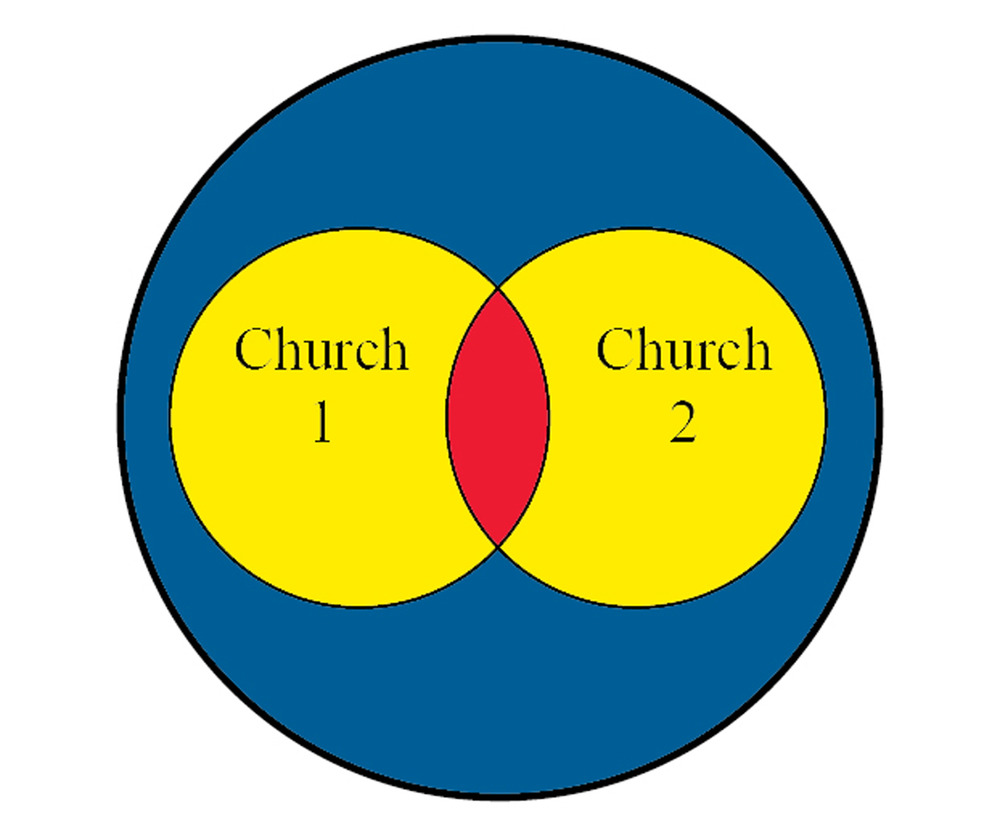
For the purposes of description, let’s call the first one CHURCH 1 and the other CHURCH 2.

There are some who are members of both, some who are members of only one, and some who are members of neither. I think of it, mathematician that I am, as a Venn diagram:

Church_venn_diagram2


Envisioned in this way, I would suggest that CHURCH 1 is made up of those who would call themselves “religious” and CHURCH 2 is made up of those who would call themselves “spiritual.” Those in the red region might call themselves both spiritual and religious. Those in the blue might call themselves neither spiritual nor religious. You get the picture.

Based on these operational definitions of “church,” here’s my best shot at answering the title question: Yes and No. CHURCH 1 is dying. CHURCH 2 is alive and kicking and ain’t going anywhere.

Stay tuned.

Chick-Fil-A and Me

28 Jul

Since the first posting of the article from which the brouhaha about Chick-Fil-A and the same-sex marriage debate erupted, I’ve been “sitting” with the whole thing, watching the responses from people with varying perspectives on the issue, trying to distill my own feelings and thoughts into words.

I happen to have several friends and extended family members who are closely acquainted with the Cathy family and have been for years — one who sits on the boards of more than one nonprofit organization started by the founder of Chick-Fil-A, one who grew up in Truett Cathy’s Sunday School class, one whom I knew in a completely different arena who sits in a position of influence at the company. A few years ago, I had the pleasure of doing some consulting work with the company because of him.

I have never completely agreed with the religious beliefs of Truett Cathy, but that fact has never stood in the way of my respect for the actions he has taken through the years, the most prominent of which is, of course, the fact that Chick-Fil-A stores are closed on Sunday. The devotion of Chick-Fil-A and the heretofore millions spent by the founders to provide housing and solid, loving home environments to children of high-risk circumstances, though less widely-known in a national sense, is a standard of “practicing what one preaches” that I wish I had the financial wherewithal to emulate. I like to tell friends from out of state the story of how the original “dwarf house” might not have gotten off the ground and stayed there (serving steak, by the way, I hear) except for the employees of Delta and the Ford plant long gone from Hapeville, and of Mr. Cathy’s loyalty in making it his and the company’s policy to fly only Delta (when possible) and buy only Fords.

None of my vicarious pride in those things has changed. And it won’t.

But I don’t share Dan Cathy’s views on the subject of same-sex marriage or the apparent views of many that Christianity or democracy or patriotism is “under attack” and in need of the safety of numbers (or the wrath of God) to prove it one way or the other. For the record, it’s also my opinion that the “cow theme” has run its course. I no longer look forward to the next new commercial or billboard because the marketing concept has become stale for me. However, I am quite aware that the marketing decisions of Chick-Fil-A are not mine to make, and have not felt it my duty to try and influence another’s decisions about fast food because of it.

But I am offended. Not by Dan Cathy’s statement of his belief, but by what I consider the trespass of those who claim the authority of their versions of God or the U.S. Constitution over mine, the crossing of borders into a region over which they do not have jurisdiction. And I am saddened, because for a time, I will not be able to defend Dan Cathy’s rights to his own beliefs and my right to my own at the same time. A line has been drawn where there need not have been one and as a result, that most important principle underlying the notion of America (in my view, straight from the teachings of Jesus as well as John Locke) that all humans are created equal and are entitled to their beliefs as long as the manifestation of one’s beliefs does not unnecessarily diminish the value or opportunity of another who does not share them, has once again been trodden underfoot for me.

I don’t know how I’ll feel in a month or two or a year from now. Things change and thankfully, so do feelings and perspectives. Meanwhile, if you see me at Chick-Fil-A, know that it is because I wanted a piece of chicken fried in peanut oil. Nothing more, nothing less.
And if you don’t, check a billboard to see if a cow’s gone missing.

Why Are We So Surprised?

13 Jul

Lewis Rothschild: People want leadership, Mr. President, and in the absence of genuine leadership, they’ll listen to anyone who steps up to the microphone. They want leadership. They’re so thirsty for it they’ll crawl through the desert toward a mirage, and when they discover there’s no water, they’ll drink the sand.
President Andrew Shepherd: Lewis, we’ve had presidents who were beloved, who couldn’t find a coherent sentence with two hands and a flashlight. People don’t drink the sand because they’re thirsty. They drink the sand because they don’t know the difference.


———————————————————————————————————————-

When I first saw that scene in the movie “The American President,” I thought the concept overstated, but now I’m not so sure. I scan the plethora of ignorance posted and shared on the internet every day, even by many of my friends and acquaintances—people I would have expected to apply the rules of careful research to verify the veracity of statements made rather than unthinkingly parroting lies. I hope against hope that what I see is an illusion based on the sheer volume of mud, that the real “sand-drinkers” represent only a small percentage of the population.

Lest you think me above the fray, think again—more than once, I have jumped into some conversation, only to discover later a piece of information I had previously missed, a fact that rendered my view indefensible. Lately, though, I’ve started unsubscribing to every so-called nonpartisan newsletter I receive—the “puffing up” over imaginary evils committed on any side of a debate—even from those who once seemed to share my opinions about what might work to return us to a more stable course—obliterates the possibility of reason, and renders broad-reaching, lasting solutions impossible to find. I’ve decided to take a retreat.

I’m in good company. Jesus often went on retreats, too, and I think I know one of the reasons why. One time in particular, he and the disciples had managed to row their boats to the other side of the Sea of Galilee (or Tiberias, if you please) with the intent of going into the mountains for one of those retreats. But by the time they got across, the throngs of people had run on foot, I guess, around the sea and greeted them on the other side. The New Testament story, told several times in slightly different iterations, says that Jesus had compassion on them and postponed taking care of his own need for solitude because they were “like sheep without a shepherd.”

I don’t know about you, but I’ve seen sheep without a shepherd. Great throngs of them, with no concept whatsoever of what automobiles were or could do to them, who refused to step off an Irish road until a shepherd appeared to lead them into a nearby field. I have photos of a long line of sheep following a man down a road until there was a break in the stone wall. Jesus talked about shepherds, too—“good” ones who went looking for single missing lambs, false ones whose voices enticed these dumb animals into danger. The metaphor isn’t lost on me—any shepherd will do when sheep are afraid or unsure of what to do or where to go.

Those of us in the cars waiting patiently (and some not so patiently) for them to move assumed that the man who appeared was the shepherd for this particular flock, but there was no way for us to know. Maybe he took them back to the fold for shearing, but maybe not. Maybe he took them to the slaughterhouse instead. In the end, it didn’t matter—they were dumb enough to follow him anyway.


Jesus hoped that the crowds that hustled to the other side of the Sea of Galilee did so because they understood the truth of his message, but he was a realist. He knew that most of them only came because they were hungry or wondered if maybe, like they’d heard from one of their friends, that he was the one who would finally lead them out of occupation by the Romans and their in-country lackeys.

His disciples didn’t get it, either. Not then, anyway.

When he looked around at the mass of people, he told the disciples to feed them, and they looked back at him like he’d lost his mind. “Tell them to go into the towns and villages and buy it for themselves!” they said. “It’s not our problem they didn’t bring their own food. They could’ve gotten a good job and an education, just like we did!”

Jesus just repeated his command. “No. You give them something to eat.”

“What?” they said, again, in disbelief. “You want us to take our 200 denarii and go to McDonalds and bring back food for them? You want us to spend our money for them? Risk our own dinner? Are you kidding us?”

About that time, in one of the tellings of the story, a boy who had overheard their strategic planning meeting, approached Andrew, Simon’s brother, and handed him five loaves of bread and two fish. The disciples looked at the food and rolled their eyes. “Five loaves and two fish for 5000 people? Come on, man.”

I imagine that a number of possible responses passed through Jesus’ head, but he finally took the loaves and fish from Andrew, and said, “Make the people sit down.” It was a big grassy place, like Piedmont or Central Park, so there was room for all of the attendees.

He started at the front, handing out the food. The young boy who’d brought the bread and fish in the first place was taken care of first—Jesus would never have allowed him to go hungry. While he was going down the row, like a priest distributing communion bread, a fellow a couple of rows back reached for his bag and said, “I have some Dasani and some bagel chips and smoked salmon,” and started offering some of them to the people close by. A few rows behind that, and off to the side, a woman standing with a big bowl of water on her head took it down and handed a ladle to the fellow sitting at her feet. “I have enough water for thirty or so to have a sip,” she said, waving her hand. When questioned about what she would tell her family when she got home without the water, she said, “They’ll never know. There’s another well on my way home.”

All of a sudden, more bread and water and fish and some Burger King and Taco Bell and Chick-Fil-A bags started appearing, and 30 minutes later, an observer just passing by might have thought it was a rather large previously-planned picnic. Kids were playing together on the playground. Folks in one section were singing Hebrew karaoke, spontaneously started by a guy who’d produced his lyre. Laughter rang out from still another area. Sheep jokes, no doubt.

After a few more minutes, Jesus stands up and nods to his disciples again. “Go, gather what’s left over. Let’s make sure nothing’s wasted—there’s a soup kitchen back in Capernaum that could use it. And while you’re at it, get people to pick up their trash—you know how some of the Occupy Judea people can be.” There were no sarcastic comments this time. The disciples scattered to do what Jesus asked, and when they returned, every one of the 12 had a basket full of bread.

Somebody yelled, “Hey, man, are you for real? You need to run for office!” And then the crowd slowly picked up the chant. “Jesus, Jesus, he’s our man. If he can’t do it nobody can!”

When Jesus heard this, he knew it was time to get out of there, so he slipped away into the hills, which was, as you recall, what he’d started out to do in the first place.


Don’t think it was easy for Jesus to sidestep the amazing opportunity he had. He was a human being, after all. From the day he was baptized by John in the Jordan, he knew he’d be tempted many times to use the indestructible power of what he knew to control the people who followed him. He knew that if he let himself, he could get used to the blind adoration. He knew that if people were starving or fearful of starving, things could get ugly.

That’s why, I’m convinced, that just after the Spirit had descended on him like a dove and he’d heard the voice of God, he went on that long retreat by himself. You know, the going into the wilderness, the one that lasted 40 days or so. He went to wrestle with those very demons, and arm himself for future encounters, like this one, that he knew would come. That first long retreat had only one purpose—self-examination and preparation to subdue the all-too-human tendency to become enamored with  ourselves when granted positions of authority where we and others believe we can excel, to fall prey to the narcissism of beginning to believe oneself above the law—superior to those who nominated us in the first place. He went to the desert to honestly ask himself if his morality, his high talk about God and love and nonviolence would hold up if he himself was starving.

Jesus wasn’t stupid. He knew that when he came back from that first retreat that he would face the temptation over and over again, that sometimes he’d be hungry and sometimes not, sometimes lauded and sometimes jeered, sometimes praised and sometimes humiliated, and he would have to be strong. He knew that most of the sand-drinkers, blind forever to the true meaning of abundance, would miss the mark, mistaking the meaning of his parables, and try to put him in charge of their lives—all with the misguided belief that he would wave a magic wand and either make their misery go away or protect them from suffering in the first place, if they were “good” people who followed the rules.

He knew, too, that the sand-drinkers are capricious, that in the end, the people who yelled, “Jesus, Jesus, he’s our man!” that day when he’d fed them were the same who would yell “Crucify him!” when they realized that they had misjudged him, that he hadn’t come to lead a charging army against the oppression of Rome. And because he knew it, he sometimes slipped away when he was tired and discouraged to get his head about him and remember again, who he was. “Are you the King of the Jews?” asked Pilate. “You say I am,” was all he responded.


Jesus is the only person in the history of the world, so far as we know, who, presented with the opportunity to assume the illusionary mantel of power, praise, and superiority, turned it down, and completely escaped its built-in delusions. The only one.

And yet, in the face of that exception, we still act surprised when what once seemed to be wine turns out to be sand.