Archive | Uncategorized RSS feed for this section

All in the Order

9 Mar

I hopped onto Facebook this morning and read a post by a good friend about a new book he’s written. The book is Lead, Serve, Love by Gregory Lang. I heartily recommend it, as I do all of the books he has written. But something bothered me about the title when I first heard about it. I thought it had to do with the title itself—I am a book shepherd/publisher and I think about book titles and cover designs all the time.

I was wrong. What bothered me is the order of the words.

We humans naturally place things in sequence: Get Ready, Get Set, Go! Step 1, Step 2, Step 3… Ready, Aim, Fire! It helps us to “chunk” tasks into separate segments, makes jobs more manageable. But it sometimes gets us into trouble.

I rather think the order in which Jesus would have placed these words, and the actions around them, was the reverse: Love, Serve, Lead. He sure spent a lot more time talking about love and service than about leadership, and implied, at least to me, that true leadership derives itself from loving and serving.

The more I thought about it, the more I realized that this disordering may well have been the mistake of Christians from the very beginning. Even the disciples had trouble with it—worrying about who would sit where at the table, who would be invited to the banquet, who would sit at the right hand of Jesus in heaven, who got to make the laws. Jesus’ answer was always the same. Love first. Even at the end, he said, “Love others as I have loved you.”

He didn’t say, “Lead others as I have led you.” I think he meant that, too, but it was third in the progression. Think about what happens, as in the example above, if we “fire” first and think about getting ready or aiming later. We do it all the time. Our mantra is “Shoot first, ask questions later.” And as a result, people are often wounded…or worse.

I find it particularly offensive when Christians impose their brands of leadership, never thinking until later, if at all, about whether or not their plans, their decisions, their actions are out of love. You see, it’s far too easy for us when we hear the word “lead” to raise ourselves up above those we are called to lead. The ego is instantly invoked. Let somebody actually hang a title on us and we’re doomed. “King of the Jews?” asked Pilate. “You say that I am,” replied Jesus. What hangs in the midst of those lines for me is, “I didn’t say it. You did.”

When Jesus was asked who he was by the disciples, he didn’t answer then either. He didn’t have to. “Whom do you say I am?” he replied, and the answer we know. That answer didn’t come because he wore a badge or had a certificate in his robe. If I know that you love me first, that you think of what’s best for me first, and that you have demonstrated it over and over again in service to me, then when you rebuke me, or deny my requests, I trust that there is a reason that I do not see or understand behind your decision. And I will follow you to the ends of the earth, submitting gladly to your leadership whether you have a badge on your chest or not. But even if you do, I won’t, if the order of these three words is reversed.

For Lent, I’m giving up thinking about leadership and spending time on love and service to those around me—my family members, my friends, my co-workers, my colleagues, my…enemies. And I have a funny feeling that if I can crack this, I’ll never have to think about leadership again.

Join me. LOVE, SERVE…LEAD.
Who Do You Think You Are?

6 Mar

Not one for a lot of television, I only recently discovered the show “Who Do You Think You Are?” It’s in its second season, but I didn’t know about it until a few weeks ago.

Sponsored by Ancestry.com, a genealogical research site I had a subscription to years ago before the internet was as widely used as it is today, it shows famous people on a quest for finding the answers to questions about ancestors—who were they, where did they come from, where did they go (in some cases).

The interesting part of the show for me is the effect the journey has on the people spotlighted when they add a piece of their story that they didn’t have, when the paradigm shifts with respect to those from whom they are descended. Sometimes it’s good, sometimes it’s sobering, sometimes it’s painful to learn what those ancestors might have done, the conditions in which they lived, the decisions they made that would ultimately affect whether or not they were even born.

I rejoined Ancestry.com after watching the third episode, and found that in the years since I was first a member, a lot of information has been added. In one quarter of my family, through my father’s father, I’ve discovered German roots I never knew were there back in the late 1600’s. If one of my ancestors hadn’t remarried after his first wife died and had more children, for example, I wouldn’t be here—and I don’t mean not in the United States. I found, also, that my Irish ancestors came long before the potato famine—I now have the evidence that would enable me to join the DAR (Daughters of the American Revolution). Most got off the boat in Maryland. The rest came to Virginia and drifted south through North and South Carolina before arriving in north Georgia, mostly in the early 1800’s.

If we could go back far enough, I think we would find that we all started from the same general area. Those Germans weren’t always in what came to be known as Germany, after all. And there’s speculation and some physical evidence that the Celts were once French before they arrived in Ireland.

The lines of relationship are not nearly as clear as we sometimes think. Nor is our impact on the future as irrelevant. I like to think about things like that—to imagine sometimes what my life might have been like had I gone to a different college or married that guy or majored in math as I started out to. When future generations look back at whatever their counterpart to Ancestry.com turns out to be, they won’t likely know those things about me. And as for me, I can only speculate on what might have been.

It does matter, though. Every decision we make affects somebody else whose decisions affect somebody else, maybe even eight generations from now. It’s a big responsibility when you think about it in that way.

Who do I think I am? My brother’s…my sister’s keeper. That’s who.

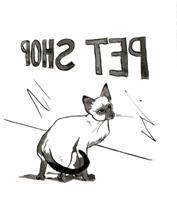
The First “Simon Story” – On Pet Shops

27 Feb

Image001

When I was eight weeks old, my brothers and sisters and I were given away, dropped off at a kitty orphanage, the Regal Pet Shoppe. Although traumatized, I always thought the name apropos…I am Siamese, after all – my royalty is obvious.

That’s where “M,” my human, found me many years ago, but I remember it like yesterday. There I was, the last of my family to be adopted. Although of a royal bloodline, my family had elected not to get those silly documents you humans call “papers.” How rude! I know who I am and I know what I am. Since I’ve grown older and wiser, the documents seem even sillier. There’s one thing no one can take away from me no matter what he or she may do to me and that is my character – what I’m made of inside.

I think even now about the day my siblings and I were abandoned. I wonder where my “real” mom is and what she’s like. M has an adopted nephew who’s had a tough time now and again. When I’m around him, I try to tell him that I know how he feels.

At first, it’s really hard not to wonder what you did that made your mom go away. It’s a hard feeling to shake because when you’re a kitten, it’s difficult to think of yourself as a totally independent cat. Although it seems pretty clear to grown-up cats that parents make decisions and do things that have nothing to do with their kittens, only time and experience can make that truth so clear for little ones. Part of knowing who you are is knowing where you come from, but adopted kids don’t have access to all of their stories. It’s okay to feel sad that you’ll probably never know some things about yourself, like where you got your blue eyes and brown ears or whether your father’s father had rings on his tail.

For about six months I wouldn’t stay in the room with M unless I was hungry. I stayed outside much of the time, and I did a lot of talking to acquaintances in the neighborhood. And you know what? After I figured out that my brown ears are my brown ears and my blue eyes belong only to me, the one thing that kept popping into my head was the fact that the day M came into the Regal Pet Shoppe, there were other kittens in the store. Free kittens.

And guess what? She paid for me!

When I find myself, even today as a pretty old guy, feeling sad about not knowing whatever became of my parents or siblings, I remember that M thought I was pretty special. She had choices and she chose me. Having somebody—anybody—who thinks you’re the cat’s pajamas is what matters more than anything in this life, or any of the other eight for that matter.

Believe me…I know.

On Yardfights

26 Feb

Note: For those of you who don’t know, nine years ago I wrote and published a book called Simon Says: Views from a Higher Perspective, available via in Kindle format by clicking here. The “true” author of the book is Simon Sharpe, Siamese Cat Extraordinaire, a very real feline who fancied himself a philosopher. And perhaps he was – during a particularly difficult time, he taught me an awful lot about life and resurrection. I “transcribed” his dictation for you. In the book, which includes wonderful pen and ink drawings by a friend of my nephew’s, there are 26 different “Simon stories.” If you like this one, I’ll post others. By the way, “M” is me, Simon’s human, and “Murphy” was his brother, a big gray and white domestic shorthair. And, believe it or not, the stories are true. VMS

On-yard-fights

Some time ago, Murphy and I were minding our own business outside when five members of a feline gang came over the fence into our yard. Since there were more of them, we knew we weren’t likely to win if a fight broke out. I ran one way and Murphy ran another to try and break them up. Two of them caught me, and in the fracas, I was bitten and scratched up. I hunkered down and “played dead.” Murphy managed to find a hiding place. Finally after strutting around for a while, the gang members left. Murphy came out to see how I was. I waved him off and limped to the door.

A day or so later, my tail – well, actually my tail “region” – started hurting. M noticed I was moving oddly and began investigating. Let’s just say that the cat who bit me hadn’t brushed, and I had two abscesses where the skin had been broken. M took me to the vet where, to my embarrassment, they shaved off the hair on my rump and stitched me up. I had to stay inside and endure the humiliation of having M put pills in my mouth and hold it shut until I swallowed, but the truth is I was a little shaky about going back outside anyway.

Finally the day came when it was all right for me to go outside. The hair hadn’t grown back on my rump yet, and I knew I was in for some teasing. I knew, too, that everyone in the neighborhood would find out what had happened, but I was tough enough to take it. It was more important for me to help Murphy reassert that we owned our yard. No matter how scared I was, the gang needed to know that they could not take over our territory. As expected, I was taunted, and M had to run the gang out of the driveway a couple of times, but eventually they got the point. No one has the right to barge into our yard and claim it as theirs by force.

M says there’s almost always a yard fight going on somewhere. She told me that in the 1930s and 40s, just about everybody in the world got involved in one that lasted four years after the US got in.

Power is a strange phenomenon. If you don’t think you have it, you want it and spend countless hours figuring out how to get it. If you do think you have it, you want more. If you get more, you know you’re bound to lose it because sometime somebody somewhere will hit on a workable strategy to take it away from you. Somebody has to be king of the yard, right?

Wrong. An obsession with power is not about superiority.

It’s about fear.

Being My Self

23 Feb

     I’ve been re-reading two favorite books of mine in recent weeks: Eckhart Tolle’s A New Earth and Parker J. Palmer’s The Active Life.

     As is so often the case with me, I have long understood intellectually the concepts they present, but have struggled to apply them in any practical sense in everyday life. That’s a problem, I think, too, with respect to our understanding and practice of what Jesus tried to teach us. The paradox is that the very concept I’m talking about is also the culprit for why it is difficult to connect the dots.

     The concept I’m referring to is what I believe Jesus meant when he said, “If any want to become my followers, let them deny themselves…For those who want to save their life will lose it, and those who lose their life for my sake will find it. For what will it profit them if they gain the whole world but forfeit their life? Or what will they give in return for their life? (Matthew 16:24-26, NRSV)

     Deny my “self.” Hmmm…There’s a lot of confusion about what that passage possibly means, some of which is the fault of psychologists and educators and pastors who come from different “operational definitions” of the word “self.” Too often we compare apples to oranges. When I talk about my “self esteem,” for example, I’m referring to “soul esteem,” i.e., holding in reverence the “authentic” me, that chip-off-the-old-block child of God “me.”

     I don’t believe that’s the “self” Christ tells me to deny. The self He referred to is what I call the “hologram” of me, the “ego” (another word subject to the confusion of different definitions), the often “inauthentic” me who is defined exclusively by the world. That “me” is the sum total of the projections of parents, friends, teachers, employers, employees, opponents, enemies, governments, you name it. Its identity and sense of self-value varies wildly based on what happens to it and whether what happens to it hurts or feels good (which also feeds its ideas about what is “good” and what is “evil”).

     If I remember that it’s the hologram who is talking when I’m upset or even ecstatic and that those feelings have nothing to do with the “real” me, it’s amazing how much better I feel about myself. Keeping those two separate in my mind is the key. But one lives exclusively in the kingdom of heaven, and the other exclusively in the world, and I can’t, for the life of me, figure out how to exist in both at the same time. “My kingdom is not of this world,” said Jesus. Boy, was He ever right about that.

     Of course, the ideal situation would be if the world was the kingdom of heaven, because then, the ego, that “hologram” of me, wouldn’t even exist. I would always be who I truly am, you would always be who you truly are, and nothing that ever “happened” would have the slightest impact on how much of a treasure each of us is to God or each other. But that’s the ideal situation, as I said, and not the reality. Knowing that, I need to make it my responsibility not only to be who I am, no matter what, but to remind my friends and loved ones, when they really need it, of who they are.

     A couple of years ago, a good friend’s nine-year-old granddaughter had a freak accident that snapped a major tendon in her ankle, and she faced a surgery to try and repair it. No one knew for sure what would happen—there was a chance that it would, but there was also a chance that she would never again walk without a pronounced limp. It was the night before the surgery and Grace, an aspiring ballerina, was restless. She turned to her grandmother, who was sitting with her while her parents grabbed a bite to eat.

     “Grandma,” she asked, “what if, in the morning when I wake up, I can’t walk?”

     My friend thought for a moment and, rather than trying to reassure her that it wouldn’t happen, answered the real question her precious granddaughter was asking by asking her a question in return.

     “Who are you?”

     The child, confused for a second, shrugged her shoulders. “Grace,” she said.

     “And in the morning,” said her grandmother, “when you wake up, whether you can walk or not, who will you be?”

     The child smiled and within minutes, drifted to sleep. She was Grace then, and she would be Grace the next day and the day after that, no matter what happened.

     God, I wish we could all remember that.

Equality

21 Feb

Philippians 2:6-8

Though in the form of God,
Christ Jesus did not cling to equality with God,
But emptied himself, taking the form of a servant,
and was born in human likeness.
Being found in human form, he humbled himself
and became obedient to death, even death on a cross.

I grew up in my grandparents’ home, as many of you know. As a little girl, I adored my grandfather, and I think it is safe to say that he adored me, too. In the absence of my biological father, my grandfather became mine, and in the absence of his own biological child, I became his. Though he died over 40 years ago now, I still carry deeply intimate memories of how I felt when I was with him—before he died, when I wasn’t in school or off reading a book, I was always by his side.

I remember, even before I was old enough for school, being in his garden with him—he behind a hand-driven plow, furrowing rows, me behind him dropping seeds and covering them up with a little hoe. By that time in his life, there were no tractors—the plow was pulled by a mule owned by his brother, a mule we walked three miles round-trip to borrow on plowing day. Well, that’s not exactly true—my grandfather walked three miles. I rode on the mule’s back with my grandfather leading him by the reins for half the journey.

Other times, he rescued me from harm’s way—the time the billy-goat tried to impale me in a stall, the afternoon when, while we were in the midst of those rows in the garden, a well-camouflaged rattlesnake came slithering between my legs. The latter might have been disastrous, except for the fact that despite my inclination to break and run, I trusted my grandfather so that I obeyed his barked command to freeze where I stood.

I followed my grandfather everywhere, emulating him in virtually everything. Sometimes the result wasn’t pleasurable—I watched him stomp on a bee once and followed suit, neglecting to notice that he was wearing hobnail boots and I was…barefoot. I flattened my thumb a few times with a ball-peen hammer, too.

I think we forget what “following” Jesus means sometimes, that it’s too easy for us to think of Jesus the human as uniquely “gifted” with the ability “not to sin” because he was also “divine,” and ignore the call to follow in his steps, to live according to his example. Not because we’re belligerent, rebellious children, but because we believe ourselves not gifted in the same way. And yet, because we are “made in His image,” I think we are also, each of us, divine—born in the “form of God.”

There are some who would call that statement “sacrilegious,” a blasphemy, a lack of reverence for my Creator, and step away from the thought, fearful that I will be struck dead where I stand, turned into a pillar of salt. The key for me is the first full line in the passage above—“Though in the form of God, Christ Jesus did not cling to equality with God.” I believe that the spirit of God is infused into us at the very beginning of all our lives, just as it was Jesus. But to acknowledge that one is a “chip off the old block” is not the same as to claim “equality” with the block itself. There is no question that we are, in no way, equal with the great I Am—just as it would be folly to say that a single drop of water is equal to the ocean. To claim that would be idolatry.

But, even so, every once in a while, if we can empty ourselves and allow that breath—that piece of the spirit of God that is already there—to fill us up completely, we see ourselves and each other through God’s eyes, just as I did long, long ago in my grandfather’s eyes.

And if we do,  we will follow him anywhere.

Guard First

17 Feb

I visited a friend out of town recently and as I got ready for bed, I noticed a book on the bedside table. Its title was one word: Boundaries. I picked it up to discover that it had been written by a pastoral counselor sometime in the past few years, and flipped through the pages to see if the pointedly Christian “take” on the subject varied from my own psychotherapist’s view of the concept. I was pleased to find that, for the most part, it didn’t.

It was “coincidental” that the book was there at that particular time, but God has always had to be “sneaky” with me. As I said in an earlier blog, I’m editing a book about the effects of “spiritual abuse,” the term some have come to use to describe sexual abuse perpetrated by a person in spiritual authority, someone to whom we have been taught to believe, by virtue of their position, that we can lower our boundaries to, becoming vulnerable in a way that we cannot dare to be in general. It’s particularly egregious to me because I believe that the crux of God’s message to us about how we are to treat each other is about boundaries—loving our neighbors as ourselves to me, as long as I can remember, has meant that we are to respect the boundaries of others as we expect our brothers and sisters in Christ to respect ours.

I would argue that a great deal of human suffering comes from the trouncing of emotional boundaries by someone or something outside of ourselves, just as  it does when our physical bodies are intruded upon by accident or plan. It affects how we feel emotionally about ourselves, our value in the grand scheme of things, because we are prone to see everything that happens to us as a function of reward or punishment. Healing of those boundaries, repairing the “fences” around ourselves if you will, comes about only in environments where we are guarded by those we love and by whom we are loved, those whom we can trust implicitly not to further the damage by stepping on already bleeding wounds.

Our first job as Christians is to guard our brothers and sisters in Christ, our vulnerable neighbors. It doesn’t matter whether we believe that they brought whatever it is on themselves. There will be time enough, later, when their ability to defend their own boundaries has been restored, to confront them if we believe ourselves to have earned the honor to do so.

That’s what Jesus did for the woman about to be stoned. He knew she was an adulteress, but he sent the rock-throwers scurrying, drew the line in the sand for her when she couldn’t do it herself…first. God knows (pardon the pun) he would not have earned her trust if he’d picked up a rock himself. Nothing he said after that would have mattered.

Forgive us our trespasses as we forgive those who trespass against us.

Most Merciful God…

5 Feb

Most merciful God,
we confess that we have sinned against thee
in thought, word, and deed,
by what we have done,
and by what we have left undone.
We have not loved thee with our whole heart;
we have not loved our neighbors as ourselves.
We are truly sorry and we humbly repent.
For the sake of thy Son Jesus Christ,
have mercy on us and forgive us;
that we may delight in thy will,
and walk in thy ways,
to the glory of thy Name. Amen.

As an Episcopalian, I find this confessional prayer from the Book of Common Prayer to be my favorite. Though brief and relatively simple, the spirit of the prayer pretty much “covers the bases” for me.

Those who know me reasonably well also know that the two lines about love address the core of my personal theology. Jesus said, according to the authors of the New Testament, that the greatest commandments were to love God with our whole hearts and to love our neighbors as ourselves, numbers one and two of the “Ten Commandments.” I believe absolutely what Jesus said, because I remain convinced that if we could just bring ourselves to comply with those commandments in the fullest possible sense, the kingdom of heaven would be not only near, but here.

These days, I don’t talk about the first commandment very often, largely because what loving God means to me has no bearing on how others feel about God, just as my relationship with any one person has no bearing on my relationship with another. But the fact is that our understanding and interpretation of what loving God and being loved by God means has everything to do with the second. Standing alone, the second commandment, “loving our neighbors as ourselves,” presents some pretty challenging problems. For instance, the definition of the word “love,” or “neighbor,” or “self,” or what “loving oneself” really entails.

I almost wish there’d been another clause to the second commandment—something like “love ourselves as God loves us” in between. Because if we love ourselves as God loves us, all is well—that love will flow right on out to our neighbors. But if we don’t really love ourselves, then we’re not going to love our neighbors either. And the fact is that most of us don’t really love ourselves—at least not in the sense I think God loves us. Until we do, to talk about loving our neighbors is a futile discussion. Loving ourselves comes first.

It will come as no surprise that my psychology master’s thesis studied self-esteem. Despite the fact that my collegiate days coincided with the upswing of secular, humanistic psychology which often denied the existence of God, I never had trouble reconciling my spiritual beliefs with the “intelligence” of emotions. There’s nothing Jesus was ever reported to say, or a parable he taught, that I could not confirm from the psychological literature. The tenets of 20th century self-psychology and object relations theory that I embraced simply undergirded what Jesus had long ago told us was true.

I return to the story of the prodigal son every time I think about it—hence the name of this blog. The father of that prodigal son loved his son. Period. Though he’d gone and thrown away his inheritance, voted for the “wrong” guy, slept with the pigs (consider the possibility that we might not be talking about literal pigs there…), gone to a different college from the one his father wanted him to or simply bucked the system and dropped out of high school, gotten his girlfriend pregnant or some such, was drug-addicted and checked into rehab again, you name it…the prodigal son’s father loved him. That father loved his son so much that he waited and waited until one day, the son came to his senses. And when he heard that his son had appeared in the distance, he didn’t walk to meet him. No, he ran to welcome him on the road.

I can hear my detractors now. “Yeah, but the father didn’t run to meet him until he came to his senses,” they say. Wrong. The father in the story didn’t know that the prodigal son had come to his senses, nor did he really care. All he cared about in that moment was the fact that his son had come home.

Though we often deny it, we often act as if by sheer will we can achieve the state whereby we will become acceptable in God’s eyes, never once considering that what we do is irrelevant. It’s the grown-up version of “If I make good grades, my daddy will love me.”

That’s where the other part of the story of the prodigal son comes in. The son who had remained at home—the one who was incredulous that his father threw his sibling a party—believed that his father’s love for him was tied to the fact that he had done what he was “supposed” to do. He believed himself loved more than his brother on the basis of their behavior, and was shaken by the unassailable evidence in front of him that what he’d believed, and acted upon (or had wanted to, but hadn’t) had been a farce.

For me, the greatest tragedy is that the church is not only the place where we first learn of that unchanging Love, but it is far too often the place that renders us unable to embrace it, even for ourselves. That was true for me a long time ago—it was the reason I left the organized church and ventured into the world of psychology. The church had become the son who stayed home. In many ways, it still is.

I remember feeling sad when I first heard the term “unconditional love” in a psychology class. There were two reasons. One was that the “unchurched” around me spoke of it as if the concept was a new discovery. The other is that the use of the adjective “unconditional” with respect to love is redundant.

Conditional love, after all, is an oxymoron.


Guest Post: From the Over 40 Crowd…

4 Feb

I don’t know who actually wrote this, but whoever you are…I think I love you!

When I was a kid, adults used to bore me to tears with their tedious diatribes about how hard things were when they were growing up, what with walking five miles to school every morning…Snow…Uphill.. Barefoot..BOTH ways…yada, yada, yada. And I remember promising myself that when I grew up, there was no way in hell I was going to lay a bunch of crap like that on my kids about how hard I had it and how easy they’ve got it!  But now that I’m over the ripe old age of forty, I can’t help but look around and notice the youth of today.  You’ve got it so easy!  I mean, compared to my childhood, you live in a damn Utopia!

I hate to say it, but you kids today, you don’t know how good you’ve got it! I mean…

1) When I was a kid we didn’t have the Internet.  If we wanted to know something, we had to go to the damn library and look it up ourselves, in the card catalog!!  

2) There was no email!!  We had to actually write somebody a letter—with a pen! Then you had to walk all the way across the street and put it in the mailbox, and it would take like a week to get there!

3) Child Protective Services didn’t care if our parents beat us.  As a matter of fact, the parents of all my friends also had permission to kick our asses! Nowhere was safe! 

4) There were no MP3s or Napsters or iTunes!  If you wanted to steal music, you had to hitchhike to the record store and shoplift it yourself! 

5) Or you had to wait around all day to tape it off the radio, and the DJ would usually talk over the beginning and @#*% it all up! There were no CD players! We had tape decks in our cars. We’d play our favorite tape and “eject” it when finished, and then the tape would come undone rendering it useless. Cause, hey, that’s how we rolled, Baby!  Dig?

6) We didn’t have fancy crap like Call Waiting!  If you were on the phone and somebody else called, they got a busy signal. That’s it! End of story!

7) There weren’t any freakin’ cell phones either. If you left the house, you just didn’t make a damn call or receive one. You actually had to be out of touch with your “friends”. OMG!!!  Think of the horror… not being in touch with someone 24/7!!!  And then there’s TEXTING.  Yeah, right.  Please!  You kids have no idea how annoying you are.

8) And we didn’t have fancy Caller ID either! When the phone rang, you had no idea who it was!  It could be your school, your parents, your boss, your bookie, your drug dealer, the collection agent… you just didn’t know!!!  You had to pick it up and take your chances, mister! 

9) We didn’t have any fancy PlayStation or Xbox video games with high-resolution 3-D graphics!  We had the Atari 2600!  With games like “Space Invaders” and “Asteroids.” Your screen guy was a little square! You actually had to use your imagination!!!  And there were no multiple levels or screens, it was just one screen. Forever!  And you could never win.  The game just kept getting harder and harder and faster and faster until you died!  Just like LIFE! 

10) You had to use a little book called a TV Guide to find out what was on! You were screwed when it came to channel surfing!  You had to get off your ass and walk over to the TV to change the channel!!!  NO REMOTES!!!  Oh, no, what’s the world coming to?!?!

11) There was no Cartoon Network either! You could only get cartoons on Saturday Morning.  Do you hear what I’m saying? We had to wait ALL WEEK for cartoons, you spoiled little rat-bastards!

12) And we didn’t have microwaves.  If we wanted to heat something up, we had to use the stove!  Imagine that!   
      
13) And our parents told us to stay outside and play… ALL DAY LONG.  Oh, no, no electronics to soothe and comfort.  And if you came back inside…you were doing chores! 

14) And car seats—oh, please! Mom threw you in the back seat and you hung on.  If you were lucky, you got the “safety arm” across the chest at the last moment if she had to stop suddenly, and if your head hit the dashboard, well, that was your fault for calling “shot gun” in the first place!  
 
You guys wouldn’t have lasted five minutes before 1970!

Regards,

The Over 40 Crowd

The Definition of Consent

2 Feb

In 1995, as many of you will remember, a suit was filed in the state of South Carolina against The Citadel with respect to discrimination against women. As it happens, I was then, and am still, of the belief that there is a definite place for schools and colleges segregated by gender. My best friend’s mother, who graduated in 1939 from an all-girls’ school, agreed. “If I’d gone to a co-ed college, I would not have had a chance to develop leadership skills,” she said. “I would never have run for office.” My older sister, who went to Tift College, the then Baptist version of the Methodist Wesleyan and Presbyterian Agnes Scott Colleges in Georgia, also agreed. Somewhat shy when she entered as a freshman, she would serve as the Junior Class President and President of the Baptist Student Union in her senior year. But she wouldn’t likely have even run for similar offices at Georgia.

I agreed completely with those who maintained that there was nothing wrong with the Citadel’s being an all-male military college and though, since Shannon Faulkner’s lawsuit and subsequent admission and resignation a few weeks later, over 200 young women have graduated from the Citadel, I still feel some sorrow about that.

Even so, I applauded the lawsuit and the result. The reason? Because The Citadel is a state-supported school. As a working and taxpaying woman, I found it highly disturbing that the taxes paid by my counterparts in South Carolina were used to support a college they could not attend. The solution was simple—make The Citadel a private school. Of course, money fears might have erupted, but I suspect had the state withdrawn aid to The Citadel, the alumni would have more than made up for the shortfall, much as the alumni of Mercer reportedly responded when the Southern Baptist Convention pulled its support.

I feel the same way about abortion. Though I am pro-choice with respect to the intrusion of government into what I consider to be personal decisions, and mystified at the irony that politically speaking, the party that advocates against restrictions on gun purchases is the same one that advocates restricting a woman’s right to make a decision about her own body (and vice versa), I supported the Hyde Amendment. I believe it unconstitutional to require any person who believes abortion is wrong for any reason to financially support the costs of that personal decision, just as I believe it wrong to pay taxes for a benefit to which I am not entitled.

I know there are those who will suggest that my pro-choice stance condones what choices a free person will make, but that’s a debate for a different day. Suffice it to say that the very same reasoning renders Sarah Palin guilty of condoning Jared Lee Loughner’s “choice” because she’s against gun control.

But apparently the Hyde Amendment, a rider which continues to be renewed, isn’t restrictive enough. So, a representative of the “limited government” party, during a financial catastrophe unlike that any of us except those over 80 can remember, has presented a bill that presumes to punish businesses—those same businesses who already can’t afford to provide insurance for their employees and continue to drop like flies in the current recession—for buying policies that do not explicitly exclude coverage for abortion, and in attempting to tighten the grip of that “limited government,” has included in that bill redundant language that ventures into the realm of defining not the meaning of rape, but consent.

For those who have not read the actual verbiage of the bill and the most offending section:


H.R.3  – NO TAXPAYER FUNDING FOR ABORTION ACT

SEC. 309. TREATMENT OF ABORTIONS RELATED TO RAPE, INCEST, OR PRESERVING THE LIFE OF THE MOTHER.

The limitations established in sections 301, 302, 303, and 304 shall not apply to an abortion—

(1) if the pregnancy occurred because the pregnant female was the subject of an act of forcible rape or, if a minor, an act of incest; or

(2) in the case where the pregnant female suffers from a physical disorder, physical injury, or physical illness that would, as certified by a physician, place the pregnant female in danger of death unless an abortion is performed, including a life-endangering physical condition caused by or arising from the pregnancy itself.


This is an unnecessary bill and a frivolous one, and I consider it a flagrant misuse of time and taxpayer money. So, at the risk of being misunderstood in that gray area, let me be perfectly clear, Mr. Smith and members of the House Ways and Means Committee. You are not my keeper spiritually, religiously or physically, and you do not have my consent to continue with this any further.