Archive | Uncategorized RSS feed for this section

Untitled

16 Sep

Harry3months1-web

We called him “heart boy.” When he sat, as felines often do, with his front legs together, tail wrapped around his haunches, the lighter brown tufts of fur on his chest converged in the shape of that universal sign, but whether or not that particular marking had been there, it would have been an appropriate nickname for the spirit of the regal Siamese who invaded our house nine years ago.

From the time we brought him home and he curled up on a pillow beside me on the couch, I was his primary person. A beautiful specimen of his breed, his seal-point apple-head kitten self would for a while adorn the business card of the breeder from whom we got him.

When we picked him up that day, we met his parents–his mother, a lithe and beautiful cat woman, and his father, massively built and darkly colored who stared at me with a ferocity that would frighten even the bravest of souls. Named for J.K. Rowling’s immortal hero, Harry Potter Sharpe would take after both–inheriting the visage of his sire, but the sweet temperament of his mother, reminding me of many humans I have known.

He trusted me with a completeness I did not deserve, demanding little from me and giving so much more. Though I never tried it, I think I could have held him upside down by his tail and he would not have complained. He wasn’t a lap kitty, but he loved to be hugged and carried around looking over my shoulder. Though his coat was always immaculate, his nightly bedtime ritual involved a game Jan called “Gotcha,” in which she would “throw” him down on her bed, sprawl across him and ruffle him up. He would purr so loudly during the whole affair that I could hear him all the way down the hall in my room. It was the signal that he would soon swagger down the hall and jump up on my bed and compose himself before curling up at my feet for the night.

If I happened not to be in bed, he came looking for me and would start a caterwaul that wouldn’t stop until I followed him to my room. Closed doors that separated us were not tolerated well, nor were my tendencies to be a loner. The family–consisting of Jan and me and Sally, his gray and white domestic shorthaired little sister–had to be together in one room if we were all home.

Like all my pets have been, Harry would become a marker of time in my life, a gift of God to provide what I needed most on my journey. His gentle but unceasing demand that I acknowledge him gave me the constancy, the touch of normalcy we needed in a time of unequaled change.

I think he knew, though no boxes have yet been packed, that we were preparing to leave once again, moving into yet another chapter of our lives. A lover of routine, change of any kind was not his friend. When suitcases came out, he skulked around, watching with a critical eye. Once I found him inside an open suitcase, his 20 pounds of flesh sprawled across my clothes. I wondered if it was an act of resistance or if he was simply stowing himself away for the trip. But this time, I think, he decided not to go. Perhaps he thought his job complete. The signs of his illness came suddenly, almost to the day of our decision to move.

We put him down on Friday. I carried him in a white beach towel, forgoing the disrespect of a carrier, which he considered to be just another closed door. I held him close, careful not to disturb the staples from the surgery two weeks before. He did not struggle, trusting me even to the end to do the best I could for him.

Rest in peace, heart boy. You are stowed away forever in mine.

Harry-2012

September 11, 2002

11 Sep

Ten years ago, I was sitting with three friends in a pub in Carlow, Ireland, eating lunch. En route to Dublin to fly back home the next day, we’d meditated earlier in the morning about what had transpired only a year before. As we ate, Sky TV showed then President Bush and others reading the names of those lost to the terror of 9/11. Suddenly, the sounds of this busy restaurant ceased and for a full 60 seconds, not a soul moved, stopped in their tracks. The same scene played itself out across the Republic of Ireland, in every hotel and restaurant, a nationwide observance of a moment of silence in respect for not only those lost in the tragedy, but for all Americans, including the four of us. It was a while before we were able to swallow again because of the massive lumps in our throats.

I had asked a young hotel clerk earlier in the week what he had thought about it all and he said that, of course, he had been shocked and dismayed, but that in the waning hours, he had thought, “Well, now they know how it feels.”

Of course, he referred to the fact that he had grown up in the days before the truce, when an IRA bomb was as likely to go off as not. He had lost friends, perhaps relatives, in the longstanding conflict, and had, I’m sure, coveted the sense of insulated ignorance we had enjoyed.

I would think about the moment in Carlow and this young man every day for a while, trying to remember when, if ever, I had stood for a moment of silence for the victims of tsunamis, of earthquakes, of hurricanes, of those killed at the hands of true tyrants and despots. I finally despaired of searching, because I could remember no such moment of honor except for the long habit of Southerners to pull to the side of the road and stop in a show of respect for those passing behind a hearse.

We are brothers and sisters in the greatest nation in modern history, a nation at a crossroad, not unlike that we encountered 150 years ago. The battle lines are different in technicality and quite varied, but they are the same. Everywhere, one group of people gives lip service to equal rights for all citizens, yet seeks to control the behavior of others, establishing laws that cannot be enforced and will accomplish nothing of substance, refusing to engage in conversation that might yield a better way forward for all sides. Wasn’t that the point of democracy?

As Ben Franklin famously once said, we must hang together or we will most assuredly hang separately. It will take more bravery to do so than we have shown thus far, and a capacity to love our neighbors as ourselves that seems curiously lacking in a nation that publicly proclaims itself as under God, but only as long as our 401-Ks are secure.

I find myself looking around in restaurants these days to see who may be close by before I dare to speak in more than a hushed tone. And I remember another restaurant a decade ago, and I am strangely embarrassed.

Is the Church Dying? Part 1

9 Aug

A few weeks ago, on the heels of the Episcopal Church’s General Council, Ross Douthat wrote a column in The New York Times asking that question. A dear friend of mine sent me an offline email suggesting I consider the topic for a blog since we’ve had a number of discussions of a similar vein and she knew I’d have an opinion or two. I’ve been stewing about it since. Here’s where I’ve gotten so far.

I’m a social scientist by passion and training, skilled in both the art and practice of the scientific method and the critical thinking required to identify patterns and trends and attempt to assign meaning to them for the purpose of diagnosis and prognosis. It only made sense to me to approach the question from this vantage point.

One of the first tasks involved in designing an experiment is to define, for clarity’s sake, what it is that one intends to study and how it is that she will measure it in quantifiable terms. We call that an operational definition. For example, if I am studying the comfort of a chair, because the word “chair” evokes a different picture in the mind of different people, I must try to ensure that anyone who reads my report knows exactly what I mean when I say the word. Before I go off half-cocked (as far as you’re concerned) and conclude that a chair is comfortable, you need to know that I’m talking about a recliner, and not a folding chair. Likewise with regard to the word “church.”

This word has two very different meanings for me. One is an entirely man-made institution, complete with rules of membership, measures of good-standing, a board of directors, and a CEO. It’s measured either by the size of the building in which meetings take place, the number of people in the seats on certain days of the week, and the number of dollars in the bank account. Let one of its CEOs write a book or get on TV and usually, for a time, all of the numbers go up.

The other has members, too, but the measurement of its health is much more intangible. Money may be involved, but not necessarily. Sheer numbers may be involved, too. But mostly, this church is measured by the fruit of the labor of its members. It’s not always obvious–sometimes the fruit appears quickly, sometimes it’s years later before the seeds sprout into plants. And sometimes, nobody sees it at all except God.

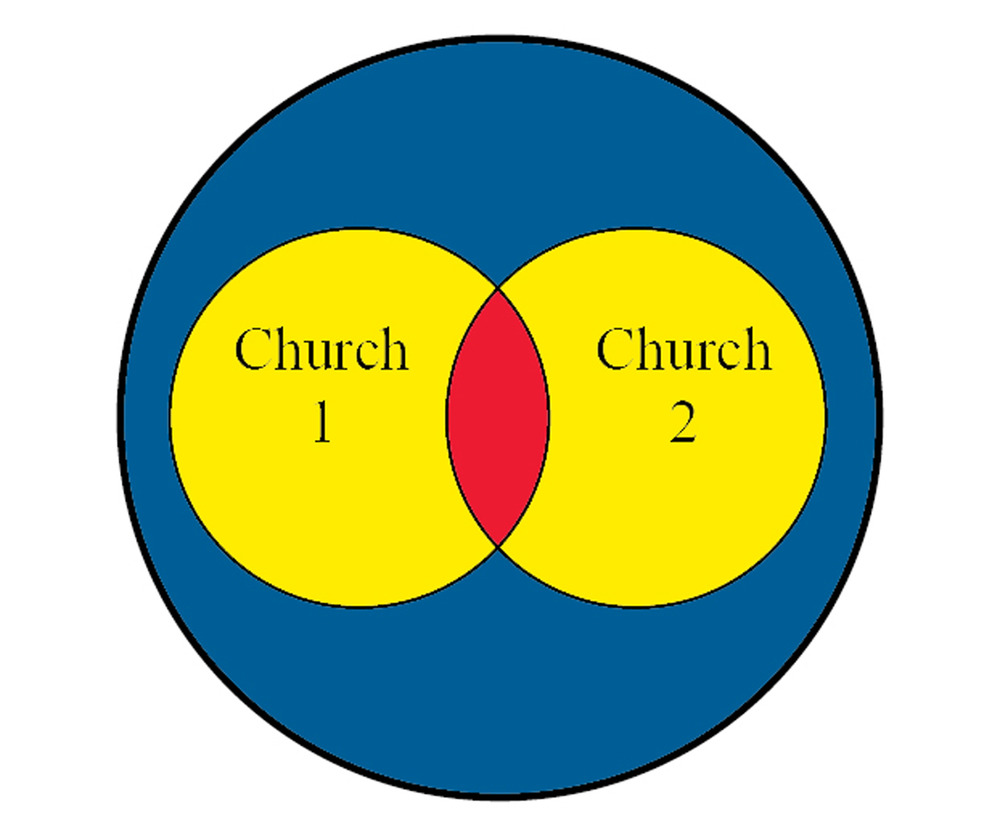
For the purposes of description, let’s call the first one CHURCH 1 and the other CHURCH 2.

There are some who are members of both, some who are members of only one, and some who are members of neither. I think of it, mathematician that I am, as a Venn diagram:

Church_venn_diagram2


Envisioned in this way, I would suggest that CHURCH 1 is made up of those who would call themselves “religious” and CHURCH 2 is made up of those who would call themselves “spiritual.” Those in the red region might call themselves both spiritual and religious. Those in the blue might call themselves neither spiritual nor religious. You get the picture.

Based on these operational definitions of “church,” here’s my best shot at answering the title question: Yes and No. CHURCH 1 is dying. CHURCH 2 is alive and kicking and ain’t going anywhere.

Stay tuned.

Chick-Fil-A and Me

28 Jul

Since the first posting of the article from which the brouhaha about Chick-Fil-A and the same-sex marriage debate erupted, I’ve been “sitting” with the whole thing, watching the responses from people with varying perspectives on the issue, trying to distill my own feelings and thoughts into words.

I happen to have several friends and extended family members who are closely acquainted with the Cathy family and have been for years — one who sits on the boards of more than one nonprofit organization started by the founder of Chick-Fil-A, one who grew up in Truett Cathy’s Sunday School class, one whom I knew in a completely different arena who sits in a position of influence at the company. A few years ago, I had the pleasure of doing some consulting work with the company because of him.

I have never completely agreed with the religious beliefs of Truett Cathy, but that fact has never stood in the way of my respect for the actions he has taken through the years, the most prominent of which is, of course, the fact that Chick-Fil-A stores are closed on Sunday. The devotion of Chick-Fil-A and the heretofore millions spent by the founders to provide housing and solid, loving home environments to children of high-risk circumstances, though less widely-known in a national sense, is a standard of “practicing what one preaches” that I wish I had the financial wherewithal to emulate. I like to tell friends from out of state the story of how the original “dwarf house” might not have gotten off the ground and stayed there (serving steak, by the way, I hear) except for the employees of Delta and the Ford plant long gone from Hapeville, and of Mr. Cathy’s loyalty in making it his and the company’s policy to fly only Delta (when possible) and buy only Fords.

None of my vicarious pride in those things has changed. And it won’t.

But I don’t share Dan Cathy’s views on the subject of same-sex marriage or the apparent views of many that Christianity or democracy or patriotism is “under attack” and in need of the safety of numbers (or the wrath of God) to prove it one way or the other. For the record, it’s also my opinion that the “cow theme” has run its course. I no longer look forward to the next new commercial or billboard because the marketing concept has become stale for me. However, I am quite aware that the marketing decisions of Chick-Fil-A are not mine to make, and have not felt it my duty to try and influence another’s decisions about fast food because of it.

But I am offended. Not by Dan Cathy’s statement of his belief, but by what I consider the trespass of those who claim the authority of their versions of God or the U.S. Constitution over mine, the crossing of borders into a region over which they do not have jurisdiction. And I am saddened, because for a time, I will not be able to defend Dan Cathy’s rights to his own beliefs and my right to my own at the same time. A line has been drawn where there need not have been one and as a result, that most important principle underlying the notion of America (in my view, straight from the teachings of Jesus as well as John Locke) that all humans are created equal and are entitled to their beliefs as long as the manifestation of one’s beliefs does not unnecessarily diminish the value or opportunity of another who does not share them, has once again been trodden underfoot for me.

I don’t know how I’ll feel in a month or two or a year from now. Things change and thankfully, so do feelings and perspectives. Meanwhile, if you see me at Chick-Fil-A, know that it is because I wanted a piece of chicken fried in peanut oil. Nothing more, nothing less.
And if you don’t, check a billboard to see if a cow’s gone missing.

Why Are We So Surprised?

13 Jul

Lewis Rothschild: People want leadership, Mr. President, and in the absence of genuine leadership, they’ll listen to anyone who steps up to the microphone. They want leadership. They’re so thirsty for it they’ll crawl through the desert toward a mirage, and when they discover there’s no water, they’ll drink the sand.
President Andrew Shepherd: Lewis, we’ve had presidents who were beloved, who couldn’t find a coherent sentence with two hands and a flashlight. People don’t drink the sand because they’re thirsty. They drink the sand because they don’t know the difference.


———————————————————————————————————————-

When I first saw that scene in the movie “The American President,” I thought the concept overstated, but now I’m not so sure. I scan the plethora of ignorance posted and shared on the internet every day, even by many of my friends and acquaintances—people I would have expected to apply the rules of careful research to verify the veracity of statements made rather than unthinkingly parroting lies. I hope against hope that what I see is an illusion based on the sheer volume of mud, that the real “sand-drinkers” represent only a small percentage of the population.

Lest you think me above the fray, think again—more than once, I have jumped into some conversation, only to discover later a piece of information I had previously missed, a fact that rendered my view indefensible. Lately, though, I’ve started unsubscribing to every so-called nonpartisan newsletter I receive—the “puffing up” over imaginary evils committed on any side of a debate—even from those who once seemed to share my opinions about what might work to return us to a more stable course—obliterates the possibility of reason, and renders broad-reaching, lasting solutions impossible to find. I’ve decided to take a retreat.

I’m in good company. Jesus often went on retreats, too, and I think I know one of the reasons why. One time in particular, he and the disciples had managed to row their boats to the other side of the Sea of Galilee (or Tiberias, if you please) with the intent of going into the mountains for one of those retreats. But by the time they got across, the throngs of people had run on foot, I guess, around the sea and greeted them on the other side. The New Testament story, told several times in slightly different iterations, says that Jesus had compassion on them and postponed taking care of his own need for solitude because they were “like sheep without a shepherd.”

I don’t know about you, but I’ve seen sheep without a shepherd. Great throngs of them, with no concept whatsoever of what automobiles were or could do to them, who refused to step off an Irish road until a shepherd appeared to lead them into a nearby field. I have photos of a long line of sheep following a man down a road until there was a break in the stone wall. Jesus talked about shepherds, too—“good” ones who went looking for single missing lambs, false ones whose voices enticed these dumb animals into danger. The metaphor isn’t lost on me—any shepherd will do when sheep are afraid or unsure of what to do or where to go.

Those of us in the cars waiting patiently (and some not so patiently) for them to move assumed that the man who appeared was the shepherd for this particular flock, but there was no way for us to know. Maybe he took them back to the fold for shearing, but maybe not. Maybe he took them to the slaughterhouse instead. In the end, it didn’t matter—they were dumb enough to follow him anyway.


Jesus hoped that the crowds that hustled to the other side of the Sea of Galilee did so because they understood the truth of his message, but he was a realist. He knew that most of them only came because they were hungry or wondered if maybe, like they’d heard from one of their friends, that he was the one who would finally lead them out of occupation by the Romans and their in-country lackeys.

His disciples didn’t get it, either. Not then, anyway.

When he looked around at the mass of people, he told the disciples to feed them, and they looked back at him like he’d lost his mind. “Tell them to go into the towns and villages and buy it for themselves!” they said. “It’s not our problem they didn’t bring their own food. They could’ve gotten a good job and an education, just like we did!”

Jesus just repeated his command. “No. You give them something to eat.”

“What?” they said, again, in disbelief. “You want us to take our 200 denarii and go to McDonalds and bring back food for them? You want us to spend our money for them? Risk our own dinner? Are you kidding us?”

About that time, in one of the tellings of the story, a boy who had overheard their strategic planning meeting, approached Andrew, Simon’s brother, and handed him five loaves of bread and two fish. The disciples looked at the food and rolled their eyes. “Five loaves and two fish for 5000 people? Come on, man.”

I imagine that a number of possible responses passed through Jesus’ head, but he finally took the loaves and fish from Andrew, and said, “Make the people sit down.” It was a big grassy place, like Piedmont or Central Park, so there was room for all of the attendees.

He started at the front, handing out the food. The young boy who’d brought the bread and fish in the first place was taken care of first—Jesus would never have allowed him to go hungry. While he was going down the row, like a priest distributing communion bread, a fellow a couple of rows back reached for his bag and said, “I have some Dasani and some bagel chips and smoked salmon,” and started offering some of them to the people close by. A few rows behind that, and off to the side, a woman standing with a big bowl of water on her head took it down and handed a ladle to the fellow sitting at her feet. “I have enough water for thirty or so to have a sip,” she said, waving her hand. When questioned about what she would tell her family when she got home without the water, she said, “They’ll never know. There’s another well on my way home.”

All of a sudden, more bread and water and fish and some Burger King and Taco Bell and Chick-Fil-A bags started appearing, and 30 minutes later, an observer just passing by might have thought it was a rather large previously-planned picnic. Kids were playing together on the playground. Folks in one section were singing Hebrew karaoke, spontaneously started by a guy who’d produced his lyre. Laughter rang out from still another area. Sheep jokes, no doubt.

After a few more minutes, Jesus stands up and nods to his disciples again. “Go, gather what’s left over. Let’s make sure nothing’s wasted—there’s a soup kitchen back in Capernaum that could use it. And while you’re at it, get people to pick up their trash—you know how some of the Occupy Judea people can be.” There were no sarcastic comments this time. The disciples scattered to do what Jesus asked, and when they returned, every one of the 12 had a basket full of bread.

Somebody yelled, “Hey, man, are you for real? You need to run for office!” And then the crowd slowly picked up the chant. “Jesus, Jesus, he’s our man. If he can’t do it nobody can!”

When Jesus heard this, he knew it was time to get out of there, so he slipped away into the hills, which was, as you recall, what he’d started out to do in the first place.


Don’t think it was easy for Jesus to sidestep the amazing opportunity he had. He was a human being, after all. From the day he was baptized by John in the Jordan, he knew he’d be tempted many times to use the indestructible power of what he knew to control the people who followed him. He knew that if he let himself, he could get used to the blind adoration. He knew that if people were starving or fearful of starving, things could get ugly.

That’s why, I’m convinced, that just after the Spirit had descended on him like a dove and he’d heard the voice of God, he went on that long retreat by himself. You know, the going into the wilderness, the one that lasted 40 days or so. He went to wrestle with those very demons, and arm himself for future encounters, like this one, that he knew would come. That first long retreat had only one purpose—self-examination and preparation to subdue the all-too-human tendency to become enamored with  ourselves when granted positions of authority where we and others believe we can excel, to fall prey to the narcissism of beginning to believe oneself above the law—superior to those who nominated us in the first place. He went to the desert to honestly ask himself if his morality, his high talk about God and love and nonviolence would hold up if he himself was starving.

Jesus wasn’t stupid. He knew that when he came back from that first retreat that he would face the temptation over and over again, that sometimes he’d be hungry and sometimes not, sometimes lauded and sometimes jeered, sometimes praised and sometimes humiliated, and he would have to be strong. He knew that most of the sand-drinkers, blind forever to the true meaning of abundance, would miss the mark, mistaking the meaning of his parables, and try to put him in charge of their lives—all with the misguided belief that he would wave a magic wand and either make their misery go away or protect them from suffering in the first place, if they were “good” people who followed the rules.

He knew, too, that the sand-drinkers are capricious, that in the end, the people who yelled, “Jesus, Jesus, he’s our man!” that day when he’d fed them were the same who would yell “Crucify him!” when they realized that they had misjudged him, that he hadn’t come to lead a charging army against the oppression of Rome. And because he knew it, he sometimes slipped away when he was tired and discouraged to get his head about him and remember again, who he was. “Are you the King of the Jews?” asked Pilate. “You say I am,” was all he responded.


Jesus is the only person in the history of the world, so far as we know, who, presented with the opportunity to assume the illusionary mantel of power, praise, and superiority, turned it down, and completely escaped its built-in delusions. The only one.

And yet, in the face of that exception, we still act surprised when what once seemed to be wine turns out to be sand.

 

One More Day That Will Live in Infamy

27 Jun

As a young woman, I used to imagine that the downfall of my beloved country would come from our participation in wars that were not ours to fight, the investment of too much in human life and money for goals that are impossible to attain. Korea, Vietnam, Iraq.

Then, as I grew older, I became concerned about the declining wisdom of our children, their abilities, as well-rounded individuals, to think critically, to perceive with a high probability when they’re being manipulated, duped.

To accomplish the first requires the second, whether we’re talking about battles fought with guns or weapons of mass manipulation. To evaluate with wisdom which battles to fight and which to stay out of requires a shrewd, incisive capacity to evaluate all of what might be at stake in every decision, especially as an unintentional side effect.

I have always delighted in what I considered the hand of God in science–the frequency with which the most life-changing things are discovered by accident, in the unexpected side effects of experiments designed to test completely different hypotheses. The discovery that led Tom Edison to the incandescent bulb after he’d gone down another path for years; the fact that Hans Selye, who documented the "fight or flight" response of the human nervous system and its effect on the immune system, was actually trying to isolate what he thought was a brand new hormone when he happened to notice a pattern that would illuminate the role of physiological effects of stress on illness, emotional and physical. (He failed to find a new hormone, by the way.)

If they hadn’t been paying attention to the small things, they might have missed the discoveries that would improve all our lives. If they hadn’t been looking at all of the possible implications of their experiments, who knows where electricity and medicine would be now?

But side effects are not always good ones. As with drugs, where, for instance, we make decisions about whether keeping our blood pressure controlled is more a priority than avoiding the need to pee at inconvenient times, we must evaluate all our decisions, predicting as best we can what the positives and negatives will be and judging whether or not to proceed on the basis of whether achieving happiness (assuming we can) or avoiding suffering is the more important goal, the more far-reaching in its consequences if achieved.

It’s the paradox of duality–we humans can focus on achieving happiness or avoiding suffering, but not both at the same time. When we elect people to make decisions that benefit the majority of us, we must be able to trust there is someone looking at both and that the decisions will be made, not on the basis of who has the most money, but the most character and compassion.

I think that’s what Albert Einstein was getting at when he said, "The release of atom power has changed everything except our way of thinking…the solution to this problem lies in the heart of mankind. If I had only known, I should have become a watchmaker." Had he known that his discoveries would help to lay the foundation not only for the power of good but for weapons of mass destruction, he would have pointed his focus of study toward another aspect of the measurement of time.

While we’ve been focused on similarly unsolvable battles over abortion and whose rights come first, or the intent of our founding fathers when they wrote the 2nd Amendment, and while we wait with baited breath, more interested in whether the "liberals" and "conservatives" will "win" the battle over universal health care than in helping those innocent bystanders who are dying of diseases that might have been cured if they’d been able to afford a doctor’s care…the Supreme Court decided that the voice of money is equal to the voice of human conscience–that the "collective bargaining" power of money united trumps the "collective bargaining" power of wisdom united. All at the behest of men whose goal is to use the power of money to manipulate the masses through sleight of hand to support the maintenance of their money and position and power.

The ideals of democracy depend on the individual’s freedom to vote his conscience on the basis of his own truth, but a vote purchased is no vote at all, much less one of conscience or truth.

Man does not live by bread alone, Jesus said. But I submit that he’ll die trying to, especially if he has a barn full of bread and has been convinced that someone is trying to steal it from him.

As an American woman, I can live with whatever decisions are made about abortion, about who gets what financial support from the government and who doesn’t, about immigration, about same-sex marriage, even if I fall into the demographic group affected most negatively by the decision of whomever is in power, because the results do not threaten to affect all Americans or the principles on which our country was founded.

But if we allow it to stand, I’m afraid we will rue the decision of Citizens United, and that day will one day be counted among the signs that the end of the age of America had come. Pray that Alexis de Tocqueville was right when he wrote, “The greatness of America lies not in being more enlightened than any other nation, but rather in her ability to repair her faults.”

Salute

28 May

I was talking with a soon-to-be 92-years-old veteran the other day, and our conversation ventured away from the memoir I am publishing for him to a discussion of the tough decisions of Presidents.

I told him that, in my lifetime, I thought the most courageous act of a President had been Ford’s pardoning of Richard Nixon. He’d done what he believed the responsibility of a President was—to make decisions for the good of the country as a whole regardless of their personal impacts. The decision to pardon Nixon, whose albeit illegal violation of the boundaries of common decency pales in comparison to the barrage of garbage we are subjected to daily, did, I think, render him unelectable by a bloodthirsty public.

My older friend has a different perspective. “For me,” he said, “it was Truman. I think Truman may have saved my life.”

Of course, Mr. Harris referred to Truman’s decision to drop the atomic bomb. Mr. Harris had flown over “The Hump,” the range of mountains over which US flyboys had flown supplies from India to China after the fall of the “Burma Road.” He felt sure he would have been reassigned to fly fighters over Japan had the war in the Pacific Theatre continued into the fall of 1945.

I had to agree that his choice of impactful decisions trumped mine, at least overtly. Whether or not the impact was, in net result, good or bad, will have to be determined by somebody better than I.

We talked on about other military decisions our feet-of-clay Presidents have had to make in isolation, final calls based on a mix of opinions and opposing views from advisors—Obama’s decision to pull the trigger, sending the Navy Seals to get Osama bin Laden; Carter’s attempt to rescue the Iranian hostages; Eisenhower’s pre-Presidential decision to proceed with the D-Day invasion.

The weight of responsibility is unfathomable. In light of that, it is easy to understand why dark-haired men (so far) have “won” the office only to leave four or eight years later gray and haggard. A million little details out of one’s control, some monitored, some unknown, serve, in a NY minute, to render you forever the focus of disdain or admiration, the visible monument to courage or debauchery.

As I sat there with Mr. Harris, though, I realized that in truth, these sorts of decisions were and are made every day by every man or woman who has served in a military conflict. Do I turn right or left? Do I fire or not? Do I kill another whom I will never see, much less know? Will the end justify the means? Will I die instead, the object of someone else’s scope? Mr. Harris was sent out in a fighter to see if he’d draw ground fire, but fortunately, he hadn’t.

Whether they talk about it or not, whether they returned in body or body bag from Valley Forge or Yorktown, Gettysburg or Manassas, Okinawa or France, Seoul or Saigon or Da Nang,  Kuwait or Iraq or Afghanistan, every one has made the decision, right or wrong in the judgment of arm-chair heroes, to do what they thought best for the others in their units, best for a nation of other men and women, instead of themselves.

For that “full measure of devotion,” to borrow a phrase from another President who would also be called on to make a decision in isolation, I salute you all today and every day.

Dear President Obama: There’s Something in the Water in Washington

28 May


Dear President Obama:


There is obviously something in the water in Washington that has turned intelligent people into fools, especially about education.

There are no easy or pat answers to the closing of the income/achievement gap in education. As a former testing professional, I can tell you that test scores certainly reflect progress toward those goals just as they can a student’s progress toward mastery of a subject, but only that. Data that inform decision-making are wise; data that drive it without the influence of common sense are dangerous.

What standardized test scores measure today is not how teachers perform, but how poorly you and policymakers of the past who presume to be experts have performed in identifying and addressing the substantive issues underlying the gap. Data suggesting that NCLB has failed are piling up; “Race to the Top” will soon follow suit if it continues the way it is going.

Public education is not a business. Admittedly, the administrators of education can learn some things from the best practices of business in how to treat employees and financial management in general, but the Boston Consulting Group has no business defining the metrics of great teaching. The goal of education is not to create homogenous widgets with cookie-cutter skills; every “product” that rolls out of this “manufacturing facility” is “one-off” by design. Nor is democratic government a business—few CEOs in corporate America would remain in office for long if each employee’s vote carried the weight of an equal shareholder’s in the company.

There is an epidemic in this country of individuals who project onto others accountability for what others do. You are held responsible for raising the deficit as if you’d inherited it at $0 and for being unable to reverse the financial disasters of President Bush as quickly as we might have hoped. I would hope that you, in particular, would take care not to do to others what has been done to you—that of projecting onto teachers the full load of responsibility to overcome the effects of things over which they have no control—parents who abdicate their roles as the instillers of values, the impact of hunger and homelessness on student attention spans, and the burden of administrative busywork required that usurps the already finite time and energy teachers once had to interact authentically with their students.

Everyone knows you can lead a horse to water but you cannot make him drink. I would think you would know, too, that you can lead a student to the edge of learning, but you can’t make him learn, and you can’t make him want to. The job of the teacher is to lead students to the edge of a river and coax them to take a drink. If they succeed in getting him to taste the water, and the student discovers for himself the refreshment and satisfaction that it brings him, he will determine to drink again of his own accord. But no matter what, there will be some who, for reasons neither s/he nor you nor I will ever fathom, will never take a drink. To make teachers responsible for that is unconscionable. They, alas, are not magicians.

What happened here in Atlanta is not diagnostic of the honesty of teachers and administrators as much as the narcissistic ignorance of policymakers out of touch with reality and common sense. I’d be interested in seeing your scores and theirs on an SAT taken today. I’m curious—if lower than when you were in school, would that be your fault or the fault of your teachers?

Great teachers have administrators who support them when they demand good behavior in their classes. Great teachers shouldn’t have to unionize to be paid a decent wage, but as citizens of this country should be free to do so if necessary. Great teachers deserve acknowledgement and respect as the trusted authority in the lives of children and young adults. You will find them in every urban high school, every rural community. You will find them in “underperforming” schools and schools from where high risk students are mysteriously absent and test scores high. You will even find them in charter schools and private schools, but not as many, because anyone can teach the gifted.

A great teacher is one who loves learning herself, who knows the satisfaction of mastery. She longs to see the look in the eye of a student when he makes the connection. That look is the carrot for which a great teacher works.

A great teacher is relentless in his efforts to provide opportunity to his students to experience success and knows that no triumph is too small to celebrate, even if the clowns in the federal government disagree.

A great teacher commits to do everything in her power to engage students in the process of learning, even when they don’t know they’re learning. He’ll show up in a Civil War uniform, stand on his desk reciting a soliloquy from Hamlet, go over multiplication tables for the fifteenth time, buy extra supplies and not get reimbursed, and pray (in whatever words he chooses) for the wholeness of every student he touches. And never be voted Teacher of the Year.

President Obama, restore to teachers the freedom to do those things they are meant to do and student test scores will take care of themselves. But continue to oppress them with bullshit, persecute them by taking their livelihoods on the basis of political grandstanding and you will break their hearts. And with them, the institution that has taken care of the heart of America itself.

The “opportunity costs” of having the wrong people in the wrong jobs are enormous. Not only do outcomes desired have no chance of manifestation, but those who have a chance to bring them about are denied access to the opportunity to do so. In the end, everyone loses.

But I’m not talking about teachers here. I’m talking about you. The opportunity costs of having the wrong person in the job of President, as representatives, as senators, as head of the DOE, are astronomical, and we don’t have time to wait.

We’ll find out in a few short months what your board of directors (all 300 million members) thinks of you. Either way, in a matter of years, you will be gone and your legacy recorded in those history books that no one will bother to read because they’re too busy being drilled so they get the right multiple-choice answers on their standardized exams.

I voted for you. I’ve defended you. And I’ve been disappointed. Don’t embarrass me by being just another President who spit in the face of those who gave you the foundation to become who you are. Put the governance of public education back in the hands of those in whose hands it belongs—the hands of those who know what the hell they’re doing —the ones who know what’s really on the line.

Put it back in the hands of the teachers themselves.

And do it now. We don’t have time to wait for you to evolve on this one.

Swing, Just Swing

10 May

For some years now, I have attempted to “play” golf. On some days, things have gone better than others, especially if I’ve had a chance to practice with some regularity, and my “muscle memory” is, as a result, well exercised.

Let me get out of practice, though, and my performance becomes nightmarish. I go for a lesson and things get even worse. It’s generally because I get tight, tense, sure I’ll forget something. Sometimes I find myself holding my breath as I run through the things I’ve been told to do and the things I’ve been told not to do.

Keep your head down and your knees bent. Or is it keep your butt down? Keep your left arm straight. Don’t rock and don’t steep your shoulders as you hit the ball. Hold the grip loosely in your hands and let the club do it. Oh, and don’t forget to follow through.

Do it all at the same time and all will be well.

In contortions, every muscle on edge, I swing the club and its head slams into the ground behind the tee. The ball dribbles 25 yards ahead and I grimace.

Oh, yeah, I think. The weight shift. I forgot the part about the weight shift.

Each hole after that presents a new challenge. One time I forget not to rock. The next time to keep my head down. By the time I reach the 18th tee, I’m tired, I’m cranky, my elbow hurts, and I’m acutely aware that I spent a fair penny to have this much fun.

On this last hole, I decide to stop thinking about all the rules. I relax, grip the club, step up to the ball, and just swing.

In a near-perfect arc, the ball shoots from the tee, flies straight down the middle of the fairway, bounces and rolls and finally comes to rest 175 yards away. And I laugh out loud.

The concept is simple, really. All those rules were intended to help me accomplish one thing—to swing the club along an imaginary plane and let it propel the ball by whipping it up and out as the head of the club passes through on the way to the end of its journey.


A friend of mine who was studying the Old Testament once counted the laws in the Torah. There were more than 600. Do this. Don’t do that. Eat this. Don’t eat that. Wear this. Don’t wear that. Say this. Don’t say that.

I came to fulfill the law and the prophets, said Jesus. Which laws? asked the disciples.

The greatest commandments are these, said Jesus. To love the Lord God with everything you are (since he already loves you, it’s only natural). And then, love yourself and your neighbor according to the same measure (if God loves you, then who the heck are you to NOT love you? And, while we’re on the subject, your neighbor is every other human, even the ones you don’t like and the ones you will never meet).

If God is love and Jesus and God are one, then love is the fulfillment of the Torah and the prophets. In other words, learning to love is the point of the rules—all 600+ of them. Paul seemed to think so. “Owe no one anything except to love one another; for the one who loves another has fulfilled the law. The commandments, “You shall not commit adultery; You shall not murder; You shall not steal; You shall not covet”; and any other commandment, are summed up in this word, ‘Love your neighbor as yourself.’ Love does no wrong to a neighbor; therefore, love is the fulfilling of the law.”

When playing golf, it doesn’t matter what you do or how you do it as long as you swing your club in the plane. The ball flies every time. If you practice that, pretty soon all you have to do is take a deep breath and swing away.

You will know the truth and the truth will set you free, said Jesus. Relax and just love away.

Wow. What if it really is that simple?


Looking for Solomon

9 Feb

Mark Twain is quoted as having said, “When you find yourself in the majority, it’s time to rethink your position.” Increasingly, I’m wondering if he wasn’t right on the money. Jesus reportedly alluded to the same thing in a different way. “Wide is the road to destruction,” he said, and “narrow the way to life.” It doesn’t take much to figure out which road will accommodate the majority and which won’t, and sometimes that makes me nervous. Jesus himself was clearly in the minority—I dare say that it was majority opinion that resulted in his death.

Because of that, I’ve always thought the Achilles heel of democracy, and equally so of republics allegedly based on democratic principles, is that there is no guarantee that the “majority” is made up of the wisest or most emotionally mature folks among us, much less the most moral. Just because the group of people yelling about something happens to be larger in number doesn’t automatically make them wrong, but it certainly doesn’t make them right, either. We’ve got plenty of examples of that in history—laws that flew in the face of the words of the Declaration of Independence about our being endowed by the Creator with certain inalienable rights. We all know that even the majority of the founding “fathers” of our country—those property-owning, Anglo-Saxon, XY-chromosome-bearing fellows—weren’t thinking of people like me, a woman, or the ancestors of Martin or Barack, when allusions to life and liberty and the pursuit of happiness were made.

I think—I hope—that most of us know they were wrong about that.

But I think they were right about a lot of things, and one of them was the separation of church and state. For the sake of repetition, that was church, not God, a distinction few of those so fired up about the concept seem to make.

Church is a man-made thing, forever limited in its ability to define universal truth and morality because humans are forever limited in our perspectives, our experiences, our conclusions, our opinions. A white woman born in the South in the 1950’s, though I may live to be 100 years old, I will never completely understand what it is like to be black or Asian. I will never completely understand what it is like to be male. I will never know what my experiences might have taught me if I had been born on Long Island, much less in Pakistan, or Indonesia, or South Africa. Nor will you ever completely understand what it is like to look through my eyes, if you aren’t female or Caucasian or Southern, and weren’t an adolescent during the turbulent 1960s. And you won’t, even if you are female and Caucasian and Southern and born in 1957, because you are not and will never be…me.

Accepting that, our only recourse is to hold the uniqueness of every “other” in honor, and listen to each other, seeking those characteristics, those traits, those rights that belong to each of us, all of us. Among those is the freedom to worship as we choose, so long as our own brand of “churchianity” does not impede the rights of others to worship as they choose, no matter how wrong we, in our self-assigned omniscience, think they are.

There’s no doubt—the ideal of American citizenship is just that. An ideal. It requires a certain emotional maturity, a recognition that just as I am unique and special, so are you, and your rights to life, liberty and the pursuit of happiness (however you define it) are just as important as mine.

Perhaps I’m crazy, but I would swear that that’s what Jesus was trying to tell us, too.