Archive | Uncategorized RSS feed for this section

Are you waiting for the same thing as I am?

18 Dec
It was 1969 and at the end of a mixed bag of a decade. As an adolescent in the midst of her 13th year, I was acutely aware of what was going on around me—the Vietnam War was still in process, two Kennedy brothers, Martin Luther King, Jr., and a number of others involved in the civil rights movement in one form or another had been killed. Still in the midst of the “Cold War,” we were less than a decade past a time when school kids wore dogtags and regularly went through drills where they crouched under desks or with their heads between their knees. Age 30 was a line of demarcation. If over 30, many people thought those under were irresponsible, lascivious, out of control. If under 30, many thought those over were rigid, oppressive, too in control. Yet, in the midst of it all, we’d actually sent some guys off into space and landed them on the moon! Very involved in the organized church in my small town of Cordele, Georgia, I became aware of another battle raging, one which emanated from the venerated Emory University, not two hours driving away from my home. A professor had said God was dead and the literal minded (I said literal, not liberal, mind you), similarly to today, had a metaphorical heart attack.
I was already questioning spiritual things by that point—the fact that inside church we were singing, “Jesus loves the little children of the world,” and outside church the same people were clearly saying, “But we don’t.” And then I’d read for myself that Jesus talked about loving our neighbors and turning the other cheek, and had even repaired the ear of a soldier cut off by Peter, who’d grabbed a sword from somewhere and lopped it off. Yet at the same time, it was somehow God’s will that we send young men just a few years older than I was halfway around the world to kill the Communists?
For Christmas that year, my sister gave me a little book of poetry and prose she’d bought for me at her college bookstore. It was a small book in size, but there was nothing small about the messages inside. In fact, this little book provided for me the feeling I wasn’t alone in considering the possibility that none of us knows or can know the “whole truth,” and that skepticism and curiosity about contradictions only strengthens, matures, refines one’s faith. To this day, I keep the book close by. It isn’t as difficult as it used to be, because almost 40 years later, I was given the pleasure of republishing the little book by Dr. Lois Cheney, the woman who’d written the gems inside. One of my early favorites is now a favorite again.
How does God’s truth prevail?
A large chunk of truth was placed right in the midst of men by the Almighty God. And people saw it and were awed by it, and were humbled by it. They walked around and around it, looking at it, gazing at it, and loving it. Then they got organized.
First, they posted a guard over it, while others built a fortress for it. That was o.k. for a while. Then they decided to do more with it. So they sent in five wise, devout men to study it. They stayed in there a long, long time. Then strange and quarrelsome noises began to come from within the fortress, and out stalked the five men, red-faced and very angry, each with a large packet of papers under his arm. They walked off in five different directions reading loudly from their papers, which said what the chunk of truth really meant. People scurried around, first listening to one and then another, and finally they grabbed up all their belongings and followed after the one they liked the best. And they built little camps about a mile away and studied the pages of their chosen leader, which told them what the truth really meant.
Things would be calm for a while, then from first one camp and then another, would come sounds of angry voices and scuffling. And you’d see several people jump up and walk off in different directions with fresh packets of paper under their arms, that explained what the truth really meant. Again, little clusters of people would follow, and they’d establish fresh camps about a mile further off. This went on and on.
Soon there were many, many camps for miles and miles in all directions, each with its packet of papers, explaining how the truth really was. Sometimes they would argue and debate which of them was closer to the ancient fortress. Sometimes there’d be awful fights between camps, and the camp that won would proudly enlarge its scope of what truth really meant, and pride themselves on expanding and perpetuating the real truth. Sometimes camps would combine their packets of paper. Sometimes some people would get weary with the whole thing, and go off without any papers at all. They’d establish camps where the land was good or the water was plentiful or some other reason than setting up a camp around some silly papers.
Every once in a while would come a wanderer, usually all alone. The wanderer would roam through the camps or skirt them, and would wind up coming right up to the neglected and overgrown fortress, and walk right in and stare at the real chunk of truth. The wanderer would gaze and gaze at it, and pick it up and handle it, and stroke it, and start strutting all over the place, glowing and carrying on, and generally throwing camps into confusion. The wanderer would do all sorts of old-fashioned things in old-fashioned ways, grinning and humming all the while.
And that’s how God’s truth prevails.
Which one of these people are you? Are you waiting for the same thing I am?

Vally
P.S. You can buy a copy of God is No Fool for yourself right here. And believe me, if you’re like me, if you’re alive then, it will still be on your bedside table 30 years from now.

A Weekend to Remember

5 Oct

I went into the weekend slammed with work I had been unable to complete because of previous commitments. In my case, it’s usually feast or famine, so when feast times come, it’s usually best to dive in headfirst and remain there until most of the tasks are completed or at least whittled down.

But God had a different idea. A lot happened, but most of it spurring a contemplative mood that I haven’t been able to shake. Which is part of the reason I’m writing this. I can’t get back to work without saying something.

In the first place, one of those earlier commitments had been to spend two days with an author client, now friend, going over her manuscript, which is about a woman from the Greatest Generation, a woman who, as an aside, was the first civilian woman ever to jump out of an airplane with a parachute. That incident had occurred when she and her husband were traveling from Teheran back to Cairo where he was stationed just after WWII. They’d landed in the desert at night, and managed to find their way to each other despite it. (Almost comically, she’d jumped wearing a dress suit and high heels, and managed to do so without even getting a run in her nylons, which were still quite scarce.) A group of Bedouians had ultimately come along and led them in the right direction, or they might not have made it.

Then I’d gone to my first Leadership Asheville class, the topic of which was History and Diversity, and learned about the unanticipated negative impact of urban renewal back in the 60’s and 70’s on the African-American community.

Those two things alone were enough to get me started, but the ride had only just begun. Thursday and Friday had involved a children’s picture book about a stork and a pelican who were best friends, written by an author who happens to be Jewish. We’d ventured into a discussion of our feelings and ideas about the current deal with Iran.

By “accident,” I found out that a childhood friend, Gwyn Hyman Rubio, who I had only seen once in 40 years was signing her most recent book at a bookstore in Waynesville on Saturday afternoon. Waynesville is about 30 miles west of Asheville, and despite the rainy forecast, I decided I had to take my chances and go. I’d already heard from several friends in different parts of South Carolina that flooding had begun and the rain was still falling, but I thought, “What the heck! I don’t know when I’ll get another chance to see her.”

I figured too that it would boost my spirits. I was already feeling a little down with respect to our mutual hometown in South Georgia because one of the casualties of all my work had been the decision that I couldn’t make my 40th high school reunion, which was already in process.

By accident of schedule, my best friend Jan who’d driven over with me, and I were able to have a couple of drinks with Gwyn and her husband Angel. We talked about the book industry and its ongoing changes. We joked about the fact that though Angel is Cuban by ancestry, he isn’t related to the current presidential candidate whose last name he shares. We talked about the fact that I was missing the reunion, and commented on the continued need for racial dialogue and reconciliation across our beloved South.

Jan and I were hoping to meet her brother and sister-in-law for dinner, but missed it because of a wreck on I-40 on the way back–due, of course to hydroplaning–but were able to reschedule for Sunday evening. It was the first time we’d had a chance to see them after the tragic and inexplicable death of one of Sam’s closest friends on a motorcycle road trip they’d taken the weekend before. A large tree had broken off and fallen, landing squarely on his friend, killing him instantly. The chances were something like 1 in 20 million.

During the week, it had fallen to my friend Bek to provide support for the wife of the man who had died, and she described, in the midst of the shock and horror of the trauma, a most beautiful and holy ritual. Though both Christian and Buddhist in belief, the man’s wife had chosen the Buddhist tradition of mourning–his body remained at home, where it was carefully and lovingly washed and placed in a shroud. I couldn’t help but feel the holiness, the reverence of the experience, so foreign to most of us in the West.

Meanwhile, on Saturday night in New York, the son of two dear Jewish friends had proposed to his girlfriend. He’d drilled a hole in a book about his great-grandmother, an immigrant from Lithuania who came to New York to escape the Russian pogroms in 1906, and in the slot, he had placed his soon-to-be fiancee’s great-grandmother’s ring. It was October 3, coincidentally Brian’s great-grandmother’s birthday. Twenty-four family members had gathered together to surprise her in a restaurant around the block from their apartment in Manhattan and the celebration was on.

After hearing about it from my friends, I popped onto Facebook and saw posts from friends in South Carolina, seeing photographs from Columbia and Charleston and the flooding, of people helping others. I saw my sister’s post about her wedding day, October 4, 1996. Already planning to marry the next year, they’d abandoned those plans and married the day after he learned he had lung cancer. He would survive seven months.

I glanced at posts about the Oregon college shooting and the one just a week before in Mississippi, where a long time friend is also a professor, and the flack about the Pope expressly meeting both a gay former student and accidentally meeting the clerk in Kentucky who refused to issue marriage licenses to same-sex couples. I saw photographs of what was a joyful service at my old Episcopal Church, replete with all manner of animals brought for a blessing, including a few canines who reportedly howled in harmony with what I know was the beautiful soprano voice of my friend Jenn.

And, then, this morning, I saw a post from one of my classmate’s spouses, talking about the seeds of healing she had seen at the reunion, of racial reconciliation that had tenderly shown its face. And I had to stop and write, despite all the work still waiting for me.

At the very same moments in time this weekend, people were quietly renewing acquaintances and actively helping people they didn’t even know escape from houses submerged under water. They were mourning the very raw recent deaths of their beloveds and remembering those who have long since gone on. Even cross-species blessings were underway, odd timing given that Gwyn’s novel is about the intricacies of love for a human through the eyes of a parrot.

Black, white, Christian, Muslim, Hindu, Buddhist, Jewish, male, female, older and younger, animals and humans, dancing and singing, howling and mourning, loudly and quietly in contemplation and action. And God was in the midst of them all.

There are no lines of demarcation when it comes to Love. They are only illusions.

The Death of the Political Middle

2 Oct

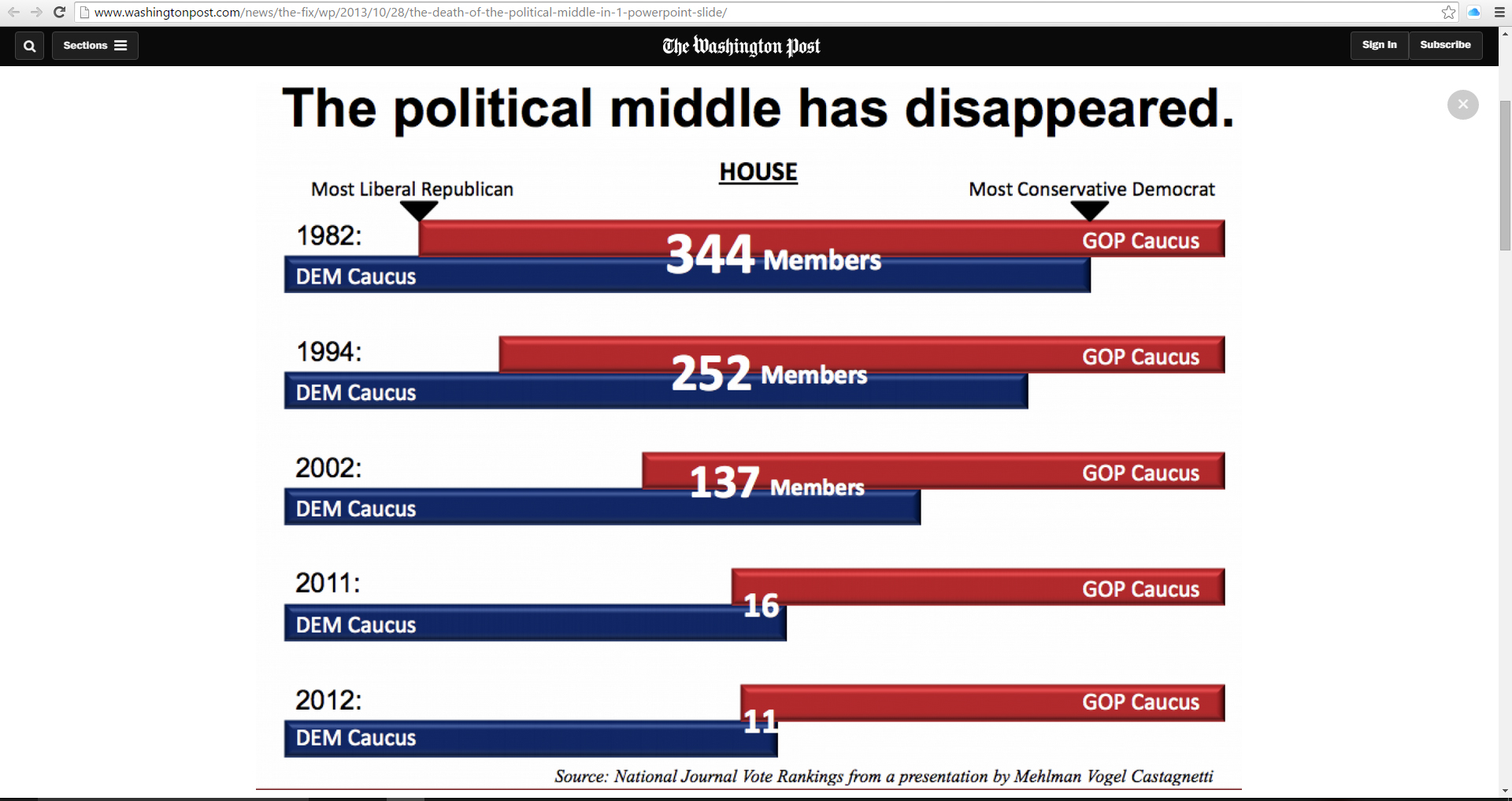
Death of the Political MiddleA friend shared this graphic about the U.S. House of Representatives and I have to say that although I was not surprised, I was disheartened. This was simply the confirmation of what I had intuited had happened in our federal government. I can guess what the same analysis would look like on a statehouse-by-statehouse level as well, given the nature of the bills introduced (and perhaps more importantly not introduced), and it isn’t pretty either.

A social scientist by training, however, I would show the same “picture” in a different way, however—as a shift from what approximated the “normal” curve to its inverse, which looks more like a “U.” And I would have reversed the picture horizontally, to reflect what we think of as “right” and “left” in political terms. Here is a pictorial representation of the normal bell curve.

normal curve with standard deviationsIn 1994, for instance, the composition of the U.S. House of Representatives looked more like this, with the most liberal Republican out near the +1 point (to the right) and the most conservative Democrat out near the -1 point (to the left). In the vernacular of the standard deviations of the normal curve, this means that the views of the representatives, irrespective of political party affiliation, fell in between. In another way of putting it, 68.2% of the representatives fell into what might be described as the “political middle.”

The rest of the crowd–namely the far-left Democrats and the hard right-wing Republicans made up the remaining 32.8%–16.4% toward the left fringe, 16.4% toward the right fringe. With influence from both fringes, the middle 68.2% found plenty of ground on which to agree, and we could depend on reason to intervene and do the hard work of ensuring that the general point of agreements, the bills introduced, included caveats that did not heavily favor one side over the other. To find a consensus and move forward, the job was relatively easy–each bill had to include as much protection for the realistic concerns of those who disagreed, whose positions fell on either side of the midpoint. There was, for the most part, respect, a fair hearing of the other perspective and dialogue and negotiation so that the result was as much of a win as possible for both sides. Those toward the middle kept the extremists on either side under control. The challenge then was the working out the details of how to handle those extraneous points of disagreement. What followed was the need to watch after implementation to make sure that the predicted positive impact expected was what was happening and to correct unintended negative consequences. Governing is project proposal and project management, theoretically approved or disapproved by the nation’s shareholders–the people.

inverted normal curve with standard deviations

Now, the U.S. House looks like this. The challenge now to productivity is that the central question being asked by both sides isn’t even the same. The abortion issue is a case in point. The question for wise people to work to answer as best they can is, “How can we honor life to the utmost as early as possible while preserving the personal liberty and opportunity guaranteed by our 1st Amendment to adult citizens?”

But no. Instead, there is the attempt to paint those who are pro-choice as anti-life as if those positions were the same, with no regard at all for the question of personal freedom and choice that is front and center when it comes to guns. And the reverse is true as well. I’m still waiting for those on the side of choice to stand up and acknowledge the evil perpetrated in the Pennsylvania abortion clinic once run by the infamous Kermit Gosnell. (If you don’t know what I’m talking about, my point is made. Google it. But be prepared. It is NOT pretty.)

You can’t work out extraneous points of disagreement when there is no basic agreement in the first place to anchor the conversation around. There must be middle ground, hem and haw, ying and yang, forward progress together in a beneficial way for all of us. The focus must be one of “both, and” and not “either, or” because if there’s one thing we know for sure, the product of the dialogue of the diverse, especially of diverse opinions on issues that affect all of us directly or indirectly, is far better than that of one side or the other alone. In plain English, two heads are better than one–especially when the heads have different perspectives and ideas to contribute that the other side wouldn’t have been able to see in a million years.

Abraham Lincoln said, “A house divided against itself cannot stand,” and we did our damndest to prove him right 150 years ago. We’re still struggling with that same ill-advised perspective, the one in which no agreement was come to about the equal value of human life irrespective of color or any other personal characteristic. We’ve given voice to those on the fringe who believe that the solution to division is easy—that all you have to do is just destroy those who disagree with you—wipe them or their influence out, either through slander, libel, humiliation, or prison—if not literal murder. Thou shalt not bear false witness, says one of the Ten Commandments (or categories, as they Jews who started this actually think of them).

Inconveniently for those false-prophet-following Christians who’ve never bothered to actually read the Bible for themselves, Jesus himself was the person from whom President Lincoln borrowed the phrase. Matthew 12:25, for your reference: “And knowing their thoughts He said to them, “Any kingdom divided against itself is laid waste; and any city or house divided against itself shall not stand.” The “them” he referred to were the Pharisees who suggested that it was through Satan’s power that Jesus had healed a man. (Sounds a lot like some quick to invoke Hitler in reference to the President if you ask me.)

I would point out, too, that some 40 years after Jesus was crucified, his words came to fruition. One faction of Jews maintained that force was the way to overturn the Roman rule, while another—notably the followers of Jesus—understood that love and kindness was the only force that could not be overcome. The clash of these two divisions, ruled by those who favored force, ended in the destruction of the temple in Jerusalem, and a diaspora of Jews that would send the whole lot into the farthest corners of the earth until 1948. We should take note of that. The Hebrews had been around a much longer time than we Americans have, and it didn’t help them a bit.

We are in a dangerous place, indeed, except for the fact that for now, the people—us—have the ability to remove from office those snakes who are creating and sustaining the divide, all with the power of our votes. Despite what the media and the political operatives would have us think, I still believe that the majority of citizens of the U.S. still look like that normal curve when it comes to their willingness to find and live according to that middle ground. But we have to move and we have to move now.

So, I ask you to join me in the next year in doing a lot of listening and not so much talking. No matter which political party you lean toward from the center, listen to what the candidates say. Pay attention to the “true colors” that reveal themselves. Be prepared to vote them out of office, even if it means voting across the party lines. Whether they’re talking about the primaries or their opponents in the general election, when you hear them bash, not the ideas of the others about how to achieve what we need to, but the others themselves, mark them off your list, once and for all. Hold their feet to the fire, because if they’ll screw those they’re supposed to agree with, they’ll screw you too. All you have to do is accidentally end up with an opinion on the other end of an inverted normal curve.

A house divided against itself cannot stand. Mark my words. And then again, don’t mark my words. Mark Jesus’s words. And Lincoln’s. Because an American diaspora is not inconceivable. And for this once-proud-to-be-an-American, Ireland is suddenly looking better and better.

We can do this.

Miracles and Grace

10 Jul

I read an article this morning in The State, the newspaper in Columbia, S.C., describing the process of how the Confederate flag came finally to be removed from the Statehouse complex there in the South Carolina capital. Speaker of the S.C. House Jay Lucas, incidentally in the role because of the indictment and conviction of his predecessor for fraudulent use of campaign funds, was quoted as saying that passing the bill in only one day was “miraculous and a testimony to the House.”

The removal of the flag from the government complex is symbolic of a first step, but only a first step, in repairing—no, check that—a first step toward establishing for the first time in South Carolina’s history the long overdue respectful and mutually-beneficial public discourse that befits a state in a nation that claims to protect the liberties of all its citizens.

But Speaker Lucas is wrong. Saying that it was a “testimony to the House” is tantamount to patting someone on the back for actually doing the bare minimums of a job he contracted to do.

I was discouraged, also, by the audacity of some of the House members asking for “grace,” which translated to ensuring a place of honor for the flag itself. I was thankful, though, that, in the article, the writer had encased the word in quotes, as I do here.

Lucas was right in calling the feat “miraculous” and there is most definitely a place for the word “grace” in this conversation, but neither word applies to actions of the members of the South Carolina House or even the Senate. There should be no attempt for those who have finally done the thing they should have done myriad times before to claim accolades for themselves. It pollutes the very air around the event. No, it was the grace of the families of the Mother Emanuel 9, indeed, spawned by the grace of the nine murdered individuals themselves that brought this “miracle,” the unhardening of hearts, about.

From the day of the public expression of forgiveness of the cold-blooded murder of their loved ones, I have been thinking of St. Paul. I have always thought it a failure in the Christian churches in which I have worshiped not to spend more time in contemplation of his conversion. Here was a young man brought up in his “church,” a member not of the wealthy majority political party in the Sanhedrin, but their rivals, the upper middle class Pharisees. Young Saul, as he’d been known then, had assumed the mantle of vigilante, representing the Pharisees’ condemnation of those Jews who had proclaimed allegiance to the words of the Rabbi Jesus. He had stood by, holding the extra clothes of those compatriots who stoned a gentle man to death who reminded them—all the while he was dying—of the history of their faith, the giants of their heritage, and the goodness of the God they all supposedly worshiped.

I can guess that the hairline crack appeared in Saul’s reserve that day, that the pricking of his conscience—the rising up of the truth from behind practiced years of denial—began then, else we wouldn’t know that story in particular. In the Book of Acts, where the story is told, what follows as a bookend on the other side of a mention of St. Philip’s ministry, is the story of the Damascus Road, the beginning of epiphany for the man handpicked by God to deliver the message to the Gentiles, those ancestors from which the majority of us Americans are descended. Without him, we might never have known the story of Jesus at all.

But it doesn’t stop there, in my opinion. The coup de grace (notice the word) came later, when, blinded by the light he had seen, Saul was sitting, shaken, in Damascus, not sure at all of what had happened to him. It was when Ananias, who, knowing full well that Saul and his band had been terrorizing those like him and Stephen and the others the apostles had ordained, obeyed the instruction of the Holy Spirit and went to him. It was when, knowing that Saul’s betrayal of the very men he had faithfully represented had sealed his fate, the community of believers protected him, ensuring his safe passage from Damascus, that the rest of his denial fell away.

Now renamed, it was as if Paul had been reborn. And it had been at the hands of grace. Nothing more, nothing less. He knew he was guilty as an accessory to murder of innocent men. He knew that he deserved nothing less than death himself, according to the dictates of the Commandments he had grown up studying. He accepted the responsibility of that, would live the rest of his life knowing he was stained with the blood of men who had done nothing at all to him—especially the fellow who’d started it all by walking peacefully, unresistingly, forgivingly, to his death at the hands of the Sanhedrin.

It has been said that mercy is not getting what we deserve and grace is getting what we don’t deserve. I am inclined to agree. Those of us who both cracked the whips and those of us who stood by holding their clothes and said nothing deserve nothing. No credit for suddenly coming to our senses, having the scales fall from our eyes, and then doing the right thing. The flag should remain in prominence somewhere—if it is a reminder of heritage, it is a heritage that will never be unstained by the wickedness of man’s inhumanity to man. It will not stop it, but keeping it in front of our eyes will, perhaps, slow it down.

Throughout history, it has never been war, conquest, violence that has changed the world. It has always been grace. We saw its effect in Gov. Nikki Haley’s eyes on June 22 as she called for the flag to be removed. We heard it in Sen. Lindsey Graham’s explanation of the change in his position on the flying of the Confederate flag at the state’s capitol. We witnessed it in the emotional words of S.C. Rep. Jenny Horne, a descendant of Jefferson Davis, the president of the Confederacy himself, in the halls of the South Carolina House. Grace that began in the forgiveness of a misguided young man like Saul.

Amazing grace, how sweet the sound that saved a wretch like me.

“True” Christians

7 Apr

One of the stories wafting around the internet in the past week or so is the allegation that a Dublin, Georgia teacher told some member or members of her classroom that a “true” Christian wouldn’t vote for Obama since on her authority (or some website’s she defended when a parent-teacher conference was called) Obama isn’t a Christian (and by default, shouldn’t be the President of the United States despite the Establishment Clause she obviously didn’t understand when she took high school civics–assuming she passed).

It’s an allegation, yes, but I don’t have a problem believing it. I’ve been hearing such for over 50 years. My sister was told no “true” Christian would vote for Bill Clinton back in 1992, and before that being a “true” Christian was an excuse for not integrating schools. You know, it was God’s will to keep the races separate. No “true” Christian would go against a teaching as obvious as that, despite the fact that there’s nothing obvious about it at all.

“True” Christians, by my estimation, would be those who pay attention to what Christ said first, understanding even the Old Testament through the lens of a man who, if nothing else, stood on the premise that loving others–even if you’ve drunk the Koolaid that convinces you that you know the life history and circumstances of the woman in front of you in the grocery line paying with food stamps–is the only requirement for following him. Absent love, as St. Paul would later say, calling yourself a Christian and suggesting that you and you only are a “true” Christian on the basis of a voter choice is just a lot of loud noise. I think it more–namely, I think the lack of humility demonstrated by anyone who would presume they know what a “true” Christian is and are entitled to disseminate that information has taken the Lord’s name in vain. Which, in case you don’t know, is a much more serious offense.

Today a couple of days past Easter, I was thinking about the fact that the only time we know of that Jesus’s anger got the best of him was when he encountered the people in the outer courts of the temple in Jerusalem who were blocking access to the inner sanctum and profiting by it. You know, the moneychangers — the ones who were selling doves for those who couldn’t afford lambs that were to be sacrificed by some religious leader (and not themselves) and suggesting that the poor couldn’t possibly be “true” Jews because they hadn’t worked hard enough in their opinions, I guess, to merit an audience with God.

I thought about the fact that I’ve never had a problem with the concept of democracy and its parallel with Jesus’s message of the equality of people before God and the importance of people over made-up rules that protect no one except the rule-makers themselves, because they both honor the value of individual human beings irrespective of circumstance. And I thought about voting and healthcare and religious freedom and the gay-marriage controversy and “my right to an AK-47 trumps your child’s safety” and I decided that if Jesus were here and his kingdom were of this world instead of the spiritual one over which he claimed kingship, he’d be pretty pissed off about now.

But it wouldn’t be at the voters who may be denied access to vote–the inalienable right of a citizen in a democracy. Wouldn’t be at the people who couldn’t even afford a healthcare “dove” or the people who commit to each other to love and cherish each other above all others despite having the same private parts. And certainly, the guy who restored an ear Peter cut off just before running and hiding and denying he even knew Jesus wouldn’t look very kindly at someone who suggests his alleged right to own whatever weapon he wants supersedes respect for the logic and reason God gave us all. No, Jesus wouldn’t be mad at those people, and he would remind us that “true” love is demonstrated in laying down not only one’s life, but one’s demands and desires, if the inalienable rights of others are being shortchanged.

They asked Jesus how to tell the difference between false prophets and “true” ones, and his answer was clear. By the fruit of their labor. And if the fruit of the labor diminished and denied rather than encouraging, supporting and honoring the lives of all those around them, irrespective of their differing look or opinion, the Jesus I’ve read about over and over would more likely assign the phrase “false prophet.” That’s certainly who those religious leaders were whose tables got turned over. And they were the same ones who got so indignant, so angry about the possibility that if Jesus were really the king their power over the masses would be less strangling and their daily bread not so lavish, that they made up stories about him and convinced the Romans that he was a danger to them.

Down through the ages, “true” Christians most often ended up dead for the very same reasons Jesus did, and he predicted it. “True” Christians didn’t keep any of their income, such as it was. “True” Christians got eaten by lions, murdered by gladiators in front of adoring crowds. A good old middle-class wannabe Christian told Jesus he was ready to follow him and Jesus responded that he should look closely at him before he said it in earnest, reminding him that “the Son of Man had nowhere to lay his head.” I doubt who the guy voted for would’ve even entered the picture.

So, if you’re inclined to announce that anyone other than yourself isn’t a “true” Christian, if I were you, I would take pause, and remember that fruit of the labor thing. And I would contemplate just whose table Jesus would go for the next time.

Duke, Basketball, and Muslim Calls to Prayer

17 Jan

I grew up in the 60’s and 70’s in a small Southern town in southcentral Georgia where, as is true in many Southern towns, the Baptists and Methodists substantially outnumbered members of other Christian denominations, not to mention those of other faith traditions. Born into a Southern Baptist family myself, it would be a few years before I realized other traditions even existed, much less thought about what it might feel like to walk in the shoes of people whose spiritual journey was different, but as intrinsic to who they were as mine is to me.

But I would realize it and think about it, and the reason was basketball.

The catalyst for me was the delayed implementation of the Supreme Court decision in the Madalyn Murray O’Hair case ten years before, which prohibited official prayer and Bible-reading in public schools. Unlike some recent ones, that Supreme Court’s decision was one that, though I continued to be devoutly Christian, I agreed with and agree with still.

I liken my transformation to the reaction of Timothy Buskirk’s character in the movie Field of Dreams at the end of the movie when suddenly, after being completely unable to see the “baseball” men, and on the verge of buying the note on his sister and brother-in-law’s farm because he didn’t agree with the fact that they’d built a baseball field in the middle of their corn crop, the scales had fallen from his eyes.

Part of the change had to do with the fact that a couple of my friends and I had started a group at our high school that met every morning to pray before school, and no police or governmental official had said a thing about it. In fact, the principal had given us the library to meet in. We even had our picture in the yearbook, along with the other organizations. What happened is that the old “they’re trying to keep prayer out of schools” routine that’s still parroted today by many who didn’t give a tinker’s damn about prayer of any kind when they were in school…fell flat. If that was the intent of “they,” they sure came up short. Besides, Jesus said he would be there when two or three gathered in His name, not when their school made them sit through an invocation or in the moments before a football game.

The other reason was that some of my best friends from elementary school on turned out to be Jewish. Another couple of friends were Roman Catholic, which in a time not long after people had been concerned about the possibility that JFK would yield to the Pope instead of the Constitution, put them in a what must have been a quandary of sorts as well. Several of them were my cohorts on the girl’s basketball team.

I got to thinking during the “Christmas” holidays that year about what it had been like for those Jewish kids. I knew they probably hadn’t minded the time off from school, but I wondered how it had felt to them to be kids and not really understand why they didn’t get to leave milk and cookies for a jolly fat man in a red suit named after a saint (which we didn’t have in the Baptist church, but no matter) who supposedly delivered gifts to kids all over the world, but only Christian kids. (On another note, where the Catholics were concerned, I wondered about something called mass and something called Lent and having ashes put on your forehead and communion services where they actually served baked bread and wine in a cup and not saltines and grape juice in little tiny glasses.)

I came to the conclusion that the spiritual beliefs of every girl on our team, whatever they happened to be, were as meaningful to her as mine were to me, and that our abilities to play basketball together made the fact that we were Jewish and Catholic and Methodist and Baptist—and even Hindu or Muslim, if there were any I didn’t know about—a lot more interesting, and I was always curious. It bothered me, though I doubt I ever said anything about it then, that we NEVER played basketball on Sunday, because it was the Sabbath, but Friday and Saturday were okay, despite the fact that the Jewish Sabbath starts on Friday night. No matter what, however, come Monday we were back on the court together, jumping rope, running “suicide” drills, doing “ape drills,” shooting foul shots, running laps, all manner of things that made us so sore that students could easily tell who was on the basketball team the next day if they were paying attention.

It was those experiences—the wins, the losses, even the soreness we shared that mattered to us, not the things that were different about us. To do anything that in any way suggested that one of those things that made us different made one of us superior—especially our faith traditions or lack of them—wasn’t just dis-unifying. It was ill-advised. It was ignorant. It was wrong. It still is.

We were kids—American girls who just happened to also be Jewish and Catholic and Methodist and Baptist, and when we stood and put our hands over our hearts and said the Pledge of Allegiance, we weren’t pledging allegiance to the Christian United States of America or the Jewish or the Muslim. We were pledging allegiance to a country that’s by no means perfect, but holds, as one of its ideals, respect for every citizen—not the superiority of one over the other on any basis except behavior. That’s the whole point of the separation of church and state. It’s the reason we haven’t turned into Syria or Iraq…at least so far.

When I first heard of Duke University’s decision to do a public Muslim call to prayer, the powers that be had already reversed the decision. And I was frankly glad to hear it. I was equally glad to learn that a Muslim group had been meeting and praying in the basement of the chapel for some time and would continue to, just as our little group in high school did for a few more years even after I was gone. Despite the fact that the school had the good intention to attempt to “unify” students, it was a bad idea. Unless the plan was to alternate between faith traditions every day, which would take about nine years for the 2,500 or so that exist in the U.S., the best solution was not to do it at all, just as the Supreme Court said back in 1963, and let the people who choose to pray together pray together. (See above.)

Then I heard that Franklin Graham had called for Christian donors to hold back their gifts if the school didn’t reverse the decision, and I wondered if we would have heard even a peep from Billy Graham’s illustrious son if the school’s decision had been instead to read a New Testament passage. And I’m pretty sure, based on other of Mr. Graham’s actions, that I know the answer to that question, and it makes me as sad today as thinking about Jewish kids on Christmas did in 1973.

Despite all, though, I still have faith in the truly marvelous things we can do together if we just stop and show honor to the unique experiences of others, but we obviously still have quite a way to go. To earn respect, you have to give it. And until we manage as a so-called “civil” society to figure that out, I think that if Duke really wants to “unify” students, it should go back to focusing on basketball.

After all, it worked wonders for me.

V

Ignorance of Our Ignorance

28 Nov

I was a math major before I changed my major to psychology, which makes it somewhat understandable that I was attracted to the study of statistics and their use (and misuse). That interest and the relative expertise I gained in the scientific method and its use in the social sciences has brought me a lot of joy, actually, as it continues to broaden my understanding of human nature and its impact on everything from perception to what we read, what we buy and ideas about why. It, unfortunately, has brought me a lot of pain and frustration as well, having now watched through the years how often statistics have been used to manipulate the general population to achieve an end that sometimes benefits and sometimes diminishes the lives of the very same people who fall prey to the manipulation in their ignorance.

I’m not sure if it upsets me more when politicians malign groups of their own constituents with meaningless statistics that are irrelevant to any honest attempt at improving their lives or the effect of unscrupulous marketing people whose primary focus is getting people to buy things on false pretenses or the astounding hubris of those who create the unending domino game of ignorance, posting incendiary garbage that no one seems to bother to question. It leaves me in a constant quandary of trying to figure out what’s driving the behavior, since the only way to stop something is to understand what motivates it, what the payback is, as Dr. Phil says. Is it ignorance or narcissism or sheer obliviousness to the connections between the fates of those outside our circles and those of our own fates? Most of the time I end up deciding that it doesn’t really matter—the results will be the same either way. And they won’t be good for anyone except a few unless we begin to focus on what we don’t know instead of what we think we know. The only thing more potentially damaging to our country than not knowing what we don’t know is not knowing THAT we don’t know in the first place.

For example, in a political poll, suppose that it is reported that 70% of women are in favor of or disapprove of X. (Fill in the blanks with your own X.) That’s a fact, based on a single snapshot, a single question asked in a single period from a hopefully random group of women—random because if you ask too many people within a group of people like Republican women or black women or women who’ve had an abortion or women who make over a certain amount of money, the answers cannot be extrapolated beyond that group. The statistics don’t reflect the wisdom or the rightness or the reality of the subject at hand—only opinions. And not only that, opinions derived from as many unique experiences and beliefs as there are women who share the view.

Then there’s the problem of the 30% who, for whatever reasons, don’t agree. And the rather obvious fact, if you think about it, that if you walk down any street and meet a woman you have never seen before, you could no more tell whether she’s in the 70% or the 30% than you can predict the weather next year on your birthday. And though some of you may want to argue the point to further some esoteric agenda, to say otherwise only proves that you fall in that narcissistic group mentioned above—those to whom it has never occurred there exist equally valid opinions other than theirs.

Statistics do not prove cause and effect—never have, never will. Just because 70% of women believe in a certain way does not provide any information about why they believe in that way or what they will do (or not do) because of their belief. Statistics show correlations, relationships between two variables—in this case that there seems to be a strong likelihood that if you are female, you will feel this way about X. Predictive probabilities, but not explanations for anything.

So, what good are statistics then? They’re invaluable in saving time, in benchmarking change, in understanding if the actions we take move us toward achieving goals or not. They help us predict results based on probabilities, and suggest pathways for further examination. If I give you a valid and reliable psychological test, the items for which are included based on statistics, I have clues to how best to help you, clues to how well you will perform in a given job, clues to whether or not you’ll succeed in college. And if I meet you on the street, I have some data—albeit unconscious—that may help me protect myself. If the statistics suggest that most murders occur at night, the fact that some don’t shouldn’t stop me from keeping an eye out when I venture out in the night to go to the grocery store alone. But that doesn’t mean the guy in the parking lot is out to get me, either.

What we get from statistics are only ever clues. No definitive diagnoses. No pigeonholes. No guarantees. No certainties. And thankfully so. If statistics provided end-all answers, there would be nothing further to investigate. If we were robots programmed only to act in a certain way, this would be one boring place—made up of nothing but Stepford know-it-alls. Ignorant, oblivious know-it-alls.

But we aren’t all Stepford know-it-alls, statistically speaking. And those of us who aren’t can repair our faults. But we have to recognize them as faults. And the fault we must repair first is the narcissistic belief that we know the truth about anyone but ourselves, and even that is questionable.

We must repair the ignorance of our ignorance.

The Wisdom of Fences

15 Jul


Twelve years ago, I wrote and published a book of my own called Simon Says: Views from a Higher Perspective, a set of essays “dictated” by my Siamese cat, Simon. Through the years, readers have communicated with me about particular ones that resonated with them, sometimes in ways that I did not—and could not—have predicted. I recently updated the eBook version, adding a couple of new essays left out of the original, and had occasion to re-read what Simon had said. To my surprise, even I came away from some of them with different or broader ideas from those that stimulated my writing them in the first place.

This one, On Fences, which was originally focused on the importance of limit-setting for parents, set me thinking about the ideal purpose and need for “laws,” both in the secular space of democracy and the sacred space of spiritual and emotional health. “Murphy” in the story is Simon’s “brother,” a domestic shorthair. “M” is me.

on dignity 155x115

When we moved from our old neighborhood to a new house, M had a fence installed in the back yard before she would let Murphy and me outside. Whereas our old house had been way back in the subdivision, our new one was next to a very busy street.

Feeling that his freedom was being restricted, Murphy was quite upset when he discovered the fence. No matter how much he protested, however, M wouldn’t budge.

Murphy was still a young tom, with limited knowledge of the dangers of a busy street, and he just didn’t understand. He looked for holes in the fence and tried more than once to jump over it. Fortunately, M had paid for solid workmanship.

After months of frustration, Murphy learned that the limit to his exploration wasn’t going away, so he accepted the limitation and made the best of it. He played while I watched from the patio chair. Life was good.

Then one day M forgot that the yard maintenance crew was coming and left Murphy outside when she went to work. When the crew left, they accidentally left the gate open, and M saw it as she pulled her car into the driveway.

I knew she was upset because she left her purse in the car and the door open, and walked through the front yard, calling Murphy’s name. She was frightened that Murphy had gone into the street and been injured in some way.

But he hadn’t. As she rounded the house on the gate side, she saw him sitting just inside the fence. She cried a little when she picked him up and hugged him to her chest. I’m not sure why.

Later, I asked Murphy why he hadn’t gone out when he had the chance. Pensive, he told me that he HAD gone through the gate into the front yard, and had seen the rapidly moving vehicles.

“They were pretty scary,” he said, “and after I thought about it, I knew why M put up the fence. She wasn’t just keeping us in…she was keeping us safe.”

M didn’t know it, but at that moment, Murphy no longer needed the actual fence. He had built his own “fence” inside, one which I knew would keep him safe even when M and I are gone.

I thought about the whole progression of events, from the building of the fence to Murphy’s growing up, and I came to a conclusion that I know is true.

A wise parent knows when to build fences and when to open the gate.


It isn’t just the wise parent who knows when to build fences and when to open the gate. It’s the wise person in any position granted authority to govern others, especially those in political office who have been elected to represent the interests of each and every citizen within their jurisdiction, irrespective of whether those citizens voted for them or not. It’s the wise person appointed to the highest court of the land. It’s the wise person who runs a company, too.

But I still maintain that the person whose wisdom is more important than all is the parent, because the wisdom of all the others depends on it.

If I had to choose the most important responsibility of parents it would be to devise fences—“laws,” “rules of behavior” that exist in the home—that are broad enough to allow freedom for the emerging selves inside to develop to their maximum potentials yet provide realistic guidelines for living in a civil society where the fence not only protects that tender self, but the tender selves on the other side of the fence.

In psychological parlance, fences are called boundaries, synonymous with property lines detailed in titles. In political parlance, fences are called laws. In religious parlance, they’re doctrines. But no matter what, the same ideals apply in all cases. The purpose of fences is, as Murphy learned in the story, dual. In addition to protecting the authority of the person inside the fence over what happens inside the fence from assault from the other side, it protects those outside the fence from the same intrusion, intentional or otherwise, from us. Where one fence ends, another begins—and that’s true no matter which side of a fence one is on.

Perhaps it’s because I’ve been a psychologist almost as long as I’ve been a Christian, but I see virtually everything that Jesus said or did as relating to one side or the other of the fence. If Jesus talked about anything, he talked about pumping up and respecting the soul-self inside the fence and the boundary that restricted behavior in relation to those on the other side.

The kingdom of heaven to me is simple in concept, but obviously excruciatingly difficult in practice. It is a “kingdom” in which every self inside his or her fence is fully and constantly aware of God’s unconditional, unchanging love for him or her irrespective of the noise or behavior exhibited by events and people outside the fence. It is a “kingdom” in which that loved self also recognizes and respects the boundary that exists between him- or herself and the other selves who are unconditionally, and unchangingly loved by God in equal measure. It is a “kingdom” where the application of boundaries is so well-ingrained that all energies are devoted to the raising up of the citizenry as a whole. If you can expect your fences to go unmolested without constant patrol, you can join together with others and create much more wonderful things.

Jesus said he came to fulfill the law and the prophets, and then quoted two simple commandments. Love God (which by the commutative property of addition means to love Love) and love your neighbor as yourself. I can’t think of a more complete set of laws, simply because abiding by those two alone relieves any worry of breaking the rest, whether we’re talking about the “big ten” or the 600+ rules made up by the ancient Hebrews. The most tangible manifestation of love is the respecting of boundaries, especially when the thoughts and beliefs of the person on the other side of the fence vary significantly from yours. If you love your neighbor, defined as anyone else whose yard exists outside yours, you won’t kill him, you won’t covet his wife or her husband or her lawnmower or her children. You’ll honor your father and mother, who ideally are two more separate people whose authority, once their children are adults, recedes to include only the area inside their own fences, not by deferring forever to their will, but by becoming the most fully creative human you can.

Unfortunately, where the fences actually “should” be varies according to where one is standing. And also unfortunately, the “belief” of a majority has nothing to do with the reality of where a fence should be or the amount of force that one should or can exert on the fence from either side. Jesus knew that, I think, else when asked by the disciples if he would teach them to pray, the part about forgiving trespasses comes pretty early. And what exactly is a trespass? It’s crossing a property line uninvited.

I am convinced that if we could get this one concept down, the kingdom of heaven would materialize right in front of us. But making more laws in an attempt to control someone else’s behavior just because you think it a bad idea or that you know where the line should be better than the person whose fence it is in the first place—especially if his fence doesn’t back up to yours—isn’t going to bring it about. Bringing the kingdom of heaven about relates more to what Simon said about Murphy, that he no longer needed the fence because he had his own fence inside. It is learning what it means to love oneself and each other by learning what it means to self-govern and asking forgiveness when we overstep our boundaries.

Forgive us our trespasses, as we forgive others who trespass against us.

Vally

P.S. If you’re interested at all in reading other things Simon said and you have a Kindle or Kindle app, click here: Simon Says: Views from a Higher Perspective.

I have a few copies of the printed hardcover book, too. If you’d like an autographed copy, click here to email me.

On the Way to Untangling the Knots in My Earbuds

6 Jul

I went to the gym late Monday, all the while thinking about the unGodly lack of wisdom displayed by the Supreme Court ruling on the Hobby Lobby case. In less than a few hours, I’d already gotten into two “fights,” one each with people about different facets of the argument and the tactics used in “debating” the issue.

Notably, the focus of the two arguments was not the same. So it is with virtually everything discussed in the political realm these days. “Pro-lifers” argue over the definition of when life begins; “Pro-choicers” argue over where the boundary that defines where the authority of one person or group ends with respect to another in a “free” society. “Liberals” argue for the precedence of that which has impact on the inalienable rights of human beings; “Conservatives” argue for the precedence of limited government over “big” government, irrespective of its impact on human beings. Both argue into an empty space where no one is listening. No discussion on either side considers and addresses the legitimate concerns of both. Instead, finding out who can shout the loudest about how evil or ignorant those on one side or the other are or who’s most to blame for what ails us is the strategy of the day. No resolution—just polarization—can come about. And here we are.

I can’t say how many times in the past decade or more that I’ve thought of the fable of the six blind men asked to describe an elephant. One said the elephant was like a wall, another a spear, still another a fan. They had each, of course, encountered a different part of the elephant, but were blind, both literally and figuratively, to the discoveries of the other five. The argument that ensued was vicious. One thing was clear — the original goal of accurately describing the elephant had been left in the dust.

A poem, based on the old Hindu story and written by John Godfrey Saxe in the mid-1800s, ends thus:

And so these men of Indostan
Disputed loud and long,
Each in his own opinion
Exceeding stiff and strong,
Though each was partly in the right,
And all were in the wrong!

In the aftermath not described in the story or the poem, chances are that each became increasingly recalcitrant in defending their individual positions, perhaps calling each other, in modern-day parlance, dastardly epithets that elicit the beating of chests and the bravado of rulings on “our side,” whatever that side happens to be—raising the opinions of their blind observations to the level of God’s authority while loudly likening those of other groups to Satanic utterings.

In the midst of all of the chaos in my brain, I stepped onto a treadmill and reached into my bag to get my earbuds and iPod. I listen to a playlist of music I like when I walk, varying the speed of my steps with the beat of the music. I do this for two reasons, one because I have never enjoyed walking for walking’s sake. It quickly becomes too monotonous to me and I need a distraction. It’s the “spoonful of sugar that makes the medicine go down.” The other reason is that I avoid watching any of the array of televisions the Y has made available—democratically tuned in to CNN, Fox News, ESPN, a local channel, and HGTV—unless the U.S. Open or Wimbledon or the World Cup or some other sporting event I care about is on ESPN. I generally hang on to one set of the bars to keep my balance, and close my eyes.

But this time, when I pulled out my earbuds, they were snarled. I’d been in a hurry to get somewhere the last time I’d gone to the gym and stuffed them into a pocket. I stood there on an unmoving treadmill for several minutes, undoing the knots, unthreading this strand of cable from that tangle. Sometimes, I’d pull one of the buds through a hole I’d created only to discover that I’d made another knot somewhere else. I got more and more frustrated, until it occurred to me that I was dealing with a tangible example of exactly where we are with respect to the issues we face, except that the “American way” is for one group to untie its knot, with no concern whatsoever for the knots created somewhere else—largely because we seem at best, like the men of Indostan, oblivious to the very existence of other views, based on other experiences, or at worst, have become narcissistic caricatures, who are not only oblivious, but wouldn’t give a damn if a bomb went off in front of them as long as none of the shrapnel touched them. What WE see and what WE believe is all there is, and if you describe something else that stirs the possibility of some negative impact or egocentric leanings of our views, you are the scum of the earth. “You’ll rue the day you changed that filibuster rule,” said the Republican senators. What hangs in the air is the unspoken end of that sentence—“because if we can regain the advantage, we’re gonna stick it to you, just as you stuck it to us.” Never mind what the issue is – we’re gonna get even. It is both the figurative and literal blind leading the blind, adolescents playing football with the lives of the millions outside the fence. And now the Supreme Court has joined the game.

I considered leaving some of the knots and just going ahead with plugging in my earbuds. But I discovered quickly that, in order to fulfill the greater purpose—that of my recent decision to improve my health—I would have to do the work to untangle all the knots and not just some. Unless I did, the cords weren’t long enough to reach the iPod in its cubbyhole…and my ears at the same time. Yes, I could’ve walked without the music, but I live in America, where I’d always been free to choose the path I took as long as it didn’t affect anyone else in a material way. Or so I thought.

So, I took a deep breath and spent the time necessary to investigate all the knots and their interrelationships and untangle each of them while examining how different approaches would affect the tangles in other places. In every instance, the best approach turned out to be tracing the cords to their original tangles. And to my pleasure, what I discovered was that when I did that, most of the other knots disappeared as a matter of course.

The moral of the story, of course, is that I had to remember the reason I’d gone to the gym in the first place. And only then could I begin to determine how to smooth the path to fulfilling that purpose by sucking it up and carefully, cautiously examining the mess, taking time to sort out the knots, trace them to their origins, and also devise a plan to increase the likelihood that the mess I’d created this time wouldn’t happen again.

Or, as we seem so prone to do these days, I could’ve just thrown the earbuds across the room, stomped out of the gym, and sued the manufacturer of the mess, neglecting the reason I was there in the first place. Which was not a good idea, if I was honest with myself, because the manufacturer of the mess, whether I’d done it blindly or with intent, was me.

Vally

P.S. Two days later, I went to the gym, pulled out the earbuds, plugged them into my iPod, and no sound came out of one. Somewhere in the fray, I’d broken the delicate wires inside the sheathing on that side. I stuffed the broken earbud in my ear anyway, and proceeded to walk, now not just “blind” but effectively deaf in one ear too. I noticed that the music wasn’t nearly as beautiful in mono, so on the way home, I stopped by Walgreen’s and picked up a new set of earbuds.

Unfortunately, America is not, despite the apparent belief of some, unbreakable. Repairing the mess we’ve made won’t be as easy as buying a new set of earbuds, no matter how much money a few of us have. And if we are so blind and deaf that we forget the primary mission of our government—that of forming a more perfect UNION, of promoting the general welfare of ALL citizens and preserving the blessings of liberty for ALL the selves who reside under the protection of the UNITED States of America, it will be impossible.

Image

On Not Knowing That We Do Not Know

8 May

Some thirty years ago, one of my roommates brought a guy she was dating to dinner at our apartment. While we were sitting around talking, one of our cats misbehaved and I popped it lightly on the nose to discourage whatever behavior it had displayed.

My roommate’s date proceeded to lecture me on how what I had done was incorrect, according to something he’d read somewhere. I elected to let him go on with his dissertation with respect to animal behavior without challenge, intentionally not revealing that for a year, I had been the graduate assistant in charge of the animal conditioning and learning lab back in college, and had taught the students under my charge about negative and positive reinforcement and punishment and supervised their training of the rats in my lab.

It was sometime later, after we’d dabbled in conversations about the weather and restaurants in Atlanta and who knows what else, that he asked me what I did for a living.

“I’m a psychotherapist,” I said. “And, in my last year of college, I was the graduate assistant in charge of the rat lab.”

“Oh,” he said, turning a slight hint of green as it dawned on him that I probably knew a lot more about training cats than he did.

At the time, I was mildly offended, but I didn’t care about his opinion of my pet management skills, and I had long since blown him off as someone to whom I would not turn for advice. I’m not inherently a mean person, so although I could have taken him down a notch or two in his self-estimated expertise in animal behavior, I didn’t.

That’s not to say that I wasn’t influenced by the exchange, however. Social scientist to the end, although I quit the explicit practice of psychology over 20 years ago, it reminds me even today of the blindness of human narcissism—the tragedy of missed opportunities for connection and the failure to show respect to others for what they’ve learned and experienced that we have not and perhaps never will. I pledged to myself that very day to do whatever it took not to discount what another had been through or what he or she knew by virtue of occupation, vocation or personal experience that I could not possibly know.

That whole line of thinking, for me, was further expanded a few years later when I left private practice and entered the corporate world. One of my specialties in private practice had been stress management counseling, which involved teaching my clients about their bodies and how to eliminate or manage physical symptoms like headache or panic attack or non-systemic high blood pressure, followed by insight psychotherapy as it related to the perceptions and thought processes that had precipitated their stress-related disorders.

As you might imagine, many of my clients described their stress-related problems as originating in the workplace. Some were entry-level people, others were middle managers, still others were executives in charge of major departments in Fortune 500 corporations. I remember having a conversation with one of the latter about conflict resolution. I “prescribed” a course of action that involved addressing a conflict he had with his superior that made perfect sense to me in the context of everyday one-on-one relationships.

He took it all in and smiled. “I can tell you’ve never worked in corporate America,” he said. I was a little taken aback.

Within only a few short months following my entry into the corporate world, I understood exactly what my client had meant. I was humbled by the fact that he had not knocked me down a notch for daring to think I knew anything about the practical application of my limited knowledge in the context of a situation I had no experience with.

The issue was that, at the time of our conversation, I had never worked in an environment where the hierarchical organizational chart defined authority and responsibility and held sway over my livelihood. Having never had to negotiate the paradox of balancing the dual yet overlapping boundaries of interpersonal vs. workplace relationships, I had no expertise in the subject. No matter how hard I might have tried or how many business management books I might have read, I could not have learned from them what I did while being an employee and later a manager. As I look back now, the massive difference between what I knew looking in from the outside before and what I would come to know once I was inside was not unlike that between looking at a photograph of Ireland and standing at the Cliffs of Moher.

Those two incidents have remained a constant reminder to me of three interrelated things:

  1. The more I know, the more I am humbled by what I don’t know and either can’t know or never will.
  2. No matter what I do know, even if it is my area of credential, there is someone else who knows something more or something different or something more valuable about that subject area in question that would benefit me. And, perhaps most importantly, that person could just as easily be the cashier at the grocery store, the immigrant roofing a house or the roommate of a friend as it could be the CEO of Microsoft or the Prime Minister of Egypt.
  3. The day I become certain that I “know” everything about anything based on the snapshot I see and show blatant disrespect for the truth those who’ve stood where I can only dream of going can teach me…will be the day I become dangerous to myself and everyone around me, especially if given a little authority.

Far too many of those we have elected to power, giving a little authority by virtue of our votes, appear either to have never known or to have forgotten these things.

And I struggle not to be afraid.