Archive by Author

The Water and Sugar are Already Here

7 Apr

My dear friend Susan Carson responded to my blog yesterday in such a powerful way that there was nothing to do except share it with you. Thanks, Susan. And Amen.

I read your latest blog post, Lemonade, with interest, because I, too, am somewhat discomfited by what seems like a glib instruction to take what you get and make something wonderful with it, regardless. Some days this seeming glibness has grated on my nerves more than others. I didn’t give it much thought until your post, because as glib as that saying might be, your post made me uncomfortable, too, for some reason, so I had to examine it a bit more closely.

What I realized is that I see something different in that phrase, at least upon careful examination. I didn’t find it to be about my ability to create anything, contrary to the basic instructional nature of “…make lemonade.” You’re right that we humans are the created, not the creator of the stuff of life, but for me the phrase speaks not to the need to wait till God provides the source for the other ingredients but that the Source is already there with us, in us. We already have the sugar and water, if you will, in that infinite Living Water, which is God’s “sweet” Grace. What we do need, as you said, is the humility and the patience to recognize them whenever and wherever we are.

As I lay in bed thinking about this last night, I thought of the discussion we’ve had in EFM about the sign of the cross we make from time to time, the vertical and the horizontal motions from forehead to heart and shoulder to shoulder, about trying to live in that center where those lines intersect. The lemons that life gives us lie on the horizontal; the water and sugar of God’s Grace in our lives are the vertical. The lemonade, if you will, is at the intersection.

Or, to use your inner/outer imagery that you spoke of in that same conversation, for me I think the lemons are “out there” in the outer circle, and the sweet water of Grace is there in your inner circle with you. When I think of it this way, that God and his grace aren’t just there behind me waiting for me to turn around and notice him (one visualization that has always spoken to me of my separation from God and my failure to notice his being there for me always) but really WITH me, through me, in me, all around me…when I truly take this in for a moment, a feeling of such complete peace washes over me, and I can be, just for that moment, refreshed and stilled in that knowledge. It doesn’t change my circumstances, and it doesn’t pay my bills or calm the rest of the family circumstances down or fix my car, but it tells me if God is with me in this place I’m at, right now, then all that stuff doesn’t matter, not in the long run. The lemonade for me is this stillness.

Lemonade on a hot day is pure heaven, a momentary relief from the humid Georgia summer’s day. Recognizing God’s presence in that intersection of daily problems and minutiae is like that, a momentary glimpse of heaven on my doorstep, a sign that if I can just put my own fears aside and wait, God will act, and he will always surprise me in the best way possible. That’s lemonade, and it’s worth waiting for.
Lemonade, That Cool Refreshing Drink

6 Apr

For some reason, I’ve always been vaguely irritated when I’ve read or heard the adage, “When life gives you lemons, make lemonade.”

Don’t get me wrong. I love lemonade, and I understand and embrace the message conveyed—be grateful; learn from the “sour” experiences in life; use those lessons you couldn’t have learned any other way to view the richness of life, in all its pain and joy.

What bothers me, I think, is the communication that I can make anything of anything. I’ve had my share of lemons—fewer than many, more than some—and though I’ve often tried very hard, when the lemons threatened to bury me, to find water and something to sweeten the concoction, I haven’t been very good at it. More than once, I’ve found what I thought was sugar and water enough to quench my thirst for the moment, only to discover that the stream from which I’d drawn the water was drainage from rain, and not the tributary of a river.

I’m not saying that we shouldn’t search for water and sugar. What I’m saying is that I’m much better off when I realize that I am incapable of creating water and sugar. I can’t “make” anything. I’m the creature, not the Creator.

It’s about trust and patience and humility—trust that “all things” really will “work together for good,” patience to allow God time, and humility at the realization that we are powerless to initiate the creation, but called to co-create with the raw materials only God can provide. No original thoughts here.

So, if you ask me, when life gives you lemons, don’t try to make anything. Pray, instead, for living water and honey, for the vision to see them in the most unexpected places, and the will to stay out of the way of their appearance.

And then call the neighbors and invite them over to your lemonade stand, and laugh out loud at their faces when they realize it’s free.

We are bold to say…

2 Apr

It was late in the afternoon and I had stepped into a dark hallway in the office building and encountered a Muslim co-worker kneeling on a prayer mat. Embarrassed at having interrupted what I considered an intimate act of worship, I tiptoed back to my office and waited another few minutes before leaving for home. I had another couple of emails to send, after all.

Later, I told a friend from church about the incident and she shook her head.

“That makes me so uncomfortable,” she said, almost angrily.

“Why?” I asked.

She shrugged. “I don’t know. It’s just so weird with the five times a day thing. And the pointing toward Mecca.”

I didn’t respond. Instead, I thought of all the times in years’ past, before I returned to the “organized” church, that I’d found myself in a restaurant and seen people at a neighboring table join hands and pray before their meal. Since then, I’ve done it a few times myself, but I’ve been aware of the discomfort of some around me–people I know I’ve seen in church.

In every Christian church I know of, the Lord’s Prayer is a mainstay. “Thy will be done on earth as it is in heaven,” we repeat every Sunday. In the Episcopal church, we’re even “bold” to say it.

Apparently not enough to say it unless we’re standing in a gothic cathedral or a prayer group. Not as bold as that Muslim fellow I saw, who five times a day, knelt and prayed to Allah.

What are we afraid of? That somebody may find out we’re Christian?

Chances are pretty good, though there is no mention of it in the Gospels, that the day the disciples asked Jesus how to pray, was not on a Sunday or a Saturday. Might’ve been a Monday. I’ll bet, too, that the “Sermon on the Mount” happened on a Tuesday morning or something. Or maybe it was a “lunch and learn.” But we can’t pray boldly except on Sunday or Wednesday or in the presence of other Christians.

Can’t stop at prayer, though. Jesus didn’t command us just to pray. And he said, “Go and teach, not go and tell.” We need to do something, to be so bold as to do what Jesus told us to do. You know…oh, my gosh, look around and make sure no one sees…to be so bold as to…I don’t know, this could be tough now so get ready…LOVE our neighbors and ourselves. On Monday and Tuesday and Thursday and Friday and not just on Sunday.

It’s been at least 15 years since I stepped into that hallway. Maybe I should have asked him if I could share his mat, and knelt down right there and prayed the Lord’s Prayer alongside him. It would have been a bold thing to do.

But, I didn’t.

And yet we wonder why the message of the church today isn’t compelling.

Good Fences Make Good Neighbors

29 Mar

Everywhere I go, everything I read, it seems, ends up talking about boundaries. In earlier blogs, I’ve written about editing a novel about sexual misconduct by pastors and other spiritual leaders. That book, which is about to be released, is most assuredly about boundaries.

The concept of boundaries is a simple one, really. I think that’s because there are all kinds of them in a tangible sense—lines on the highway, fences around yards, even walls in our homes and offices. When it comes to emotional boundaries, though, things start to get fuzzy.

I’ve decided that one of the problems we humans face in this regard is related to something I learned about writing from my 11th grade English teacher. She was talking about the standard foundation of communication—and the bugaboo of sentence fragments.

"Write in complete thoughts," she said. "Don’t start sentences with ‘and’ or ‘but.’"

Another student in the class raised his hand. "But Miss Ginter, authors do it all the time in the books you have us read."

"That’s true," she replied, "but you have to understand it’s a rule and the reasons behind the rule before you can get away with breaking it."

When all is said and done, I think most boundary violations are simply the result of people not knowing where they are, or thinking they’re somewhere that they’re not. Of course, there are plenty of people who know where the boundaries should be, but choose to violate them anyway, and give the rest of us a bad name. The end result is that instead of assuming that another is ignorant of where the boundaries are (or simply hasn’t thought about it), we more quickly project onto him or her motives and intent that simply aren’t there. And go further, even, to act in vengeance or to punish them for their indiscretions without thinking.

There are daily examples of perfectly wonderful relationships destroyed over time because of boundary violations (perceived or real)—ranging from those between individuals, like parents and children or spouses or friends, to those in the workplace, those between elected leaders and their constituents, especially those between nations. John Locke once said, "Where there is no property, there is no injustice." But let you and I disagree where the property line is…well, you get the picture.

Repeated over and over, boundary violations in all sectors of life constitute abuse of the person violated and often result in tragedy. One might think boundary violations innocuous in day-to-day interactions, but they aren’t. Think about road rage, for instance. Definitely a boundary violation there. Just as in road rage, anger is ALWAYS the emotional response to a boundary violation. It’s a good signal, both for the violated and the violater, that a boundary, perceived or real, has been crossed. Emotionally mature people respond to the sign by examining their own feelings to determine where the breach occurred and alert the offender in a respectful way, if the violation is deemed to be reality-based. On the other side of the line, when anger is expressed toward us, especially unexpected anger, our responsibility is to look for ways in which we might have crossed a boundary without knowing. We can’t read each other’s minds, so defusing the unnecessary feelings around conflict requires that the offender and the offendee sit down together and talk in an atmosphere of mutual honor and respect.

Unfortunately, either none of us is especially emotionally mature or we have abdicated our responsibility in relationship to each other, or both.

That’s especially disappointing to me when I see it in my Christian brothers and sisters, because Jesus talked about boundaries all the time. In fact, I dare say that it’s all he talked about. In my way of thinking, love itself, in the way he described it in countless parables and demonstrated it with everyone he met, is about drawing the line carefully between ourselves and others while savoring the mutually shared bond of relationship as children of the Most High God. Our singular mission is to remember first the value we have to God and then to extend that esteem to everyone we meet–from family members to friends to bosses and subordinates, to the customer service rep on the phone to the President or the Pope.

The tragedy of boundary violations is not just on the side of the violated, however. If we plow through the "fences" of others, we rob them of their ability to focus, unassailed, on developing and claiming their unique gifts, of reaching the highest purpose for which God created them uniquely. But we also rob ourselves of the opportunity to receive those gifts. I wonder sometimes how much beauty we have squelched, how much love we have rendered impotent without realizing.

As the poet Robert Frost once wrote, "Good fences make good neighbors." He had a point. So did Jesus.

"Let not the sun go down upon your wrath."

Peace be with you.

How could we have missed that?

20 Mar

A few years ago, a close Christian friend of mine and I were debating about homosexuality and God. She and I were on “opposite” sides with respect to the issue.

At some point in the discussion, she told me about a previous discussion with a pastor friend of hers, in which he’d said, “What if, when I get to heaven, God tells me he made them that way?” It had stunned her out of a close-minded and rather rigid position, and had resulted in a broader capacity for empathy. She’d tried to put herself in a gay person’s shoes and imagine (because that’s all she could do) that homosexuality wasn’t a choice, and once she had, she’d been able to imagine, also, the agony of being rejected on the basis of something about herself that she couldn’t control—like the fact that she had freckles, blue eyes, and auburn hair.

If that had been true, if she’d been rejected on that basis as unworthy because others said she was, she could’ve worn pancake makeup and dyed her hair blonde, but what a sad position to be in—forced to pretend, for the sake of belonging, to deny who she was, how God had made her. Fortunately, Alleyne was never forced to hide her Irish ancestry—her blue eyes and gorgeous red hair, and her raucous laugh were her trademark.

I miss that lady. She’s gone—died way too early 3 ½ years ago. She loved me in a way I’ve seldom been loved, and because her obvious regard for me had nothing to do with anything I said or thought, I was free to allow myself to consider her point of view as well. Let’s be frank—it is equally plausible that I will get to heaven and have God say he didn’t make them that way. So I had to ask myself, “How, if at all, would that change my position on the subject?” And truthfully, “Is it any of my business?”

On this particular issue, my “self-investigation” resulted in a strengthening of my position, but it might not have. I assumed for a moment that homosexuality is a choice, and began to think about “good” and “bad” choices I’ve made and continue to make in my life. (I put those words in quotes because to call those choices good or bad is based on my opinions about those choices and not necessarily others.) I thought about some of those choices and I can’t say that I would defend any of them publicly with the fervor that gay pride groups and organizations do. I’m a smoker, for example, an admittedly stupid choice for a woman as bright as I am, but you’ll never find me supporting or participating in a “smoker’s pride parade” because it’s a choice, not a part of my identity that I can’t get rid of. On that basis, it struck me that no one would subject himself or herself to the persecution, malicious projections, or discrimination I’ve seen those folks experience on the basis of something they had a choice about, unless they were masochistic.

I don’t know what God told Alleyne about the issue when her spirit was set free in September of 2007, or what I will be told one day. And because I am acutely aware that not one human among us, including the apostles (who even Jesus said didn’t always “get it,” even when he spoon-fed them in person) and definitely including me, has “the last word” about what God thinks and doesn’t, I hope to escape the arrogance of being party to limiting the pursuit of happiness of my gay brothers and sisters, diminishing their contributions to the general society, damaging their reputations, or controlling behaviors of theirs that do not impact me.

But Alleyne and I didn’t stop with the gay issue. Our discussions went far beyond it to a host of things Christians believe Jesus said or meant because somebody else said so (especially preachers), without questioning if their interpretation made sense when considered in the context of their own lives. For instance, I suspect that the “Holy” Crusades were anything but holy, that the Salem witch hunts were an atrocity, and that my Confederate ancestors believed with no question that creatures with dark skin were not fully human because their church “leaders” told them so. But they were wrong.

And who was it that said women weren’t holy enough to be ordained as ministers and priests? Couldn’t have come from Jesus—he had the audacity to talk to a woman at the well, which was bad enough, but she was a Samaritan, for God’s sake! Just like that dastardly neighbor guy in Jesus’ story, the one who took care of his Hebrew brother who’d fallen among thieves.

Ye shall not add unto the word which I command you, neither shall ye diminish [ought] from it, that ye may keep the commandments of the LORD your God which I command you, says the Bible in the Old Testament  (Deuteronomy 4:2).

I find it quite ironic that it’s easy for Christians to dismiss the Koran or the Book of Mormon as being additions or subtractions to the commandments (those Ten Commandments, by the way, that followed in Deuteronomy 5), while at the same time ignoring that there are no commandments that say “Thou shalt not allow women into the ministry,” or “Thou shalt not allow those brothers to the south of you with even darker skin than yours to partake of the blessings of the great I AM,” or “Thou shalt not sleep with thy brother if male or thy sister if female.” All sounds to me like stuff somebody just might have added. The term “false prophets” comes to mind.

Thou shalt not take the name of the LORD thy God in vain: for the LORD will not hold him guiltless that taketh his name in vain. 

This, which is one of the commandments, has nothing to do with “curse words.” It has to do with claiming we are representatives of God, arrogant to say that our take on the Bible is the end all, practicing all manner of evil against our brothers and sisters while wearing the cloak of God and proclaiming it as justification of our misguided deeds.

If Jesus actually said what he was recorded as saying 40, 50, 70 years after his death, then we can’t escape the fact that the words that kept coming up over and over in his sermons and conversations were “love” and “serve,” not “judge” and “punish.”

And I wonder if when we get to heaven, God will say, “How could you have missed that?”

You, Me and Tim McGraw

17 Mar

I have to be honest. I haven’t always understood the people who spend countless hours in the activity of digging up information on their ancestors. It wasn’t that I didn’t understand the importance of providing a written heritage to future generations—my sister and I grew up in my grandparents’ home and we heard the “stories.” It was that I didn’t see the point, for me.

Unlike many of our contemporaries, my sister and I were actually interested in hearing the stories when we were kids. Our father abandoned us when I was just an infant and we knew very little about his side of the family except that he was the youngest of ten. On top of that, he died in 1975, essentially closing the door to our knowing anything beyond the folklore, the few family “legends” which still persisted. In many ways, it was okay with us—we weren’t honestly sure if we wanted to know. Yet, at the same time, not knowing left both of us unable to find a sense of wholeness—to not know your father is like having half your DNA missing.

On my computer last night, I watched the episode of “Who Do You Think You Are?” that featured country music star Tim McGraw. Early in the show, he talked about when he saw his birth certificate at about age 11 and learned not only that the man he’d thought was his father wasn’t, but that his “real” father was major league pitcher “Tug” McGraw. He talked about contacting Tug when he was a teenager, and being rebuffed, and then after turning 18, being invited to Tug’s home. He’d summoned up the courage to ask Tug if he thought he was, in fact, his son.

This giant of country music stopped at this point in the story, unable for a moment to hold back the emotion he obviously still feels. As you might imagine, Tug’s answer, as those who watched the program or know anything about Tim McGraw can tell you, was yes. It is unlikely that Tug knew the impact his answer would have—he’d never wondered whose child he was, had never been faced with the black hole of emptiness of not knowing who he belonged to.

“It changed who I thought that I could be,” said Tim. “There was this light that I could hold onto…something in me that I discovered that I didn’t know was there.”

By accident of fate, I was denied the opportunity to hear those words of connection from my father. To this day, even in my mid 50’s, I’m not sure how to refer to Rob Lee Sharpe when I talk about him to someone else. I have no memories, no stories to tell, so I can’t contribute to conversations about fathers, even to the extent that my sister, who was seven when he left, can. I have no visceral sense of his spirit, whatever it was.

Just three years ago now, in the midst of grief over the loss of a close friend to whom I had once “belonged,” I returned to involvement in the organized church after 30 years, and as a part of the celebration of my confirmation, I sang a song, backed up by a bunch of wonderful teenagers who were also being confirmed that day. I first heard the song when another dear friend sent me the link to a video, and knew that I had to sing it, that I had to say its words out loud. And if you know me, you know I can’t sing a song if I don’t believe what I’m singing. It will come as no surprise that the name of the song was “Who Am I?” Nor will it give you any pause that the climactic line of the song is, “You told me who I am…I am yours.”

Even at 50, it changed who I thought that I could be. There was this light that I could hold onto…something in me that I had forgotten for a long, long time.

You can see that video by clicking here. Turn up the sound. And remember, that, no matter what you’re going through…earthquakes, tsunamis, you name it…

You’re God’s too.


All in the Order

9 Mar

I hopped onto Facebook this morning and read a post by a good friend about a new book he’s written. The book is Lead, Serve, Love by Gregory Lang. I heartily recommend it, as I do all of the books he has written. But something bothered me about the title when I first heard about it. I thought it had to do with the title itself—I am a book shepherd/publisher and I think about book titles and cover designs all the time.

I was wrong. What bothered me is the order of the words.

We humans naturally place things in sequence: Get Ready, Get Set, Go! Step 1, Step 2, Step 3… Ready, Aim, Fire! It helps us to “chunk” tasks into separate segments, makes jobs more manageable. But it sometimes gets us into trouble.

I rather think the order in which Jesus would have placed these words, and the actions around them, was the reverse: Love, Serve, Lead. He sure spent a lot more time talking about love and service than about leadership, and implied, at least to me, that true leadership derives itself from loving and serving.

The more I thought about it, the more I realized that this disordering may well have been the mistake of Christians from the very beginning. Even the disciples had trouble with it—worrying about who would sit where at the table, who would be invited to the banquet, who would sit at the right hand of Jesus in heaven, who got to make the laws. Jesus’ answer was always the same. Love first. Even at the end, he said, “Love others as I have loved you.”

He didn’t say, “Lead others as I have led you.” I think he meant that, too, but it was third in the progression. Think about what happens, as in the example above, if we “fire” first and think about getting ready or aiming later. We do it all the time. Our mantra is “Shoot first, ask questions later.” And as a result, people are often wounded…or worse.

I find it particularly offensive when Christians impose their brands of leadership, never thinking until later, if at all, about whether or not their plans, their decisions, their actions are out of love. You see, it’s far too easy for us when we hear the word “lead” to raise ourselves up above those we are called to lead. The ego is instantly invoked. Let somebody actually hang a title on us and we’re doomed. “King of the Jews?” asked Pilate. “You say that I am,” replied Jesus. What hangs in the midst of those lines for me is, “I didn’t say it. You did.”

When Jesus was asked who he was by the disciples, he didn’t answer then either. He didn’t have to. “Whom do you say I am?” he replied, and the answer we know. That answer didn’t come because he wore a badge or had a certificate in his robe. If I know that you love me first, that you think of what’s best for me first, and that you have demonstrated it over and over again in service to me, then when you rebuke me, or deny my requests, I trust that there is a reason that I do not see or understand behind your decision. And I will follow you to the ends of the earth, submitting gladly to your leadership whether you have a badge on your chest or not. But even if you do, I won’t, if the order of these three words is reversed.

For Lent, I’m giving up thinking about leadership and spending time on love and service to those around me—my family members, my friends, my co-workers, my colleagues, my…enemies. And I have a funny feeling that if I can crack this, I’ll never have to think about leadership again.

Join me. LOVE, SERVE…LEAD.

Who Do You Think You Are?

6 Mar

Not one for a lot of television, I only recently discovered the show “Who Do You Think You Are?” It’s in its second season, but I didn’t know about it until a few weeks ago.

Sponsored by Ancestry.com, a genealogical research site I had a subscription to years ago before the internet was as widely used as it is today, it shows famous people on a quest for finding the answers to questions about ancestors—who were they, where did they come from, where did they go (in some cases).

The interesting part of the show for me is the effect the journey has on the people spotlighted when they add a piece of their story that they didn’t have, when the paradigm shifts with respect to those from whom they are descended. Sometimes it’s good, sometimes it’s sobering, sometimes it’s painful to learn what those ancestors might have done, the conditions in which they lived, the decisions they made that would ultimately affect whether or not they were even born.

I rejoined Ancestry.com after watching the third episode, and found that in the years since I was first a member, a lot of information has been added. In one quarter of my family, through my father’s father, I’ve discovered German roots I never knew were there back in the late 1600’s. If one of my ancestors hadn’t remarried after his first wife died and had more children, for example, I wouldn’t be here—and I don’t mean not in the United States. I found, also, that my Irish ancestors came long before the potato famine—I now have the evidence that would enable me to join the DAR (Daughters of the American Revolution). Most got off the boat in Maryland. The rest came to Virginia and drifted south through North and South Carolina before arriving in north Georgia, mostly in the early 1800’s.

If we could go back far enough, I think we would find that we all started from the same general area. Those Germans weren’t always in what came to be known as Germany, after all. And there’s speculation and some physical evidence that the Celts were once French before they arrived in Ireland.

The lines of relationship are not nearly as clear as we sometimes think. Nor is our impact on the future as irrelevant. I like to think about things like that—to imagine sometimes what my life might have been like had I gone to a different college or married that guy or majored in math as I started out to. When future generations look back at whatever their counterpart to Ancestry.com turns out to be, they won’t likely know those things about me. And as for me, I can only speculate on what might have been.

It does matter, though. Every decision we make affects somebody else whose decisions affect somebody else, maybe even eight generations from now. It’s a big responsibility when you think about it in that way.

Who do I think I am? My brother’s…my sister’s keeper. That’s who.

The First “Simon Story” – On Pet Shops

27 Feb

Image001

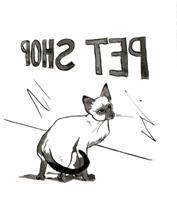
When I was eight weeks old, my brothers and sisters and I were given away, dropped off at a kitty orphanage, the Regal Pet Shoppe. Although traumatized, I always thought the name apropos…I am Siamese, after all – my royalty is obvious.

That’s where “M,” my human, found me many years ago, but I remember it like yesterday. There I was, the last of my family to be adopted. Although of a royal bloodline, my family had elected not to get those silly documents you humans call “papers.” How rude! I know who I am and I know what I am. Since I’ve grown older and wiser, the documents seem even sillier. There’s one thing no one can take away from me no matter what he or she may do to me and that is my character – what I’m made of inside.

I think even now about the day my siblings and I were abandoned. I wonder where my “real” mom is and what she’s like. M has an adopted nephew who’s had a tough time now and again. When I’m around him, I try to tell him that I know how he feels.

At first, it’s really hard not to wonder what you did that made your mom go away. It’s a hard feeling to shake because when you’re a kitten, it’s difficult to think of yourself as a totally independent cat. Although it seems pretty clear to grown-up cats that parents make decisions and do things that have nothing to do with their kittens, only time and experience can make that truth so clear for little ones. Part of knowing who you are is knowing where you come from, but adopted kids don’t have access to all of their stories. It’s okay to feel sad that you’ll probably never know some things about yourself, like where you got your blue eyes and brown ears or whether your father’s father had rings on his tail.

For about six months I wouldn’t stay in the room with M unless I was hungry. I stayed outside much of the time, and I did a lot of talking to acquaintances in the neighborhood. And you know what? After I figured out that my brown ears are my brown ears and my blue eyes belong only to me, the one thing that kept popping into my head was the fact that the day M came into the Regal Pet Shoppe, there were other kittens in the store. Free kittens.

And guess what? She paid for me!

When I find myself, even today as a pretty old guy, feeling sad about not knowing whatever became of my parents or siblings, I remember that M thought I was pretty special. She had choices and she chose me. Having somebody—anybody—who thinks you’re the cat’s pajamas is what matters more than anything in this life, or any of the other eight for that matter.

Believe me…I know.

On Yardfights

26 Feb

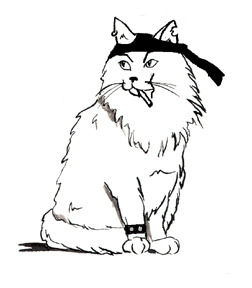
Note: For those of you who don’t know, nine years ago I wrote and published a book called Simon Says: Views from a Higher Perspective, available via in Kindle format by clicking here. The “true” author of the book is Simon Sharpe, Siamese Cat Extraordinaire, a very real feline who fancied himself a philosopher. And perhaps he was – during a particularly difficult time, he taught me an awful lot about life and resurrection. I “transcribed” his dictation for you. In the book, which includes wonderful pen and ink drawings by a friend of my nephew’s, there are 26 different “Simon stories.” If you like this one, I’ll post others. By the way, “M” is me, Simon’s human, and “Murphy” was his brother, a big gray and white domestic shorthair. And, believe it or not, the stories are true. VMS

On-yard-fights

Some time ago, Murphy and I were minding our own business outside when five members of a feline gang came over the fence into our yard. Since there were more of them, we knew we weren’t likely to win if a fight broke out. I ran one way and Murphy ran another to try and break them up. Two of them caught me, and in the fracas, I was bitten and scratched up. I hunkered down and “played dead.” Murphy managed to find a hiding place. Finally after strutting around for a while, the gang members left. Murphy came out to see how I was. I waved him off and limped to the door.

A day or so later, my tail – well, actually my tail “region” – started hurting. M noticed I was moving oddly and began investigating. Let’s just say that the cat who bit me hadn’t brushed, and I had two abscesses where the skin had been broken. M took me to the vet where, to my embarrassment, they shaved off the hair on my rump and stitched me up. I had to stay inside and endure the humiliation of having M put pills in my mouth and hold it shut until I swallowed, but the truth is I was a little shaky about going back outside anyway.

Finally the day came when it was all right for me to go outside. The hair hadn’t grown back on my rump yet, and I knew I was in for some teasing. I knew, too, that everyone in the neighborhood would find out what had happened, but I was tough enough to take it. It was more important for me to help Murphy reassert that we owned our yard. No matter how scared I was, the gang needed to know that they could not take over our territory. As expected, I was taunted, and M had to run the gang out of the driveway a couple of times, but eventually they got the point. No one has the right to barge into our yard and claim it as theirs by force.

M says there’s almost always a yard fight going on somewhere. She told me that in the 1930s and 40s, just about everybody in the world got involved in one that lasted four years after the US got in.

Power is a strange phenomenon. If you don’t think you have it, you want it and spend countless hours figuring out how to get it. If you do think you have it, you want more. If you get more, you know you’re bound to lose it because sometime somebody somewhere will hit on a workable strategy to take it away from you. Somebody has to be king of the yard, right?

Wrong. An obsession with power is not about superiority.

It’s about fear.